
The language of 'silence' through Mai Van Phan's 'Stone in the Stream'
In Mai Van Phan's creative journey, nature is not only an object to behold but also a spiritual space where people learn to listen and observe the subtle movements of life.
STONES IN THE STREAM
| Let the water flow in silence. The torrential downpour lasted a long time, leaving me freezing cold. Is this spring? Vines climbing along the trail The sound of birds chirping echoed down, creating a gentle murmur. The shadows of the trees swayed the rocks, creating alternating periods of shade and sunlight. How can those wildflowers remain so peaceful forever? The stone closes its eyes, calmly letting the water flow. | Those gray-footed langurs The shadows of the trees rose high and undulated again. Drizzle was falling everywhere. Moisten the most intimate area. Clouds stay where they are. The fragrant scent of ripe guavas permeates the forest. A hedgehog with its quills raised, motionless. More than anything right now. Everyone stay where you are. |
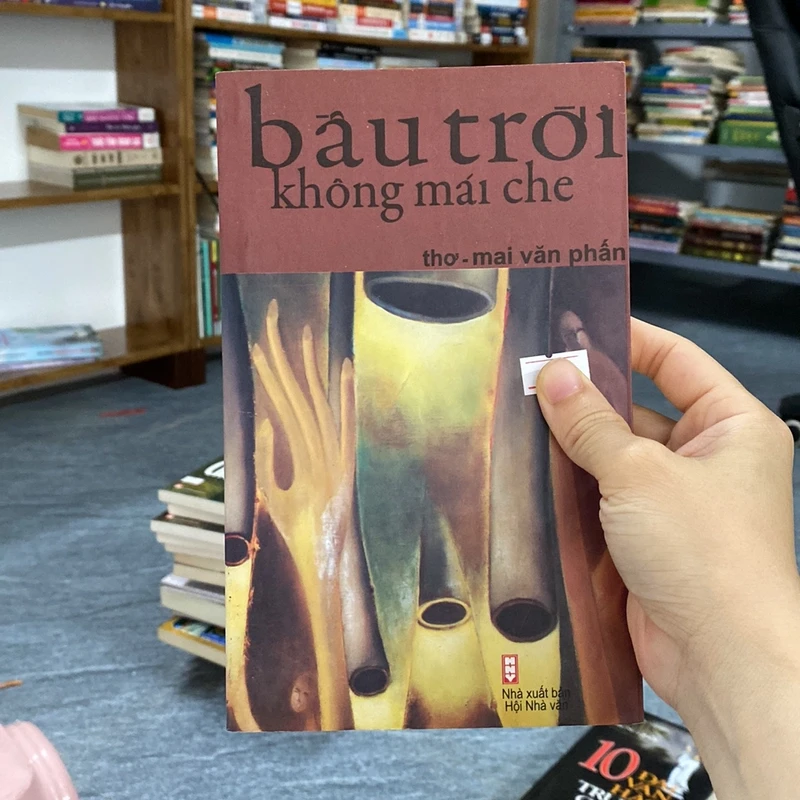
(Printed in the booklet)The sky has no roof.(Vietnam Writers Association Publishing House, 2010).
The poem "Stones in the Stream" is a beautiful testament to this perspective. From simple images that seem "fleeting" and unnoticed (in Denis Diderot's words), the poet "reveals" the beauty of a pure and profound nature, embodying a philosophy of life about serenity and tranquility amidst the endless flow of life. Nature is a beautiful world that generously and selflessly bestows its beauty, yet it never speaks of itself.
A rock, a climbing vine, or a wildflower, a cloud, the scent of ripe guava, or a hedgehog with its quills raised—all are silent, serene, still, motionless, uttering no words. And it is from this silence that nature begins to speak its own language—the language of silence, a wordless language capable of reaching the deepest levels of emotion.
The first stanza, though only two short lines, is concise and immediately sparks much thought with its evocative imagery:
Let the water flow in silence.
The torrential downpour lasted a long time, leaving me freezing cold.
The "main character" is the rock in the stream, appearing in a state of "silence" before the "torrential" flow of water. Water is always in motion, always rushing, but the rock does not resist; it simply remains "silent," so much so that it becomes "freezing cold." The rock silently transforms itself to completely merge with the water. Amidst a constantly changing world, the rock accepts all the effects of time and nature, ultimately reaching a state of tranquility. This state suggests a duality: the rock's inherent nature is such that it is always silent and serene in the face of all noise, yet it is also a choice made by the rock itself. In other words, this choice reflects/belongs to the rock's very nature. A choice inherent in its nature reveals a profound understanding and acceptance of the laws of creation.

This inevitably brings to mind Jesus, who, knowing he was betrayed by his apostles, still accepted it and willingly died on the cross to redeem humanity, or the Buddha, who, with his wisdom, recognized poisoned food but still accepted it because he did not want to alter the karmic connection and to complete the merit for his disciples. Two different religions may have different explanations, but what we realize from these two events is the serene acceptance of fate, reconciliation with the world, and boundless humility and selflessness. Could this also be what the stone in the stream is aiming for?
Traditionally, people have used the saying "water wears away stone" to praise the dynamic power of water. Now, Mai Van Phan "showcases" for us the static power of stone. While in the ordinary view, the stones in the stream bed are inanimate, unresponsive to the environment, in Mai Van Phan's eyes, the stones have entered a state of Zen, free from all agitation, and use wordless language to connect with themselves and the world around them. From here, "the world will be depicted as the poet sees it" (the title of one of Mai Van Phan's papers) – a beautiful, pristine, wordless world, nurturing within it the seeds of love for life, love for each fleeting moment of reality.
That beautiful moment belongs to spring:
Is this spring?
Vines climbing along the trail
The sound of birds chirping echoed down, creating a gentle murmur.
The question, "Is this spring?" doesn't seek an answer, but rather expresses the surprise and joy of a soul sensitive to the most subtle changes in nature. Spring isn't recognized by grand, dazzling signs, but simply by a climbing vine along a path, by the gentle chirping of birds. These are all small details, easily overlooked.
But in the poet's eyes, each little detail holds its own unique beauty. Would the climbing vines along the path cause passersby to yield, to turn in another direction, as the poetess Chiyo once did when she was moved by the small morning glory vine wrapped around her bucket to ask her neighbor for water? And would the "gurgling sound of birds" leave us wondering, just as we once wondered before the "cloud of flowers" of Zen Master Basho, unsure whether the "gurgling" was the sound of birds or a stream, or whether the "cloud of flowers" was a cloud or a cluster of cherry blossoms?
The intertwining of poetic images leads to a state of communion, harmony, and transformation of life, causing us to cease striving for clear distinctions and instead remain silent to feel the mysterious and magical beauty of nature.
The depiction of nature continues to expand with very subtle movements:
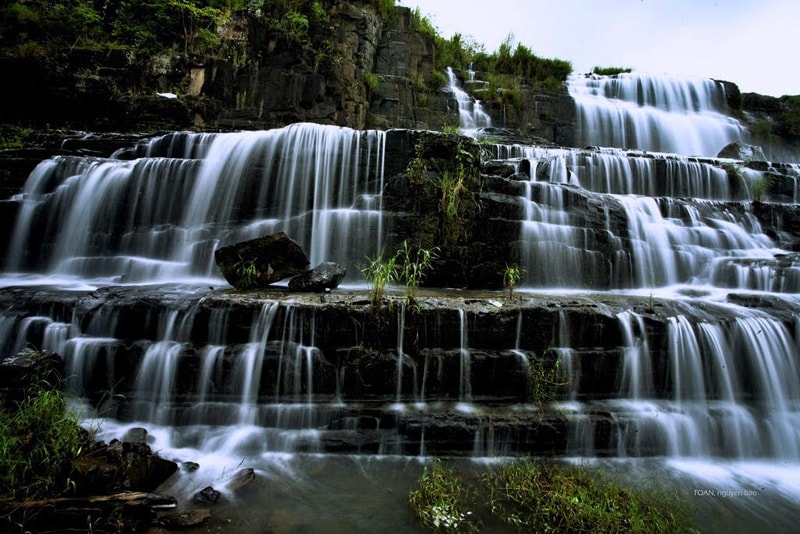
The shadows of the trees swayed the rocks, creating alternating periods of shade and sunlight.
How can those wildflowers remain so peaceful forever?
The stone closes its eyes, calmly letting the water flow.
Light and shadow alternately fall upon the surface of the stone. Wildflowers will eventually wither. Everything is subject to change. The stanza is an awareness of the impermanent nature of creation. Yet, in the face of this impermanence, "The stone closes its eyes, calmly letting the water flow." The stone "closes its eyes" not to escape, but to "calmly" merge with the flow of nature. This is a state of serenity, understanding that all change is a natural occurrence. The stone's state of mind thus bears the strong imprint of Zen Buddhism.
From the serene state of the stone, the poet's perspective continues to expand to recognize the constant interaction and transformation of all things:
Those gray-footed langurs
The shadows of the trees rose high and undulated again.
Drizzle was falling everywhere.
Moisten the most intimate area.
The gray-footed langur is a rare primate species found in Vietnam's forests. Their presence is a sign of a pristine, clean, and vibrant natural environment. The image of the langur serves as a striking detail, highlighting the unspoiled beauty of nature. On the other hand, the poet doesn't directly describe the langur troop but only notes their impact, "making the shadows of the trees rise and sway." They are present through the vibrations of the canopy, through waves of light and shadow. This reveals the poet's unique perspective: that nature is an interconnected whole. A small movement of a creature can alter the surrounding space. The langur doesn't stand alone but blends into the shared rhythm of the forest, as if all life is resonating with each other in a grand symphony of nature. In that magnificent symphony, even the seemingly invisible drizzle carries the power to penetrate "the deepest recesses." That gentle, subtle movement has a deeper impact than anything noisy or violent. The beauty of nature here conquers people not through ostentation or effusive words, but through its ability to quietly permeate the soul.
Continuing this movement and transformation, the poetic flow reaches the pinnacle of a sense of stillness:
Clouds stay where they are.
The fragrant scent of ripe guavas permeates the forest.
A hedgehog with its quills raised, motionless.
Everything seems to pause, fully present in the moment. The space is not dead silent, but alive in a very slow rhythm. The poet makes the reader realize that the beauty of the world lies not only in movement but also in moments of stillness. These are the moments when humans can most deeply feel the presence of life.
Therefore, the poem's conclusion serves as both an invitation and a philosophy:
More than anything right now.
Everyone stay where you are.
"Staying still" is not simply about physically standing still. It is a state of ceasing the restlessness, the hustle and bustle, the impatience in the soul, to listen to nature and to oneself. Here, the act of "staying still" does not come naturally like the profound tranquility inherent in stone, but appears in the form of advice, a recommendation, a suggestion for reasonable behavior for humans, otherwise they would be "out of place," "impolite" in the face of nature's humility. Perhaps this is because humans are inherently restless, their minds always agitated by calculations and desires. The final line of the poem opens up a vast space of silence. In that silence, humans have the opportunity to recognize the beauty of the world and find inner balance. The final stanza returns to the two-line form like the opening stanza, which also represents a return to the essence of nature, to the state of "silence" and "chilling coldness" to integrate the human being's essence with the universe.
"Silence" truly becomes a way for humans to communicate and connect with nature, the world, and themselves. It is also a state of mind, a peaceful choice amidst the hustle and bustle, the glitz and glamour of life. "Stones in the Stream," therefore, is not just a beautiful depiction of nature. It is also a hymn to the humble and harmonious beauty of all things.
From the smallest details that many people inadvertently overlook, Mai Van Phan discovered the miraculous beauty of life, of a philosophy of human existence. And above all, the poem affirms that, amidst the ceaseless flow of life, perhaps the most precious thing is to maintain a mindset of "a stone closing its eyes, calmly letting the water flow."
The poet Mai Van Phan once posed the question, "Can writing change the world?" We won't rush to discuss the grand things that literature has done and will do for humanity. Here, with the poem "Stone in the Stream," the wonderful thing we have is the opportunity to see the world through the poet's eyes, making the small things we easily overlook in life seem magical and meaningful. The poem thus awakens subtle emotions in the reader, sowing a seed of love for the world, of faith in the power of quiet serenity in the face of life.


