Internet slang: A double-edged sword.
(Baonghean) - From the "virtual" world of the Internet, "teenager" and "unconventional" ways of speaking and writing have entered real life, unintentionally becoming habits in communication, creating a foreign kind of Vietnamese language.
Internet language chaos
Internet slang, with its strange and bizarre variations, is no longer unfamiliar to the majority of internet users today. Browsing through forums, youth-oriented websites, or social networks like Facebook, Zalo, and Instagram, it's easy to see that young people are indiscriminately altering Vietnamese, from sentence structure to letter arrangement.
Facebook statuses like: “Hum nAi chO?i đEpj coá ay mun đy chOji zỚi tuy hOng?” (It's a beautiful day today, does anyone want to hang out with me?) spread like wildfire. Young people quickly “created” it, with many teenagers viewing it as an “invention,” a unique language they proudly call “9X language.”
Many young people with rudimentary foreign language skills don't hesitate to haphazardly insert English words into their Vietnamese sentences or combine the meanings of certain English words without paying attention to grammar or sentence structure to express what they want to say. For example, the following writing styles are currently popular online: "no table" - meaning "no discussion"; "lemon question" - meaning "lemon + question" = "stuck-up"; "like afternoon" - meaning "if you like it, then afternoon"... Foreigners who hear and see these writing and speaking styles will find it impossible to understand!
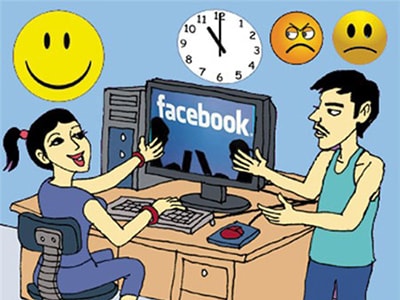 |
| Illustration: Internet |
Then there are the "mysterious" abbreviations that, unless revealed by young people, are impossible to guess what they mean. "Cmnr," "cmnl," "vcc," "vk," "ck"... it's all a mess! Furthermore, many forums and social media sites have functions to filter out unhealthy words like profanity, swear words, and sexually related terms, so young people come up with many ways to "circumvent" this.
Internet slang is so diverse and widely used by young people that recently, many Facebook users have had to express their frustration, issue warnings, refuse to respond to, or even delete comments written in inappropriate Vietnamese on their personal pages.
From the "virtual" world, internet slang has infiltrated real life. Now, in many conversations between friends at the coffee table, in family interactions, or even in meetings and work discussions, people unintentionally or intentionally use internet slang naturally.
Without discussing good or bad, right or wrong, from a linguistic perspective, it is clear that there has been a hybridization, confusion, and lack of standards, creating many risks in speaking and writing Vietnamese.
Creativity or destruction?
Internet slang is seen as a language that expresses individual freedom, rule-breaking, and informality. The Vietnam Institute of Linguistics conducted a survey on social attitudes towards internet slang. The results showed that, regarding the use of Vietnamese by young people born in the 1990s on online forums, 6.6% of those surveyed answered "like," believing that internet slang is fun, convenient, and "trendy"; 51.2% answered "dislike," because internet slang is difficult to understand, confusing, and corrupts the Vietnamese language; and 42.2% answered "normal."
Regarding the practice of "mixing" foreign words into Vietnamese, 6.6% responded "like" because they found it unusual and "trendy"; 52% responded "hate," arguing that this use of language causes confusion and ruins the Vietnamese language; and 41.4% responded "normal." These results show that there are many conflicting opinions about online language.
Dr. Le Thanh Nga, a lecturer at Vinh University, believes that language should be understood as a national "asset," constantly evolving and changing, with vocabulary and grammar naturally disappearing and emerging as a normal part of evolution. This shows that the emergence of a new vocabulary or expression is simply a reflection of the need to say something new, a manifestation of culture.
When online language, and even the language in publications by reputable publishers, featuring influential writers and artists like Ho Anh Thai and Thanh Phong, increasingly adopts new, unusual, "teen," and "unconventional" writing styles, the issue should be considered more comprehensively.
“We shouldn’t blame the youth, nor should we only see it as a language problem. Instead, we should look deeper into the mental states of real life and the existing cultural conditions. Language cannot be a disruptive force without the complicity of the socio-economic, cultural, and economic conditions! Why does the need to speak or write differently arise? Why do language disruptors appear – and why can they exist?” Dr. Le Thanh Nga questioned.
Using internet slang is a "double-edged sword"; it's a personal language but exists on social media, so it has a huge reach. Frequent use can lead to familiarity, potentially causing young people to misuse it and turn it into language used in schools and official documents.
In online language, sentences don't need to be grammatically correct or spelled precisely, and they are extremely short. Therefore, prolonged use can gradually have a negative impact on thinking. Perhaps education and cultural administrators, as well as researchers, should conduct a survey on the level of use and impact of online language in modern life…
Phuoc Anh
| RELATED NEWS |
|---|