
What should people do when they are harassed by debt collectors even though they haven't borrowed any money?
(Baonghean.vn) - When harassed or threatened, people should save phone numbers, messages, audio recordings, and images as evidence, then report it to the police for resolution.
Criminal prosecution is possible.
For several days now, Ms. Pham Thi Truong Giang, the principal of Le Mao Primary School (Vinh City), and many teachers at the school have been constantly harassed by debt collectors. Despite the fact that none of the teachers or staff at the school have borrowed any money, the initial calls involved them impersonating parents, falsely accusing teachers of beating students, and then resorting to insults and abusive language. "Later, their true intention became clear: they wanted to pressure the school into paying a debt owed to the brother-in-law of one of the female teachers," Ms. Giang said.
Not only did they harass the principal and teachers by calling them, but they also Photoshopped images of Ms. Giang and placed them on an altar. Furthermore, the debt collectors impersonated the teacher whose brother-in-law owed them money, calling two gas distributors in Vinh City to ship two gas cylinders to the school grounds as a threat. “We are truly bewildered. No one borrowed money, yet we are being dragged into this mess. We don’t know how to handle this,” Ms. Giang said.
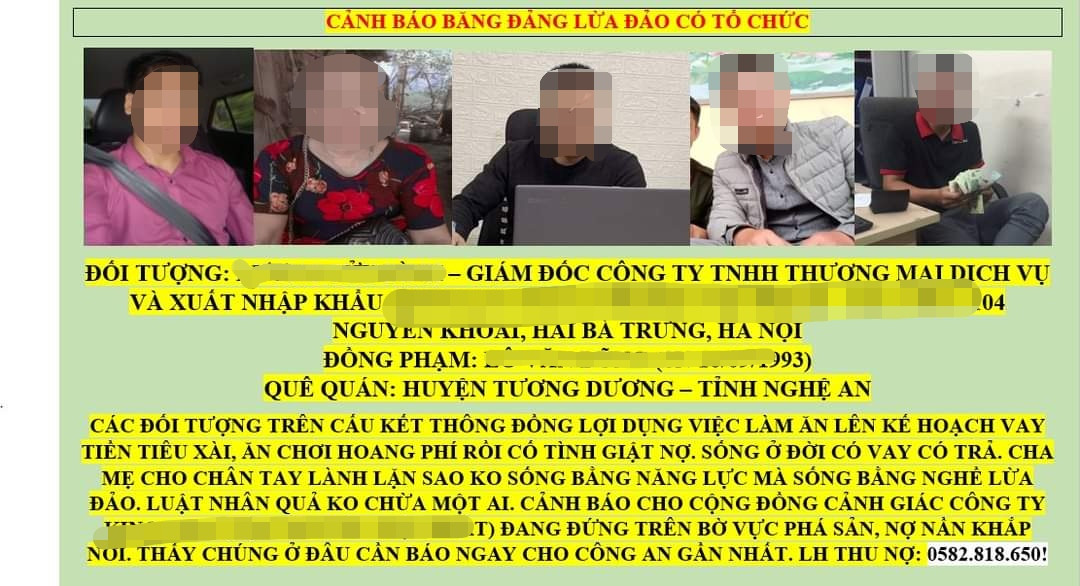 |
| A resident of Tuong Duong district was slandered on social media despite not having borrowed any money. Photo: TH |
In Anh Son district, Mr. Doan Van Thanh, Head of the District Education and Training Department, said that debt collectors even used his personal Facebook page to take pictures of him with his friend's family and falsely accuse him of having an affair with his friend's wife. The reason was that a female teacher in the district had borrowed money from a financial company and had not repaid it on time.
Speaking to a reporter from Nghe An Newspaper about this situation, a lawyer in Vinh City said that victims of harassment should save the phone numbers, audio recordings, information, and images of threatening messages, debt reminders, and debt collection notices, and send them along with a written complaint to the lending organization or individual regarding the debt reminder and collection methods used by those who are not obligated to repay the debt. At the same time, they can send a petition with evidence to the State Bank of Vietnam branch to request a resolution of the banking sector violations, or file a report or complaint with the police or the Department of Information and Communications to receive assistance in handling the use of telecommunications services to threaten, harass, and insult the honor, dignity, and reputation of others.
According to this lawyer, the act of making phone calls or sending text messages to coerce individuals or organizations into paying a fictitious debt constitutes the crime of "Extortion" as stipulated in Article 170 of the 2015 Penal Code (amended in 2017). This act carries a prison sentence of 1 to 20 years. If the caller or texter does not aim to extort property but rather to seriously insult the dignity and honor of another person, this act constitutes the crime of "Humiliating another person" as stipulated in Article 155 of the 2015 Penal Code (amended in 2017). Using telecommunications networks to humiliate another person falls under Clause 2 or Clause 3 of this article, with a prison sentence of 3 months to 5 years depending on the nature, extent of the act, and the consequences caused.
Furthermore, making phone calls to falsely accuse individuals or organizations of misappropriating property constitutes the crime of "Defamation" as stipulated in Article 156 of the 2015 Penal Code (amended and supplemented in 2017), with a prison sentence ranging from 3 months to 7 years depending on the nature and severity of the defamation and its consequences. In cases where similar acts occur but do not reach the level of criminal liability, the offender will be subject to administrative penalties as stipulated in Point g, Clause 3, Article 102 of Government Decree No. 15/2020/ND-CP dated February 3, 2020, regulating administrative penalties in the fields of postal services, telecommunications, radio frequencies, information technology, and electronic transactions. This offense carries a fine of 10 to 20 million VND.
People need to be vigilant.
According to our investigation, when borrowing money through unsecured loans, borrowers must agree to allow lenders to use and access their personal phone contacts or social media friend lists via the application. When borrowers fail to repay on time or lose contact, lenders will use this contact data to send messages and make calls to those numbers in the contact list to pressure them into repaying the debt, regardless of who they are.
Furthermore, in reality, many people who have lost their identity cards (CMND) or citizen identification cards (CCCD), or even just had their photos taken, risk becoming indebted despite not having borrowed money. Recently, the police in some localities in Nghe An province have issued warnings about this situation. According to them, in some communes and wards, a group of individuals is going from house to house asking to take photos of their CCCD or CMND, then paying people 100,000 VND for each photo taken.
The QR code and chip on the Citizen Identification Card (CCCD) contain a wealth of personal information that cybercriminals exploit for personal gain. However, many citizens still carelessly share images of their CCCD on social media. This sharing poses a risk of personal information leakage. Simply by using the QR code or information printed on the CCCD, a citizen's personal information can be easily obtained. Criminals can use images of CCCDs or ID cards shared online to register bank accounts or apply for loans through apps.
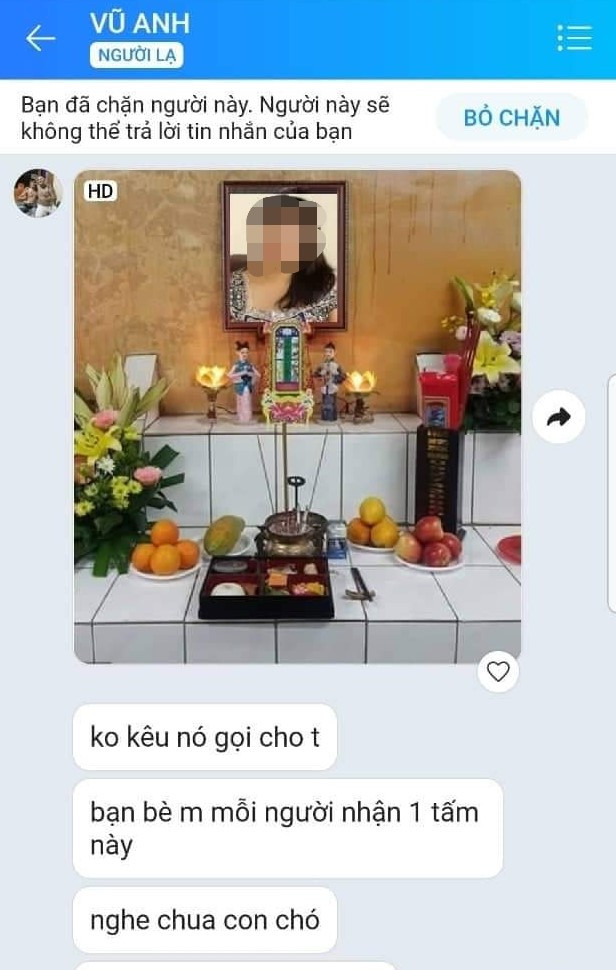 |
| A school principal had her image photoshopped onto an altar, even though she and the teachers had never borrowed money. Photo: TH |
Currently, many online loan applications only require photos of both sides of the national ID card (CCCD) to process loan contracts and disburse funds quickly. Therefore, malicious individuals often try to obtain other people's personal information, then take photos and send them to these applications to borrow money and commit fraud. These online loan apps have the advantage of simple procedures and fast disbursement, but their biggest drawback is that they skip the verification process, or if they do verify, the verification process is very superficial. This creates loopholes and opportunities for others to steal money through loan contracts.
The police recommend that all citizens be vigilant, refrain from sharing images of their ID cards and citizen identification cards on social media, avoid allowing individuals to take photos of their ID cards and citizen identification cards, and immediately report any such incidents to the nearest police station for prompt action.
Speaking with a reporter from Nghe An Newspaper, the leader of the Nghe An Provincial Department of Education and Training stated that the unit has advised all teachers and staff in the sector to carefully consider before borrowing money through unsecured online applications. For teachers who have already borrowed money, they need to understand that "borrowing means repaying," to avoid letting debt negatively impact the collective and other individuals.


