
Citizens participate in monitoring the use of health insurance cards.
(Baonghean) - To prevent the exploitation of the health insurance fund, in addition to the responsibilities of functional agencies, people need to raise their awareness when participating in and using health insurance cards, and participate in monitoring and reporting negative practices and exploitation.
| According to a report by the Vietnam Social Security (BHXH): In 2016, the Social Security sector paid for health insurance medical examination and treatment costs for approximately 144 million people (an increase of 14 million people, or about 19.8%, compared to 2015), with health insurance medical examination and treatment costs totaling approximately 69,410 billion VND, exceeding the 2016 health insurance medical examination and treatment fund by 5,130 billion VND. Around 45 provinces and cities nationwide had expenditures exceeding their allocated funds, with 9 provinces and cities exceeding the fund by more than 200 billion VND, including Nghe An with over 270 billion VND. |
Besides objective reasons such as: the mechanical increase in the number of people receiving medical examinations and treatment under health insurance; the upward adjustment of medical service prices according to Circular 37 of the Ministry of Health and the Ministry of Finance; and the implementation of inter-hospital referral for district-level hospitals nationwide... one reason leading to the overspending of the health insurance fund is fraud, abuse, and profiteering in health insurance-covered medical examinations and treatments.
Fraud and profiteering are not new, but they are occurring on a higher, wider scale, and in some places more seriously, involving patients, medical facilities, and social insurance staff. On the patient side, many people who are not enrolled in health insurance borrow others' cards to visit doctors; they misuse their health insurance cards to visit doctors multiple times a day, month, or week to obtain medication for improper use, such as selling it for money...
On the part of healthcare facilities, profiteering occurs not only in private but also in public facilities, with many manifestations: falsifying prescriptions and creating fictitious medical records; prescribing unnecessary or excessive technical services; using drugs with less competitive dosage forms, creating monopolies in bidding and driving up prices; inaccurate statistics, payments, and pricing...
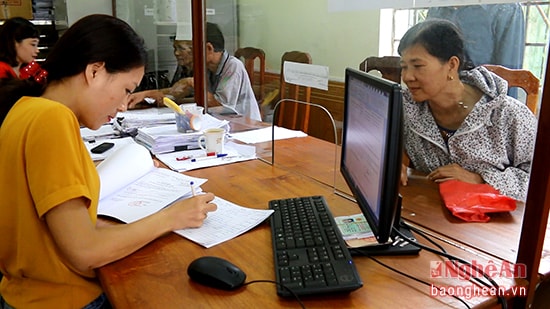 |
| Reviewing the issuance of health insurance cards at the Social Insurance Office of Vinh City. Photo: Lam Tung |
Following the directives of the Government, Vietnam Social Security, and Nghe An province, Nghe An Social Security has strengthened and tightened control over medical examination and treatment expenses and health insurance claims assessment to prevent abuse and fraudulent use of the fund, while still ensuring the rights of both health insurance participants and medical facilities. Recently, Nghe An Social Security has implemented several solutions to control costs, including adding to the contract appendix with medical facilities the average cost per outpatient and inpatient visit, and the conditions for prescribing and paying for MRI scans...
The Vietnamese Social Security agency's stance is that if technical services are truly necessary for diagnosing and treating patients, then regardless of the cost, within the scope of the patient's entitlements as stipulated by the health insurance policy and law, the health insurance fund will cover the cost. However, if the service is prescribed for screening purposes, for health checks, not necessarily needed, or if the facility abuses the system to recoup costs or "maximize" revenue from the health insurance fund, the Social Security agency will not cover the cost and will take appropriate action against the medical facility.
Entering 2017, Vietnam Social Security (BHXH Vietnam) strived to achieve 85% of the population participating in health insurance. This year, along with the implementation of inter-provincial referral systems and the continued adjustment of hospital fees towards accurate and comprehensive pricing, ensuring the balance of the health insurance fund will continue to face many difficulties. To manage the fund and ensure the rights of health insurance participants, Nghe An Social Security has implemented strict data management, strengthened control at medical examination and treatment facilities; compiled, summarized, and controlled health insurance medical examination and treatment costs from medical equipment and devices from socialized sources; and resolutely refused payment to health insurance medical facilities with violations.
In particular, continue applying information technology to management activities, coordinating health insurance medical examination and treatment facilities to implement data linkage into the health insurance claims information system to provide and retrieve health insurance card data and assess health insurance medical examination and treatment costs, contributing to improving the efficiency of managing the health insurance medical examination and treatment fund, and creating convenience for medical facilities and health insurance cardholders to access medical examination and treatment.
Nghe An Social Insurance recommends: To avoid exploiting the health insurance fund, in addition to raising awareness when participating in and using health insurance cards, people need to participate in monitoring and reporting negative practices, exploitation, and abuse of the fund, in order to promptly prevent actions that cause imbalances in the fund... Although the health insurance fund is protected by the State, the worry about overspending is not unique to anyone.
Without strict control and self-monitoring from relevant authorities, healthcare facilities, and the public, the grim forecast will certainly come true: In 2017, the health insurance fund began experiencing annual deficits and had to use its reserve fund to cover the shortfall: 14,464 billion VND in 2017, 16,736 billion VND in 2018, and 18,354 billion VND in 2019. By the end of 2019, the reserve fund will be depleted and in deficit by 144 billion VND.
Cat Tuong


