
The man who breathes life into traditional Vietnamese opera costumes.
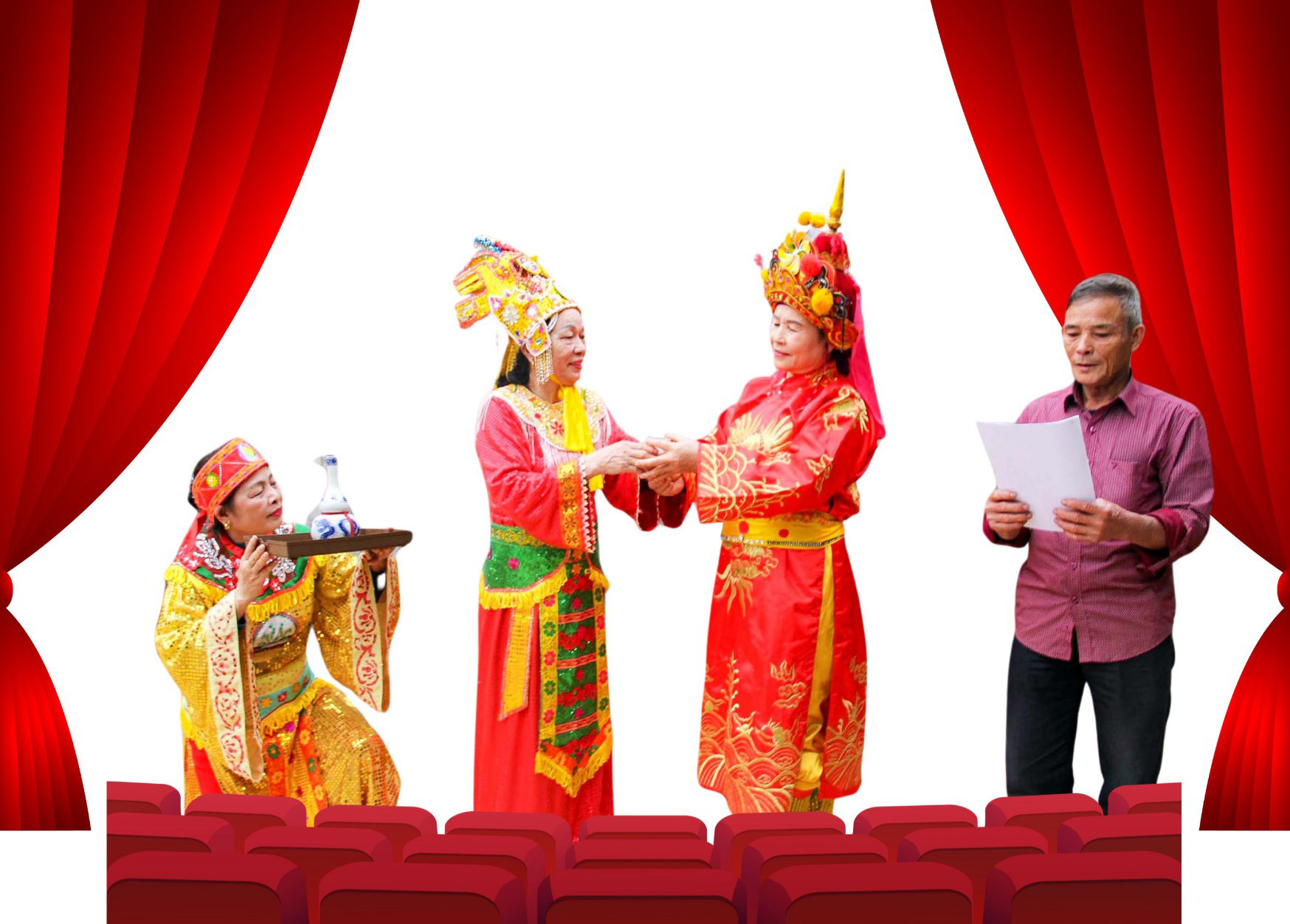
(Baonghean.vn) - Nestled peacefully behind the bamboo hedges of the village, the house of Mrs. Nguyen Thi Tham (born in 1957) has become a familiar haven for countless lovers of traditional Vietnamese opera. She is both the Head of the Traditional Opera Club of Trung Thanh commune (Yen Thanh district) and a person who dedicates her heart and soul to sewing costumes for this art form.
Working tirelessly to fulfill community duties.
Indeed, that statement is absolutely true when referring to Mrs. Nguyen Thi Tham in Hoa Tham village, Trung Thanh commune, Yen Thanh district. For nearly 20 years, she has been the head of the Trung Thanh commune's traditional opera club, and for over 30 years, she has served as the head of the Women's Association in Hamlet 7. Besides taking care of her family, Mrs. Tham dedicates most of her remaining time to village and commune affairs.
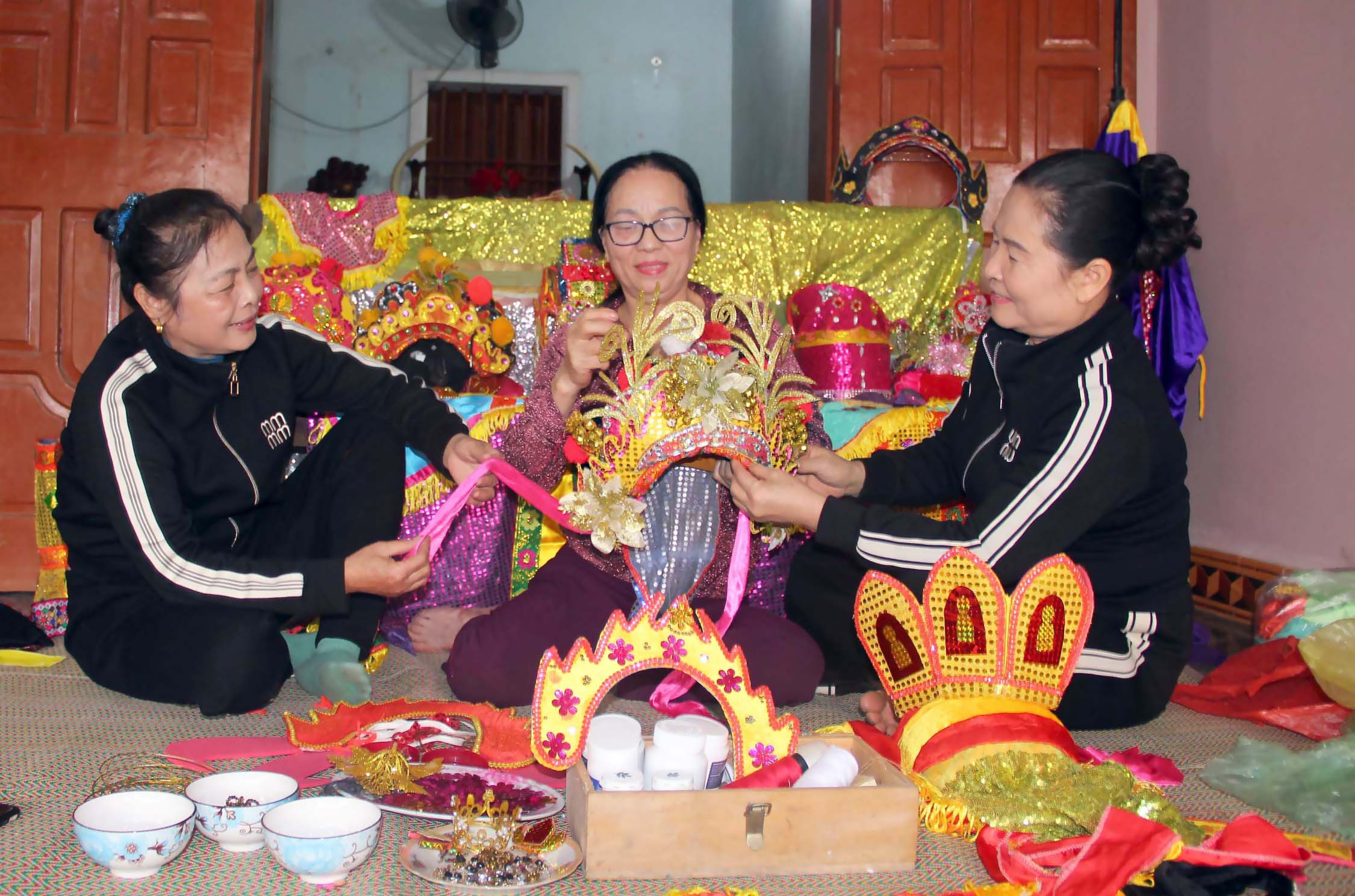
For many years, she has been known for her skillful hands, having independently learned to sew costumes and make the necessary props for traditional Vietnamese opera performances. Holding a hat she was sewing, Ms. Tham explained that the characteristic of traditional opera costumes is the preference for fabrics with bright, shimmering colors that attract the viewer's attention.
Those kinds of fabrics are hard to find in rural markets, so sometimes she has to go all the way to Vinh market to find them. After buying the fabric, she then diligently goes online and asks members of other theater troupes to better understand the styles and sewing techniques to suit the nature of each role.
She explained that the costumes for each character in traditional Vietnamese opera have their own unique style and characteristics. The costumes are based on the specific roles of the characters, such as kings, queens, princesses, officials, or ordinary people.
Just by looking at the costume, viewers can guess the social status, age, and identity of the character being portrayed on stage. Each costume for a traditional Vietnamese opera actor requires many accompanying details such as hats, beards, mustaches, boots, shoes, and props for the character to use.
As we listened to her speak, we looked at the neatly arranged bags of supplies she carefully stored for the members of the theater club. Among them, we were particularly impressed by the collection of hats she had made herself. They varied in color and style: simple hats in muted, dark tones; hats adorned with sparkling sequins and countless colorful beads; hats embellished with peacock feathers forming impressive arcs on the crown...
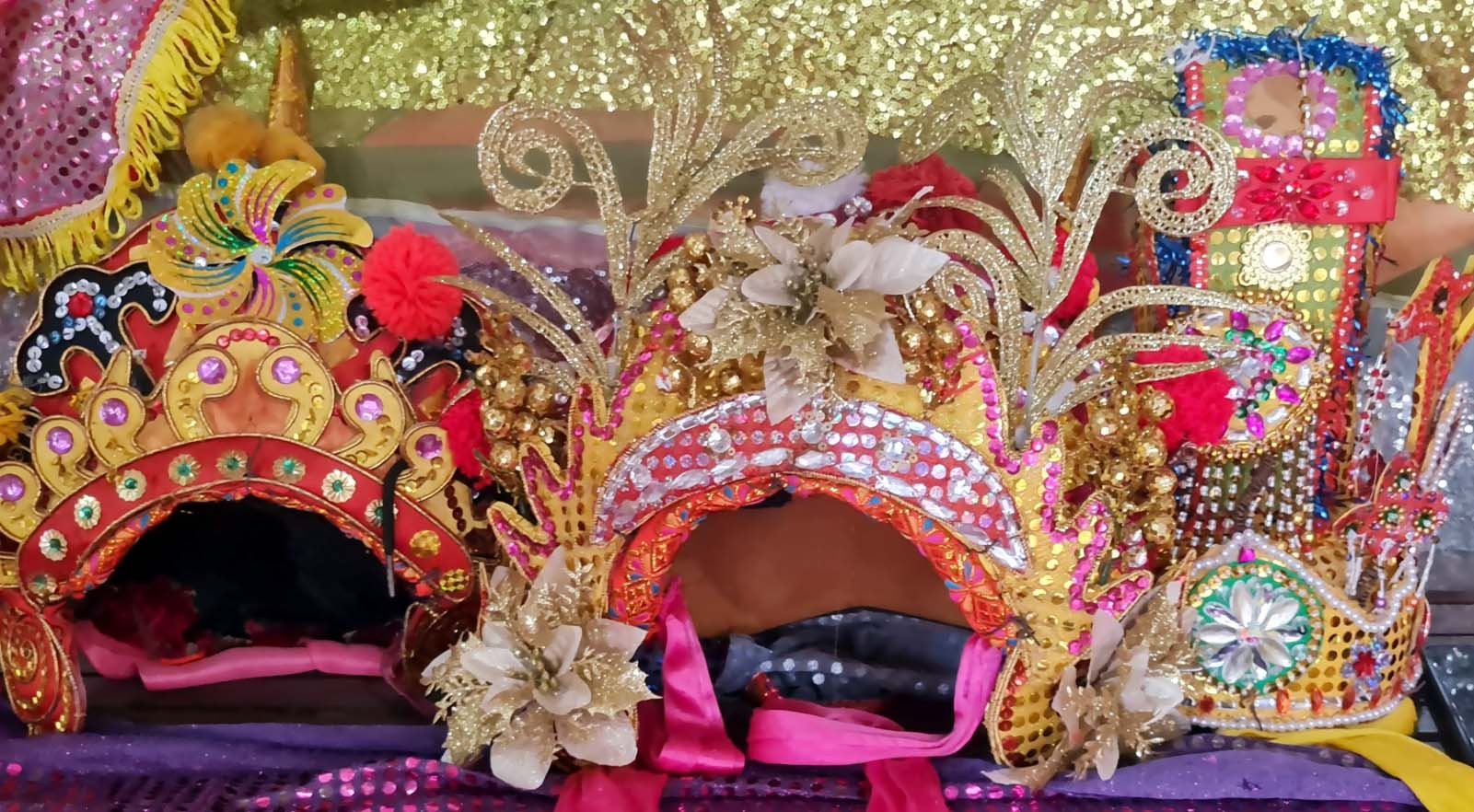
Listening to Mrs. Tham's analysis, we finally understood the profound meanings behind those colors and styles. She explained that hats make up a large portion of the costume collection in traditional Vietnamese opera because almost every character uses one. From kings and queens, officials, empresses, and young ladies to scholars, monks, farmers, young women, and children… each is conventionally assigned a specific type of hat.
Accordingly, the King wore a nine-dragon crown adorned with nine dragons. The Queen wore a nine-phoenix crown, also adorned with nine phoenixes. Generals wore golden helmets. In the costume system, the crown is one of the most time-consuming details for the maker, and it is also Mrs. Nguyen Thi Tham's forte. Therefore, members of the traditional opera club greatly admire the crowns she makes.
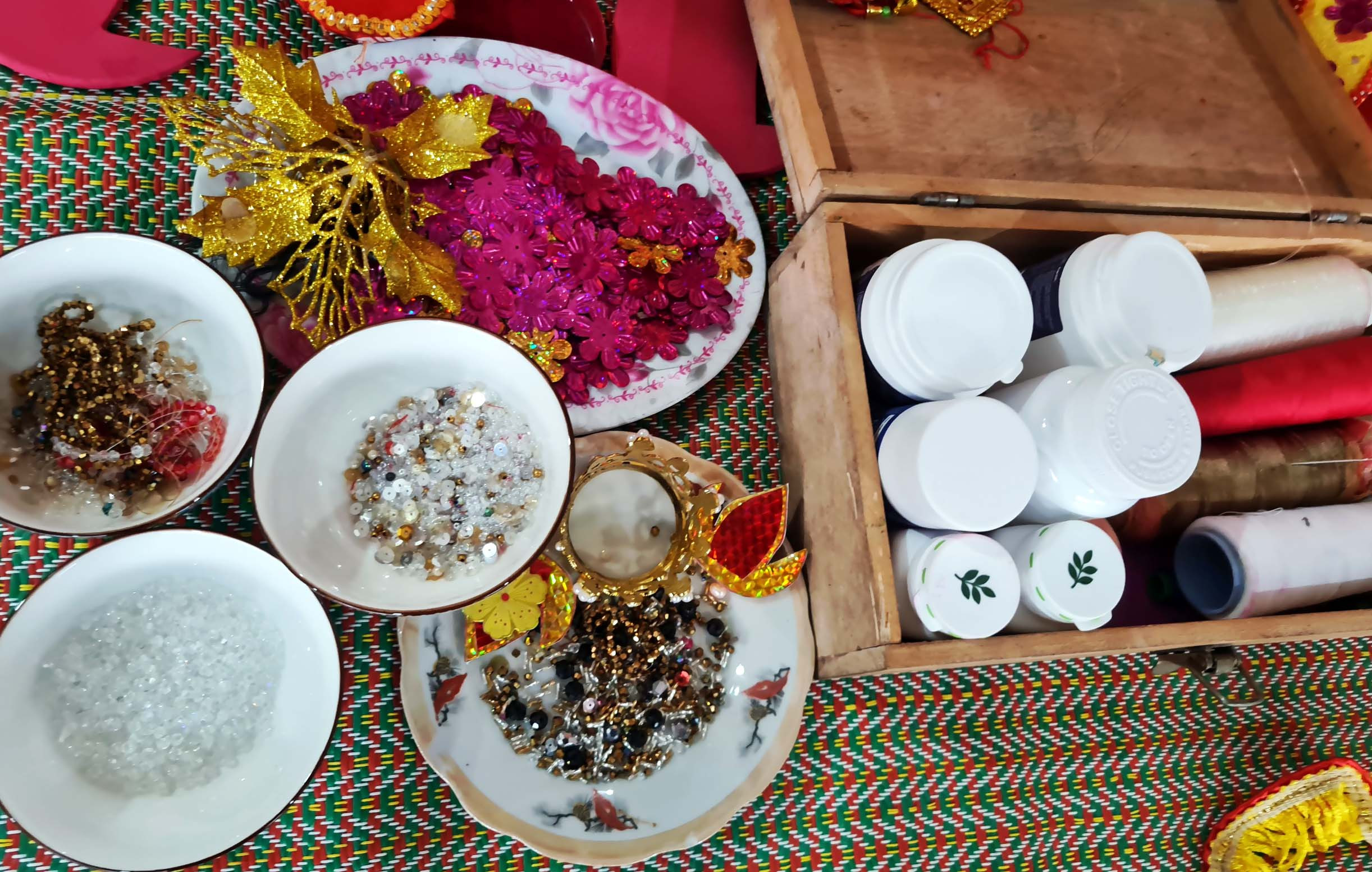
What's remarkable is that she independently researched how to make the costumes, sourced the fabrics and accessories herself, and provided them free of charge to everyone. She even lent them to other theater troupes in the district without any expectation of payment or compensation.
Recently, the Kẻ Gám Traditional Opera Club had to borrow 7 costumes, 5 props, and 2 hats from Ms. Nguyễn Thị Thâm for their performances. They borrowed them because the costumes she made were very exquisite, skillfully crafted, and suited the characteristics of each character. Yet, when it came time to pay her, she refused. For nearly 20 years, Ms. Thâm has provided almost all the costumes she makes completely free of charge to everyone.
Many were surprised, but for Ms. Tham, it was perfectly normal. According to her: “I come from a farming background, and I love and am deeply connected to traditional Vietnamese opera, so I try to find suitable props and costumes for the club members to use. For so many years, I haven't expected any payment for creating these products. My only wish is for everyone to have enough costumes to perform; that would make me very happy…”
The person who "ignites" the passion for traditional Vietnamese opera.
Recounting her connection to traditional Vietnamese opera, Ms. Nguyen Thi Tham said that from a young age, when Yen Thanh district was still bustling with opera troupes, she developed a passion for this art form. At that time, a relative on her mother's side, a member of the opera troupe in Nam Thanh commune, discovered her talent and wholeheartedly guided her. Later, he asked her parents for permission to help her participate in a few roles in the commune's opera troupe.
In her early days, she was assigned to play minor roles or portray children and grandchildren. By the age of 15, she began to make her mark on audiences with challenging roles such as Chau Long - the wife of Luu Binh in the play "Luu Binh, Duong Le," or Kieu Nguyet Nga in the play Luc Van Tien.
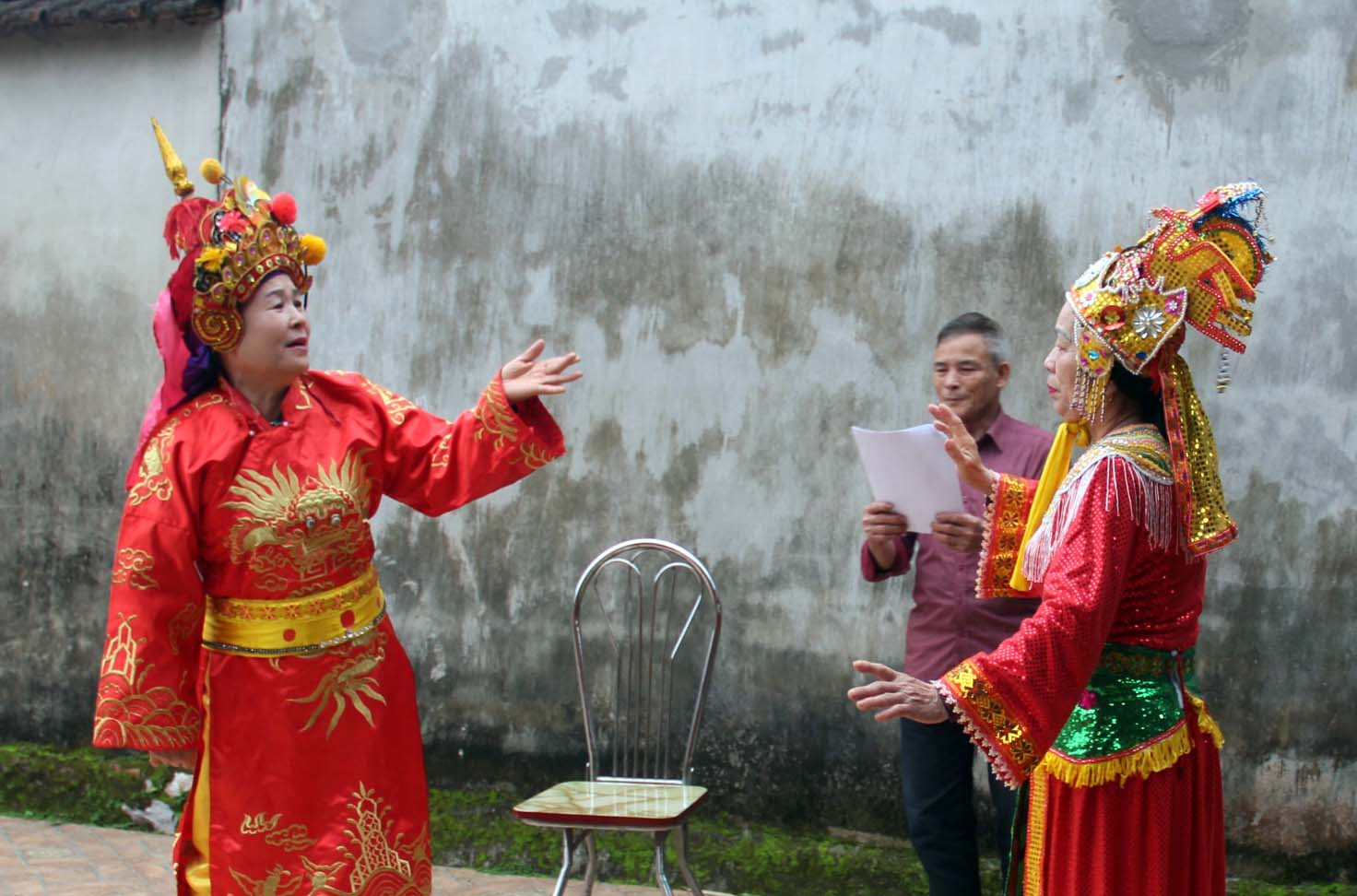
At the age of 17, she married and moved to Trung Thanh commune. Knowing that she had many previous roles, Mr. Cao Dinh Hung, the leader of the Trung Thanh commune's traditional opera troupe, approached her to invite her to join the troupe. As she reached her prime, Ms. Tham was given challenging roles such as Thi Sach in the play "Trung Trac, Trung Nhi" and Trong Thuy in "Trong Thuy - My Chau". In particular, the role of Lao Ta in the play "The Flame of Hung Son" is considered a "key" role, one that many people remember when they think of traditional opera.
Later, traditional Vietnamese opera gradually faded from Trung Thanh commune in particular, and Yen Thanh district in general. Then, in 2004, when Yen Thanh district implemented policies to revive and promote the value of traditional opera, opera clubs began to be re-established and resumed their activities. Thanks to this, the Trung Thanh Traditional Opera Club was founded with 12 members. Ms. Nguyen Thi Tham was trusted and elected as the club's chairperson.
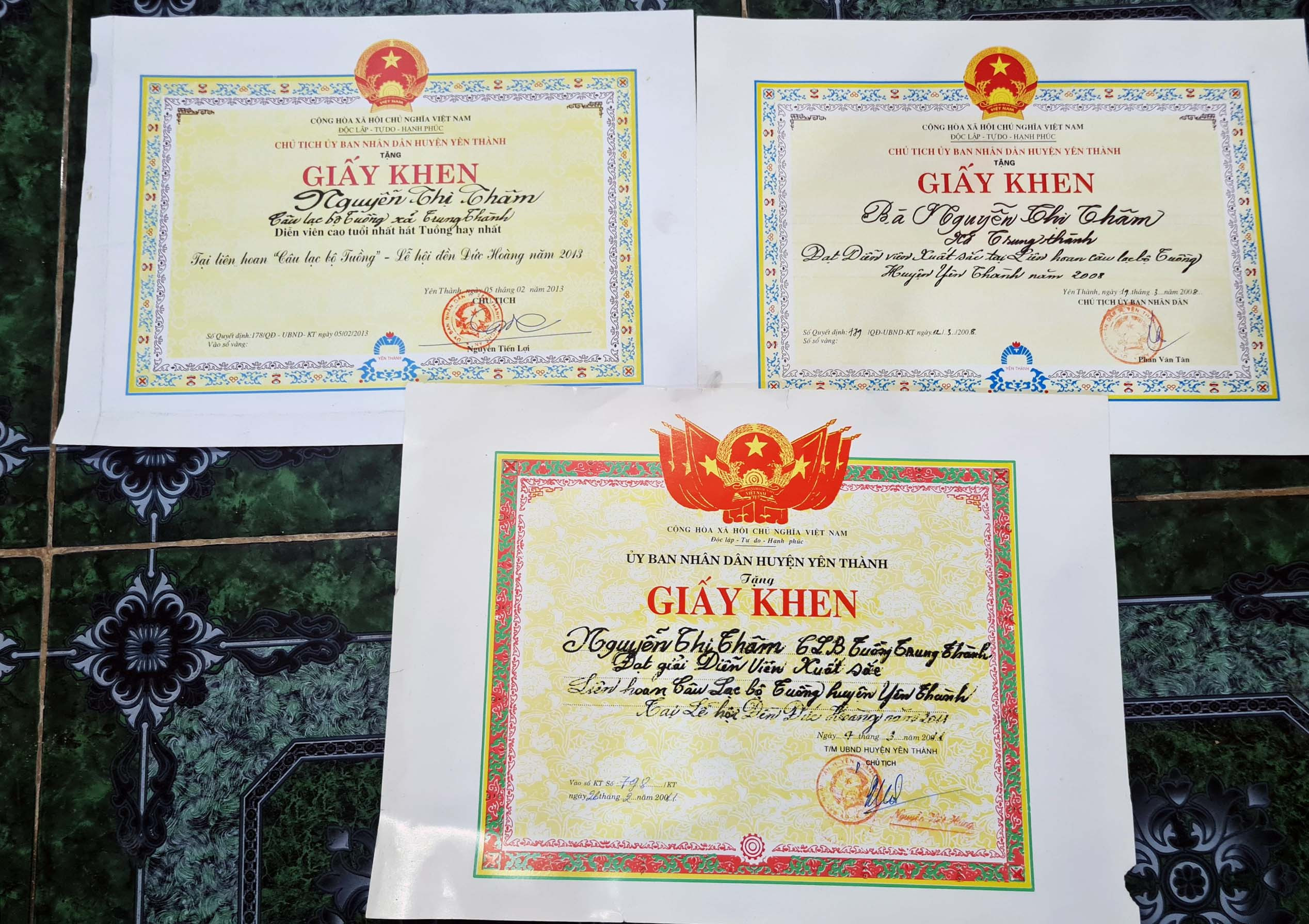
From that moment on, she dedicated herself wholeheartedly to the club and maximized her abilities in performances. As a result, she has achieved many prestigious awards such as: Best Actress Award at the Yen Thanh District Traditional Opera Club Festival in 2008; Best Oldest Traditional Opera Performer Award in 2013; Best Actress Award at the Yen Thanh District Traditional Opera Club Festival at the Duc Hoang Temple Festival in 2011…
In 2015, Ms. Nguyen Thi Tham led the club members to participate in the "Theatrical Works of Author Tong Phuoc Pho" Festival in Da Nang City. That year, the club left a deep impression on the audience and was commended and rewarded by the Da Nang City People's Committee.
These days, Mrs. Nguyen Thi Tham's house is once again open to welcome members of the Trung Thanh Commune Traditional Opera Club to practice for the Duc Hoang Temple Festival, the Gam Pagoda Festival, and other events. For them – pure-hearted farmers – singing, dancing, and embodying each role is an immeasurable joy. And in each of those roles, people remember the image of a woman meticulously caring for every stitch to create the most beautiful costumes for each actor and actress, allowing them to shine…


