
Vietnamese people spend 6 billion USD on overseas travel.
According to data from the Vietnam Tourism Association, approximately 5 million Vietnamese tourists travel abroad each year. It is estimated that Vietnamese tourists currently spend around 6 billion USD on overseas travel (compared to only about 3.5 billion USD in 2012).
Many travel companies also report a sharp increase in Vietnamese people traveling abroad, with the most popular destinations being Japan, South Korea, Thailand, the United States, and Cambodia.
Criticism of domestic tourism.
According to Ms. Tran Thi Viet Huong, Marketing Director of Vietravel Tourism Company, the number of customers registering for overseas tours last year increased by 145% compared to the previous year, while the number of customers registering for domestic tours only increased by 132%. Specifically, the number of individual customers registering for overseas tours at Vietravel was about 20% higher than the number of individual customers registering for domestic tours.
"Previously, tourists often chose to travel abroad out of curiosity, to see how foreign countries differed from their own countries. Now, the trend in tour selection has changed. Tourists traveling abroad are becoming more professional and frequent," Ms. Huong observed.
Several other travel companies also reported an average growth rate of 15% - 25% in outbound tourism. “The reason is that in recent years, conditions for traveling abroad have become easier. For example, many countries have relaxed visa policies, simplified procedures, and offered reasonable tour prices. Furthermore, countries are making great efforts to promote their tourism image to attract Vietnamese people. Not to mention, there are many overseas tours with promotions, deferred payment options, and installment plans at affordable prices.”
Many countries are constantly launching new and unique tourism products to attract Vietnamese tourists. Thailand even sent tour guides to Vietnam to learn Vietnamese in order to better understand the psychology of tourists and leave a positive impression. Similarly, South Korea, knowing that Vietnamese people enjoy watching Korean dramas, has included promotional materials about the filming locations in many tours.
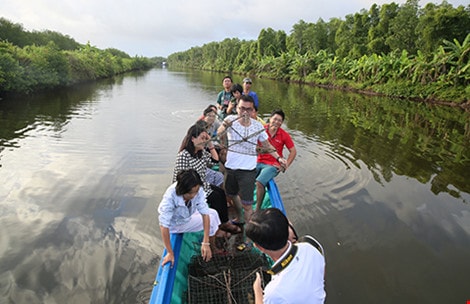 |
| With no new destinations to offer, domestic tourism is losing appeal in the eyes of tourists. Photo: TU UYEN |
Poor, lacking creativity
Some travel companies frankly acknowledge that Vietnam has many favorable factors for tourism development and attracting tourists, such as beautiful and diverse landscapes. "Currently, some Vietnamese tourism products are quite diverse and attractive. For example, tours combining flower viewing and relaxation at high-end Vinpearl villas are chosen by many tourists," Ms. Huong cited as an example.
Overall, domestic tourism is at a disadvantage compared to international tourism. Economist Ly Truong Chien observes: "Poor service, low quality, high prices, lack of creativity, and indiscriminate exploitation that damages the natural environment... are the reasons why tourists are less interested in domestic tourism. Foreign countries, on the other hand, do much better."
Furthermore, according to Mr. Chien, in many cases we only focus on short-term gains, destroying nature through projects like cable cars, unsustainable beach exploitation, and even problematic restoration of historical sites.”
Mr. Dao Xuan Khuong, a Master of Business Administration with a background in marketing research in the US and retail research in Germany, commented: “Vietnamese tourism products do not satisfy the needs of tourists. The clearest manifestation is that when visiting a place, tourists often only know how to take pictures and admire the scenery, but have absolutely no idea what the place is, or why they should go there. I believe the main problem lies in the unattractiveness of the tourism products.”
Traveling is more than just… listing places to sleep.
So what should Vietnam's tourism industry do to retain tourists? Mr. Khuong suggested that tourism companies should review their current tourism products, identify who they are selling them to, what products they need to offer tourists, and what customers truly want… Only then should they design products, rather than creating tour programs that simply list places to visit, places to stay, and dishes to try. The reason is that tourists can find this information themselves on the internet.
On the other hand, tourism products are only truly consumed when customers experience the service. This is currently a weakness of businesses. In reality, many tourism businesses completely rely on tour guides or operators. Therefore, we often see issues like substandard food, exorbitant prices, inadequate accommodations, etc.
Ms. Huong stated that, in order for domestic tourism to compete with other countries, the tourism industry must act as a bridge connecting service providers to support travel companies in developing tour products with good prices and guaranteed quality. At the same time, it must ensure the security and safety of tourists, effectively preventing price gouging. Only then can Vietnam hope to become an attractive tourist destination.
According to Online Law


