
Causes and solutions for a car tire blowout.
(Baonghean.vn) - The hotter the weather, the higher the risk of car tires bursting, causing the vehicle to lose balance and leading to traffic accidents if the situation is not handled properly.
While driving, the risk of a sudden tire blowout is always present. So, what can be done to minimize this situation and how should you handle a tire blowout unexpectedly at high speed?
First, it's necessary to identify the cause of the tire blowout in order to minimize the worst-case scenario. Unexpected tire blowouts on the road can be caused by four main reasons:
The tire is underinflated.
This is the main cause of tire blowouts. According to the operating principle of a vehicle, the air pressure in the tires is responsible for supporting the entire weight of the vehicle and the weight of passengers and luggage. Underinflated tires mean the tire casing has to bear extra "responsibility," leading to the tire's components such as steel wires, rubber, treads, and bead working beyond their capacity.
Furthermore, when the tire is underinflated, it won't cool down properly, and the increased friction area between the tire and the road surface can lead to overheating and explosion.
 |
To prevent underinflation, you should regularly check your tires using a portable pressure gauge, or you can install a tire pressure monitoring system to continuously track the air pressure in your tires. When inflating your tires, you should also adhere to the recommended pressure specifications, which are usually posted on the back of the driver's door.
Overloaded
This is a perennial problem for trucks. Overloading inadvertently pushes the tires to their "maximum load limit," where the heat generated from friction with the road surface and the need to travel over uneven roads will push the tires beyond their endurance, making tire blowouts almost inevitable.
Falling into a pothole
This is something that will "kill" your tire instantly; in severe cases, it can destroy the entire rim. Falling into a pothole at low speed will only cause discomfort, but at high speeds, the pressure from the road surface will cause the tire to burst, the rim to crack, and even worse, the shock absorber to break. If you're driving a sports car with large rims, meaning the tire wall thickness is very thin, even hitting small bumps or rocks at high speed can cause the tire to explode immediately.
Therefore, you shouldn't drive at a moderate speed if you're unfamiliar with the road, and when visibility is limited, potholes will be difficult to spot from a distance, especially when you're moving too fast.
The tires are too old.
According to manufacturers' recommendations, tires should be replaced after 50,000 km, and depending on road conditions, if frequently driven on rough roads, they should be replaced after 40,000 km or no more than 5 years from the date of manufacture, regardless of whether the tires have been driven less than recommended.
When tires are allowed to become too old, they will wear down to their limit, and when traveling at high speeds, factors such as temperature, pressure, and load capacity will destroy the tires.
 |
How to handle a flat tire
To identify a tire blowout, simply listen for these three sounds: First, a very loud bang, caused by the tire being destroyed by pressure; then, a very strong hissing sound of air escaping; and finally, a "thump-thump" sound of the rubber tire rubbing against the road surface.
In another scenario, if a tire is completely blown out, you'll hear a metallic scraping sound (of the wheel rim) against the road. So, what should we do to avoid losing control or crashing into another vehicle?
When a tire blows out while the vehicle is traveling at a relatively high speed, the driver needs to remain calm to be able to react promptly. Some drivers, encountering this unfortunate situation, may panic, lose control of the steering wheel, and even face danger by accidentally pressing the accelerator or brake pedal instead of the brake pedal.
- Avoid sudden braking:When you realize a tire has blown out, the first thing to do is immediately take your foot off the accelerator and gently apply the brakes, especially avoiding sudden braking or slamming on the brakes, even if you have ABS. At the same time, the driver should firmly grip the steering wheel and steer in the opposite direction of the vehicle's drift. If in a populated area, observe the safest direction to avoid a collision.
In this situation, it's best to try not to press the brakes. Instead, keep the steering wheel straight and firm so that the vehicle's safety systems, such as ESP (Electronic Stability Control) and EBD (Electronic Brake-force Distribution), can intervene and handle the situation. Attempting any further maneuvers will make it difficult for the ECU (Electronic Control Unit) to process the situation.
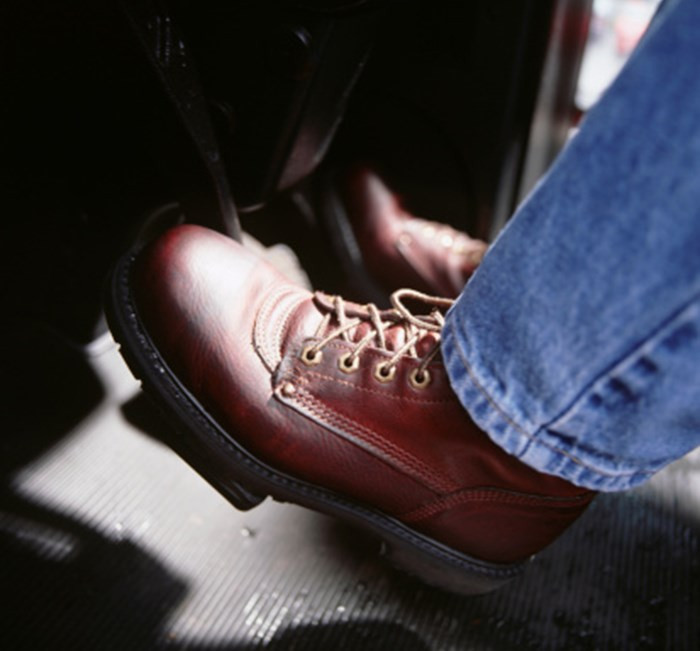 |
ButDo not release the accelerator pedal suddenly:This is because the weight shifts from the rear wheels to the front wheels, leading to a loss of control. After a few seconds of wobbling, the vehicle will regain balance, and the driver will be able to control it.
- Speed control:In the event of a sudden tire blowout on the road, the first basic action for the driver is to gently apply the brakes to gradually reduce the vehicle's speed. In some cases, due to inertia, the vehicle may continue to slide forward; at this point, the driver needs to proactively maintain speed and keep moving steadily, avoiding sudden braking which could cause the vehicle to tilt and overturn.
Stay calm, firmly grip the steering wheel with both hands in the correct position to avoid losing control (left hand at the 10 o'clock position and right hand at the 2 o'clock position). Then, gradually reduce speed and apply the brakes to bring the vehicle to a complete stop once you have regained control of the steering.
- Change lanes and pull over to the side of the road:Once you've controlled your speed, the next step is to quickly move the vehicle to a safe area (usually the roadside) to check the condition of your tires. For safety, turn on your turn signal or use your flashing headlights when it's too dark or there's insufficient light.
In the event of a serious tire blowout that makes driving almost impossible, the best course of action is to stop the vehicle completely in one place on the road and use a signpost (such as a tree branch) to warn other vehicles.
To ensure safe vehicle operation.
The tires used for the front wheels must be of the highest quality.
Both tires should be the same size and wear evenly, installed with the tread pattern correctly aligned. If you notice uneven tread wear, you should have your wheels aligned or your tires rotated. When driving, if you discover a damaged front tire, do not use the spare tire as a replacement; instead, choose the best tire in your car, even if it has to be removed from the rear wheel.
Always inflate your tires to the recommended pressure; use a pressure gauge to check the tire pressure occasionally.
When buying new tires, pay attention to the manufacturing date. Even new tires that have been stored for more than 5 years will show signs of aging. When replacing tires, drivers should record the date and mileage on the odometer. Even high-quality tires should not be used for more than 80,000 km for trucks and 40,000 km for passenger cars.
Control your speed and maintain control of the road surface to avoid hitting hard, sharp objects.
Maintain a safe distance; if you don't intend to overtake, don't tailgate the car in front. Keep your distance once you can read its license plate.
Ngoc Anh
(Synthetic)
| RELATED NEWS |
|---|


