
Poet Canh Nguyen: A lifetime of diligent writing.
(Baonghean) - I knew and became acquainted with the poet Canh Nguyen from the years after our country's reunification (1975), but shortly before that, I had read his poems through the section "Waves of Rice" in the collection "The Face of the Field". A teacher at the time made a rather insightful observation: Canh Nguyen's poetry is intimately connected to life through emotion and intellect, although its expansive nature somewhat limits the concise essence, which is a fundamental characteristic of poetry in general.
In 1987, 14 years after "Waves of Rice," Canh Nguyen released his poetry collection "Things That Cannot Be Hidden." His poems were still verbose, but in return, the poet's personality became more apparent. Reading "Things That Cannot Be Hidden," poet Nguyen Trong Tao easily discovered the strong peasant spirit within Canh Nguyen: "Canh Nguyen is a person who always feels responsible for life, especially life in impoverished and difficult places." This is a manifestation of the poet's calling that he embraced, often torturing himself, and always felt the need to confide in his colleagues.
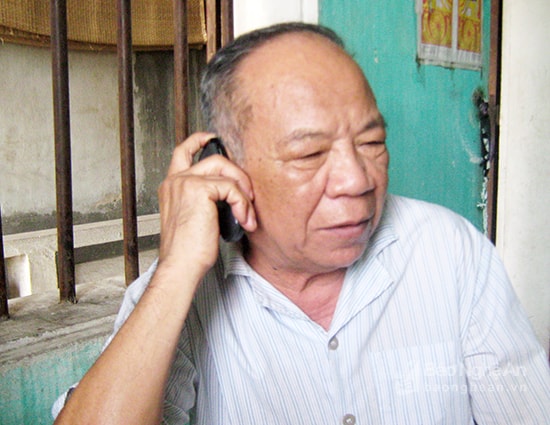 |
| Poet Canh Nguyen. Photo: Van Hung |
In early 1997, while Cảnh Nguyên was working on the manuscript for his new poetry collection, "Endless Waiting at the Wharf," I met him at the Nghệ-Tĩnh Publishing House, where he worked as an administrator and editor until his retirement. I hadn't seen Cảnh Nguyên publish much poetry in newspapers for a long time, so I was a little surprised to see him working on a book. It turned out the book included several previously unpublished poems, along with many pieces written during his student years at Hanoi University, reflecting the war against the US. Because it was a collection, the scope of life and thought reflected in the poet's soul was very broad. The writing style was also varied. The seven poems in particular (Written Along the Spring Road) easily made a strong impression due to their conciseness, rich details, everyday breath, and the writer's turbulent yet clear state of mind...
From the 1970s onwards, poet Canh Nguyen had many opportunities to get acquainted with and live in close, down-to-earth relationships with several senior artists and writers from Nghe An province, including poet Tran Huu Thung. The author of the famous poem "Visiting the Rice Fields" from the time of the resistance against the French, was both a strict teacher and a trusted older brother. Thanks to him, Canh Nguyen gained a relatively early and fundamental understanding of certain concepts about literature, the writing profession, and the intricacies of poetry-making... concepts that remained valuable to him and his younger colleagues even later on.
According to Cảnh Nguyên, poetry is essentially the poet's genuine heart opening up to humanity and nature. In it, the poet expresses their own opinions and conveys their feelings. As someone who embraces innovation in writing and accepts diverse tastes when working as an editor, he still believes that "change doesn't necessarily mean novelty," and that no matter what changes are made, readers must still feel and understand the author's message. That is, readers shouldn't be "tricked," but should still grasp the core message of the work. His poetry itself is a concrete and consistent manifestation of this concept.
Having traveled to Northwest Vietnam for news reporting, he journeyed along many roads and steep mountain slopes in the Northwest and Viet Bac regions. Then, returning to his hometown of Nghe An, he took charge of the Poetry Subcommittee of the Nghe An - Ha Tinh Literature and Arts Association; from the Association, he moved to the Nghe An Publishing House (for nearly 20 years, from 1982 to 2000). It can be said that the most passionate and challenging years of Canh Nguyen's life were primarily dedicated to his literary career. As an editor, he diligently read the works of younger colleagues, offering enthusiastic and spontaneous encouragement whenever he encountered something new or unusual, however fleeting.
I once met Canh Nguyen and the poet Phan Van Tu, who were frantically running around trying to get publishing permits, printing, and distribution for a poetry collection by a poor author from a remote village who was facing many hardships and difficulties. In our literary and journalistic circles, not everyone would think of or be able to do something like that.
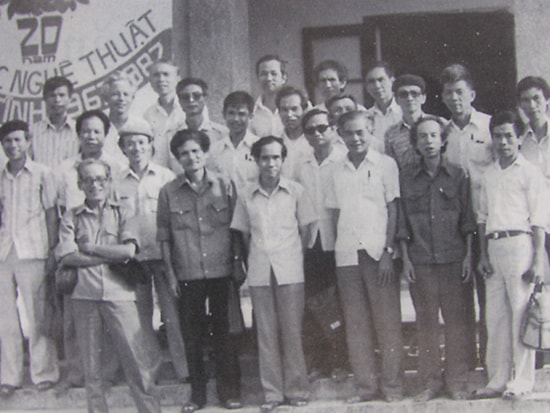 |
| Poet Canh Nguyen (middle row, second from the left) at the 20th anniversary celebration of the Nghe An Association of Literature and Arts (1967 - 1987). |
It's worth mentioning that Canh Nguyen showed an early awareness of the need to open himself up to life, as well as to art. In his "Letters to a Journalist Friend," he wrote: "I've come to realize that after a trip, our souls are infused with the intoxicating essence of life, but that doesn't mean we should rely on a rich life to become a smooth, worn-out pebble."
He traveled extensively and wrote freely across many literary forms and genres. Besides poetry, his main work, Canh Nguyen also wrote essays, short stories, novels, short plays, and folk dramas. His poetry includes both short poems and epics. His prose is rich in detail and events, although the depth of his characters' destinies is still a matter for further discussion.
After his collection of essays "The Day of the Water" (1976), he began to gain attention. Some at the time said that if he had continued with that style and those efforts, Canh Nguyen might have become a well-known essayist! Interestingly, he also wrote criticism and essays. Nearly a hundred pages at the end of his collection of miscellaneous writings "A Grain of Human Dust" (1998), besides a lengthy essay on Vietnamese couplets, which was his university graduation thesis, the author mostly devoted himself to analyzing, evaluating, and praising the phenomena and poetic values of his colleagues and friends near and far.
While some elderly journalists loudly declared that there was nothing to discuss about the literature of Nghe An, that there were no literary works from Nghe An to write criticism about,... in a small corner of Vinh city, despite his often difficult family circumstances, Canh Nguyen quietly read, reading extensively, taking notes for himself. And he wrote! Regarding his essay "Introduction to the Poetry Workshop of the Nghe An - Tinh Literature and Arts Association" (1998), Professor Le Ba Han once assessed it as a meticulously crafted piece, both comprehensive and straightforward.
Following the first volume of "Human Dust," which the author called "Upper," the second volume, "Lower," was released in 1999. It wasn't until May 2008 that Canh Nguyen published the third volume of "Human Dust" (also known as the Final Volume). Volume III is 500 pages thick, densely printed, and includes poetry, couplets, prose, discussions, and book reviews. At the end of the book is an appendix, reintroducing seven articles about Canh Nguyen's life and writings that the author felt needed to be preserved. At the end of 2014, the book "Evening Writings" was released, compiling some of the remaining manuscripts of poetry and essays up to that point.
After those three volumes, Canh Nguyen wrote less and less. In their small room on the second floor of a building on Dang Thai Than Street in Vinh City, the couple seemed to take turns being ill, so they would have the time and energy to care for each other and their grandchildren. I remember that for quite a long time, Grandpa Canh Nguyen spent most of his time tutoring his grandchild, and every week he would take the child to the provincial library on his rickety bicycle to read newspapers and borrow books for extra study. Every year at the Spring Newspaper Fair, I would meet him with a warm handshake and a smile.
As for the Literature and Arts Association and the Publishing House, those old institutions filled with many joyful and sad memories, he only visited them occasionally when absolutely necessary... Born in 1940 (Year of the Metal Dragon), in De Nhat village, Dien Nguyen commune, Dien Chau district, Nghe An province; this year, the Year of the Rooster, poet Canh Nguyen will be 77 years old. His diligent literary life and enduring, vital presence in the cultural and literary life of a region rich in poetic tradition is a true story, worthy of respect and recognition!
Nguyen Van Hung
| RELATED NEWS |
|---|


