
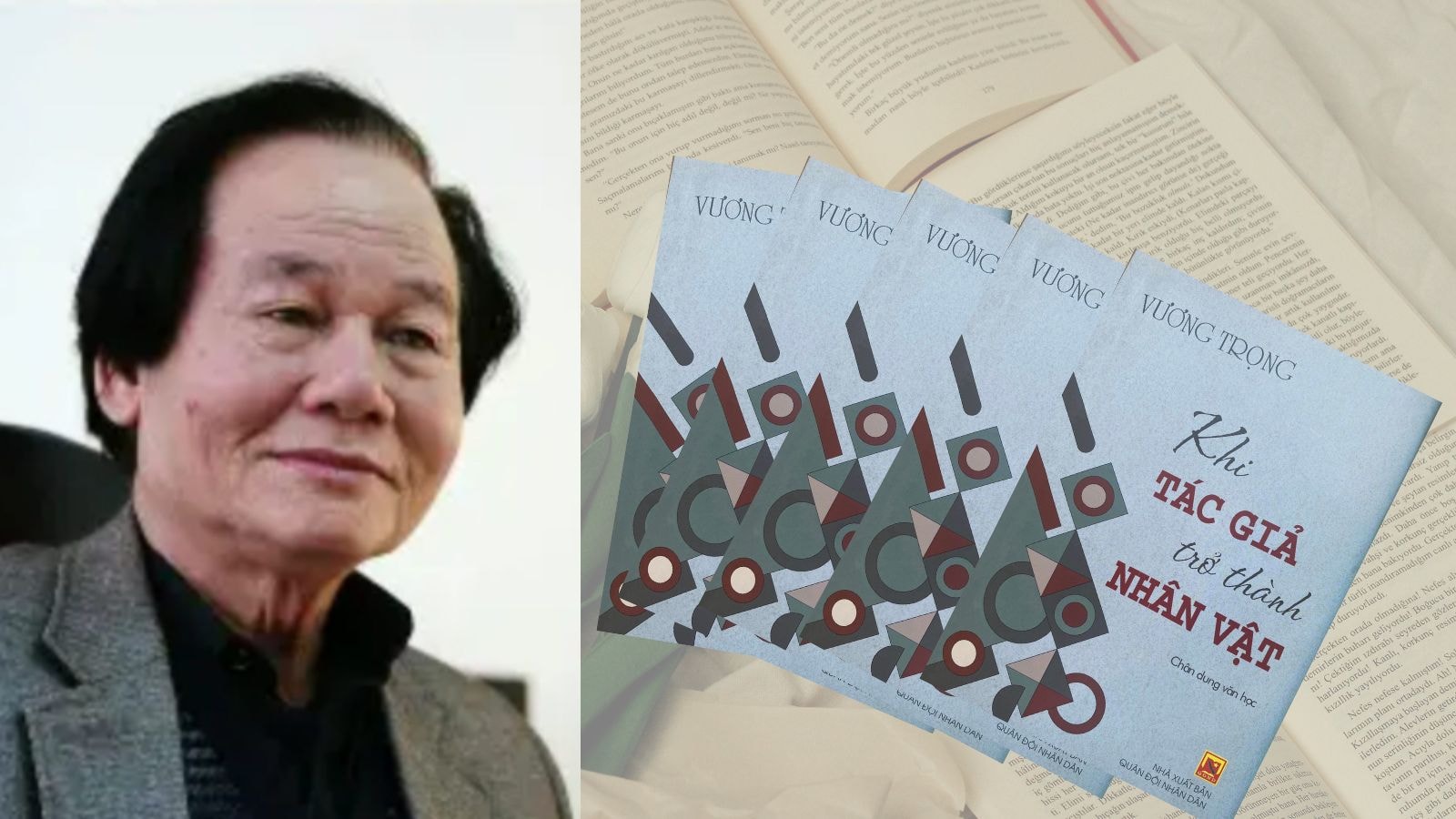
Poet Vuong Trong has gathered renowned writers to be "characters" in his new book.
The genre of literary portraits is not new in the literary world, but to gather interesting portraits, to obtain unique stories and memories, and to "construct" the writers' personalities from their real lives, so that the portraits come to life vividly, is considered a rarity. "When the Author Becomes the Character" by poet Vương Trọng is one such book.
“When the Author Becomes the Character” (People's Army Publishing House) was recently released to readers. At first glance, it appears to be a collection of literary portraits – a genre that seems familiar – but the more you read, the more you realize that Vuong Trong goes beyond simply “painting portraits.” He doesn’t collect anecdotes, nor does he “embellish” established names. He places writers in their proper position within the flow of history, as specific individuals who lived, traveled, faced danger, loss, temptation, and made choices. It is in this process that they become characters, not of the novel, but of literary life.
This is closely linked to the creative personality of Vuong Trong – a poet from Nghe An province who possesses two seemingly contradictory qualities: the profound depth of experience and the sharp, clear-headed intellect not easily captivated by glamour. Vuong Trong's writing, across all genres, always has a certain "firmness," neither sentimental nor pretentious, and not swayed by easy emotions. It is the style of someone who understands very well that to say something great, one must first speak the truth.

Vuong Trong carries in his writing the typical "Nghe An spirit." His writing is straightforward, confident, sometimes witty, but the more you read it, the more profound it becomes. He doesn't shy away from the truth, even truths that might confuse the reader, or even be difficult to hear, but it is precisely this that creates the credibility of his writing.
“When the Author Becomes the Character” focuses largely on military writers, those who emerged from war, from deep forests, trenches, bombs, and bullets. This was not a random choice. Vuong Trong understood that, in that generation, the boundary between life and literature was almost blurred. They didn't go on field trips in the conventional sense, but lived in that very harsh reality, and writing, for them, was a form of continuing the fight with words.
The stories of Vu Cao, Nguyen Chi Trung, Nam Ha, Chu Lai, Tran Huu Tong… are told in a tone that is both intimate and sober. There is laughter, and details that delight the reader with the surprisingly frank and innocent nature of the soldier-writer. Then, after the laughter, lies a deeper layer of reflection on responsibility, honor, and self-respect on each page.
The authors—the characters in the book—are presented not through titles, medals, or achievements, but through their actions, choices, and attitudes towards life. Poet Vu Cao is mentioned not only as a leading figure in the Army Literature and Arts movement during its glorious period, but also as a unique literary leader with the viewpoint of "not leading at all." This statement, seemingly a joke at first glance, reveals a profound philosophy about creative freedom and faith in the talent and character of the writer upon careful reflection.
Vuong Trong recounts the story connected to each character and their journeys, battles, hunger, injuries, and illnesses… with a restrained and measured writing style. It is this restraint that creates the weight of authenticity. When the writer has to crawl after an explosive device, when he has to live for months without a grain of rice, when he finishes his work only to be struck down by jungle fever, the reader understands that literature, in those circumstances, is no longer a professional choice but a mission.
What is valuable is that Vuong Trong does not turn his characters into "monuments," nor does he make grand pronouncements or pronouncements. He allows them to appear with their own distinct personalities, sometimes sharp-tongued, sometimes stubborn. Chu Lai emerges as a true soldier rather than a chronicler; Nguyen Chi Trung is someone willing to kneel down in the middle of an airplane to refuse an envelope; Nam Ha is a writer who understands tactics no less than a commander… Through these details, readers understand that the writer's character is an inseparable part of the work.
What makes this collection of literary portraits unique is that the author is not an outsider to the story. Vuong Trong is an insider. He was on the battlefield, witnessed, heard, and lived alongside the people he writes about. Therefore, the narrative voice in the book has the familiarity of camaraderie, but always maintains the necessary objectivity to avoid falling into sentimentality. In this book, readers not only see the portraits of the writers, but also the figure of the narrator – Vuong Trong, a poet who lives a life of restraint, values experience, dislikes embellishment; a writer who clearly embodies the "Nghe An spirit."
On a theoretical level, "When the Author Becomes a Character" presents a clear concept—though not presented as a thesis—about the relationship between reality and creativity. Vuong Trong understands very well that literature is not a copy of life. Through his portraits, he repeatedly evokes different perspectives on fieldwork, recording, observing, and contemplating; therefore, throughout the book is the "red thread" that without sufficiently deep and authentic life experiences, it is difficult to create a compelling and lasting artistic reality.
Therefore, this book is not only a tribute to a generation of military writers but also a message to writers today. In an era where literature faces many temptations of superficiality, of writing quickly, printing hastily, and reading hastily, Vuong Trong affirms the value of writing as a serious labor and a commitment to taking full responsibility for every word.
From a stylistic standpoint, "When the Author Becomes a Character" bears the distinct mark of Vuong Trong. He doesn't use elaborate theoretical concepts or complex literary structures, but it is the clarity and coherence of his thinking, coupled with the maturity of his experience, that gives each page a powerful impact. Readers sense a writer who has lived through war and lived long enough with literature to understand that the most significant things often lie behind seemingly ordinary stories.
This book, arguably, is not only for those interested in military literature. It is for all those who still believe in the profound humanistic value of words. In it, the writer doesn't stand outside observing life, but steps directly into its heart, accepting conflict, loss, and even sacrifice, to raise an honest voice. "When the Author Becomes a Character" is therefore not just a collection of literary portraits, but a book about the ethics of writing. It reminds us that, before becoming the author on the book cover, the writer has been, and must be, a character in the life of their own time. Only by daring to live as a true character can a writer leave behind timeless writings.


