
The writer Huu Phuong has ascended to the heavens.
(Baonghean.vn) - The passing of writer Huu Phuong has revived in our hearts beautiful memories of him - a dedicated teacher, a lover of poetry who composed many heartfelt early poems, and a veteran prose writer.
This morning (February 3rd), Ms. Quách Thiếu Hoa, the wife of writer Hữu Phương and former lecturer at Quảng Bình University, called to inform me, "My dear, Uncle passed away at 7:17 AM." I was speechless, overwhelmed by a profound sadness and a tremendous loss, because from now on, the literature of Quảng Bình in particular, and the entire country in general, will forever lose a literary talent, a kind and genuine person.
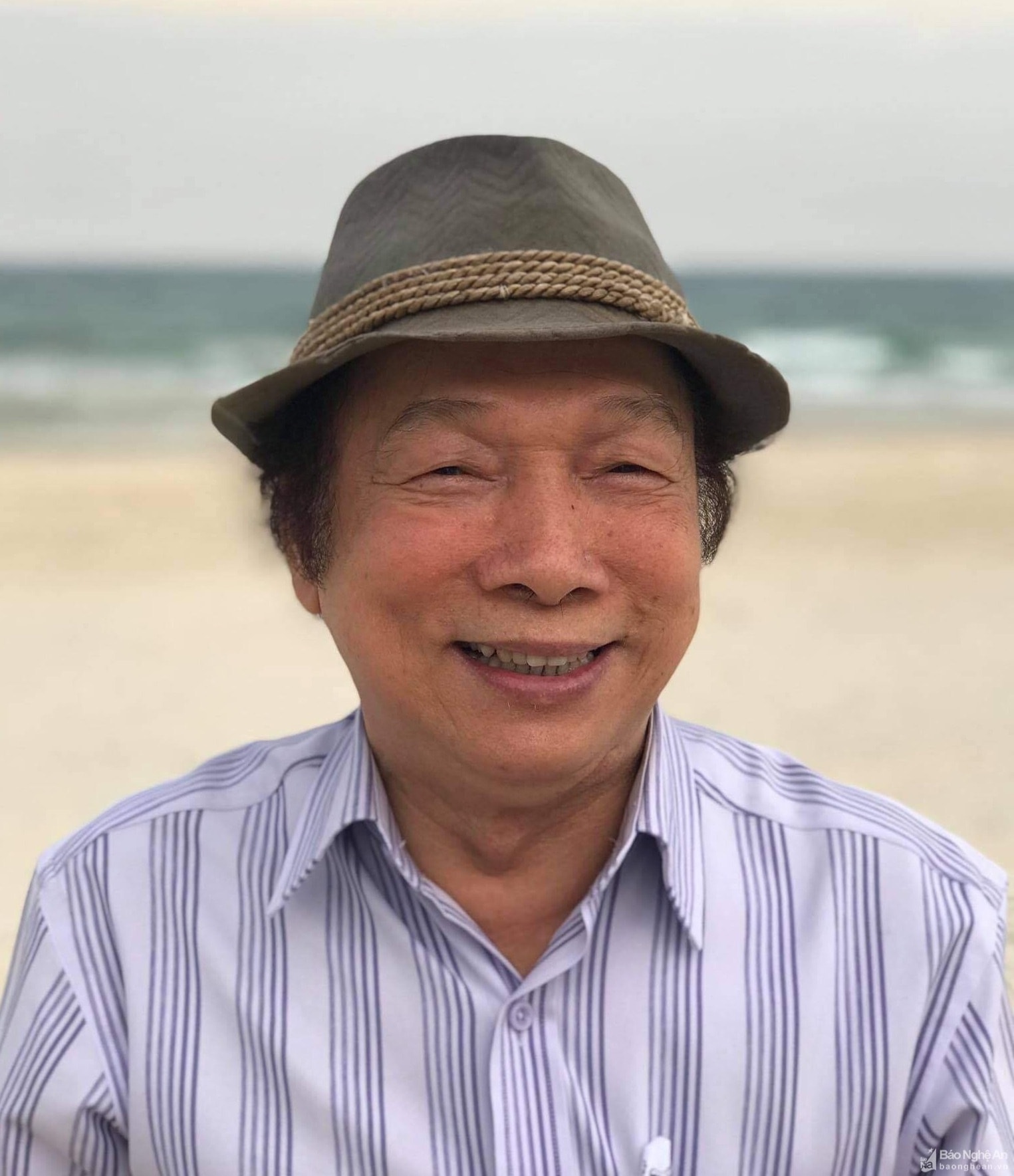 |
Writer Huu Phuong. Photo: Thuy Anh |
Writer Huu Phuong, whose real name is Nguyen Huu The, was born on December 26, 1949, in Dai Trach commune, Bo Trach district, Quang Binh province. He spent years studying in Nghe An. This land of studiousness nurtured his dream of becoming a teacher and training many generations to contribute to the country. In 1972, he graduated from Vinh Pedagogical University, and after that, he returned to his hometown to teach mathematics at Bac Quang Trach High School.
In 1973, he transferred to teach at Quang Binh Teacher Training College (now Quang Binh University). In 1982, he moved to Hue to teach at Binh Tri Thien Teacher Training College. From 1993, he worked at the Quang Binh Association of Literature and Arts, holding positions such as Vice President (1993-1998), President (1998-2009), and Head of the Vietnam Writers Association branch in Quang Binh from 1993 to 2022.
From a dedicated teacher and a lover of poetry, writer Huu Phuong transitioned to writing fiction. His first short story, "Moonlight in the Melon Garden," published in Song Huong Magazine, made a strong impression on readers. Later, his short stories and novels quickly propelled him to become a veteran writer.
 |
Some of the famous works of writer Huu Phuong. |
He left behind many valuable works for Vietnamese literature. His short story "Moonlight in the Melon Garden" was the impetus for him to continuously expand his writing career at the Army Literature and Arts Magazine, the Literature and Arts Newspaper, and other provincial magazines with stories such as "Mr. Dien Bien," "The Old Wharf," "Autumn Fairy Tale," "The Holy Man," "The Village Teacher," "The Night of the Quỳnh Flowers Blooming," etc. His short story collections include "The Holy Man" (1991), "The Night of the Quỳnh Flowers Blooming" (1995), "Wild Chrysanthemums" (1997), "The Rosy-Cheeked Guest" (2002), "The Soldier and the Girl in the Green Uniform" (2011), and "Three People on the Train Station" (2014). His novels "Summer Horizon" (2011), "Gunfire at Thien Duong Wharf" (2014), and "Turning Back is the Shore" (2019) were subsequently published.
In particular, the short story "Three People on the Train Station" was adapted into the film "Life in the Sand" (screenplay: Nguyen Quang Lap; director: Nguyen Thanh Van), which won many major awards both domestically and internationally.
Writer Huu Phuong has received numerous awards, including: the Short Story Contest of the Army Literature and Arts Magazine (1989-1990) for his short story "Night of the Blooming Quỳnh Flowers"; the Third Prize of the Second Golden Pen Award of the Ministry of Public Security (1998-2001) for his short story "Purple Sim Flowers"; the Border Guard Command Award for his memoir "Cha Lo: The Rainy Season Comes Early"; the Second Prize of the 3rd Novel Contest (2006-2010) of the Vietnam Writers Association, commemorating the 1000th anniversary of Thang Long - Hanoi; the Cup of the Ministry of Agriculture and Rural Development on the theme of agriculture, rural areas, and Vietnamese farmers in the period 1982-2011 for his novel "Summer Horizon"; and the Second Prize of the 5th Novel Contest (2016-2019) organized by the Vietnam Writers Association for his novel "Turning Back is the Shore". and the first, second, third, fourth, fifth, and sixth Luu Trong Lu Awards.
Writer Huu Phuong once confessed: "I wrote 'Summer Horizon' not to write about war, but through war to talk about the fates of people in my homeland, about the strength of the home front supporting the great front lines."
That's right! "Summer Horizon" brings together countless human destinies. Each person's fate is a painful, bitter mark. War destroyed countless lives and material resources, but it could not destroy the faith and hope of the people of Quang Binh. Amidst hardship, difficulty, and loss, the people here remain unyielding and indomitable. They, who always placed the mission of the nation on their shoulders, were determined to participate and serve on the battlefield at all costs. They embody all the qualities and characteristics of ordinary people: achievements, glory, joy, sorrow, failure, holiness, depravity, hatred, selflessness…
"Summer Horizon" by writer Huu Phuong is therefore a valuable documentary novel, possessing the narrative quality of a historical period of purely realist literature, linear and straightforward; although bound and dominated by the poetics of socialist realism, it still truthfully reflects the human condition as well as the resilience of the people of Central Vietnam during the years of bombing. The fact that "Summer Horizon" won Second Prize at the Vietnam Writers Association Awards in 2011 and the Golden Rice Cup awarded by the Ministry of Agriculture and Rural Development proves the abundant writing talent of writer Huu Phuong in that context.
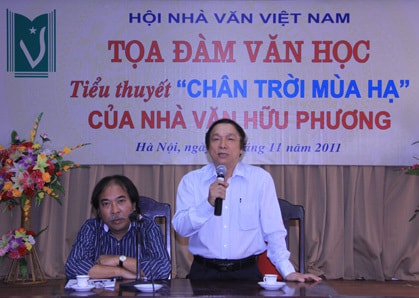 |
Poet Nguyen Quang Thieu (left) and writer Huu Phuong at a literary discussion about the novel "Summer Horizon". |
While "Summer Horizon" was imbued with epic inspiration, in "Turning Back is the Shore," amidst the dynamics of post-war literature and the changing artistic concepts and ideologies, the themes of war and soldiers were examined from a worldly and personal perspective. The irreconcilable conflicts and hatred between the two sides were placed within the context of familial bonds and blood ties.
"Turning Back Is the Shore" firmly sided with human suffering, delving into the depths of war to fairly address its consequences. The characters' thoughts and feelings in the novel are a polyphonic dialogue. It is precisely these gaps and discrepancies in the characters' inner worlds that allow the author to reflect deeply, discuss openly and multifacetedly, and reveal his artistic perspective and viewpoint on war from a post-war point of view.
War can divide a country, separate families, lovers, and friends, but love will unite and resolve all divisions, conflicts, and disagreements. Sharing the horrors and brutality of war is not meant to worsen existing wounds, but rather to highlight that any war causes destruction, loss, and tragedy for people, regardless of their side. His novel, "Turning Back Is the Shore," affirms his forte and skill in deeply examining and interpreting the brutality of war through the traumatized and tragic fates of its characters. Therefore, readers consider "Turning Back Is the Shore" one of his most successful novels, confirming his writing prowess and abundant creative energy.
During his battle with illness, writer Huu Phuong never stopped writing. He completed his novel, which was licensed by the Literature Publishing House, but he passed away before it could be printed. Two novels about the sandy land during the war, set in Bao Ninh village, remain unfinished. This is truly a great loss, a huge void in the literature of Quang Binh in particular and the whole country in general.


