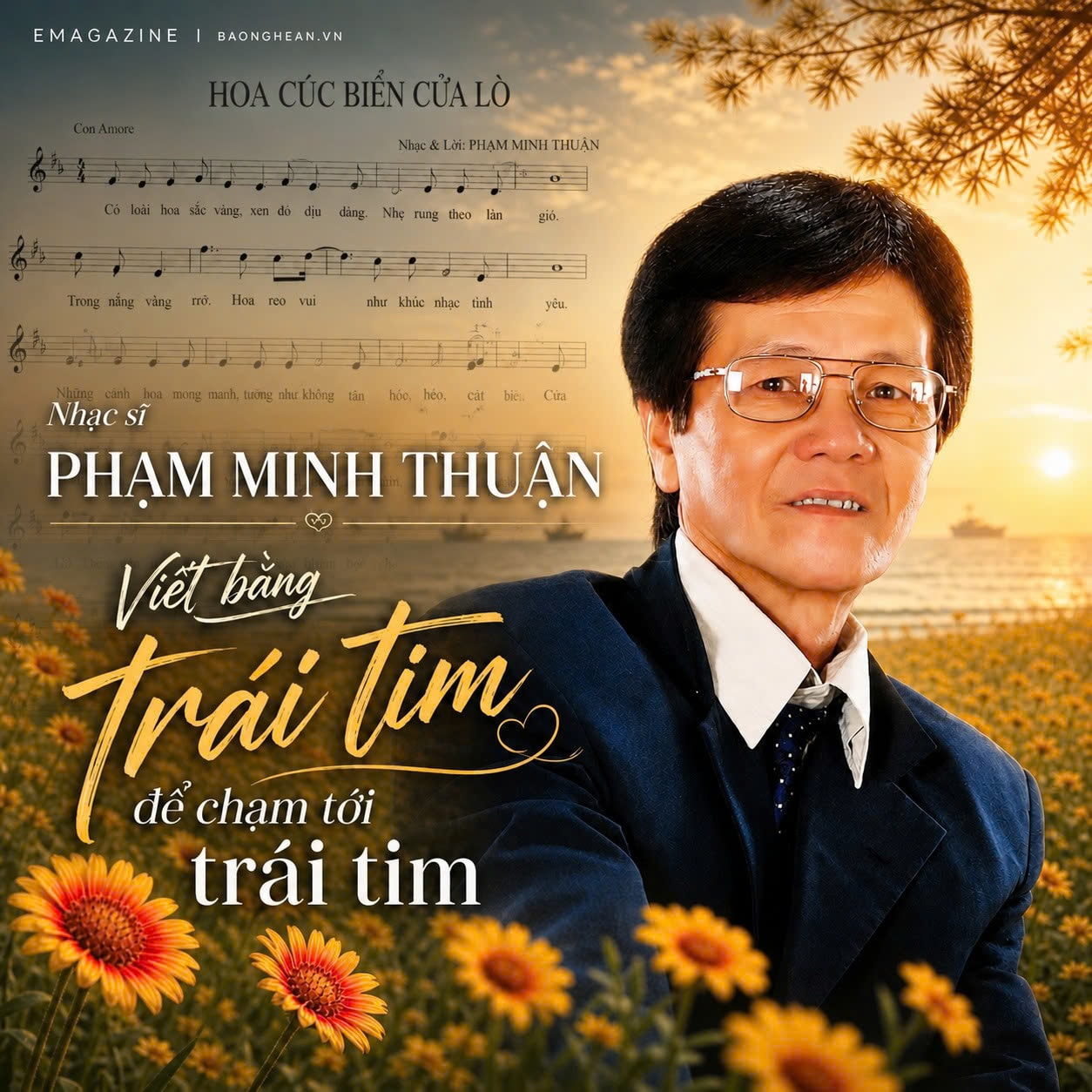
Composer Pham Minh Thuan: Writing from the heart to touch the heart.
Phuong Chi•May 3, 2026 19:30
At the Cua Lo Tourism Festival 2026, the song "Cua Lo Sea Chrysanthemum" sung by singer Ha Quynh Nhu was widely loved by the audience and is currently spreading rapidly on social media. The author of this lyrical song is musician Pham Minh Thuan.
Content + Design:Phuong Chi• May 3, 2026
*****
At the Cua Lo Tourism Festival 2026,section"Cua Lo Sea Daisy"The singing voice of singer Ha Quynh NhuOkayloved by a large audience and currentlyspreading rapidly on social media.The author of that lyrical song is musician Pham Minh Thuan. Talking to him, from a song about a flower symbolizing vitality and fidelity, to other unique compositions, it's easy to recognize in this talented musician a rich sense of humanism that runs throughout his artistic journey.
PV:Listen to the song"Cua Lo Sea Daisy"The singing voice of singer Ha Quynh Nhu, khipFew viewers want to learn more aboutthe creative journey of musicsoldierCould you share more about how you came up with this song, as well as the process of creating the work?
Composer Pham Minh Thuan:Three years ago, I had the opportunity to travel to the North on a business trip, and on the way, I stopped by Cua Lo beach. I remember that afternoon, around 2 PM, I went to the beach. My first impression was seeing a type of flower growing in very wide carpets along the coast, bright yellow in the sunlight. What was special was that the sunlight changed its color; from one angle it looked yellow, from another it had a soft reddish hue. Curious, I asked the locals and learned that it was a sea daisy.
I stood admiring the carpet of flowers for a long time. Its beauty was a very wild kind of beauty. But it was precisely that wildness that was so captivating. They grew in clusters, interconnected, and the withered blossoms became nutrients to keep the plant alive.
At the time, I hadn't thought about what I would write, but when I got back to the hotel, the sea daisies kept haunting my mind. And from there, I started to develop the song.
The text contains the following sentence:"In a moment of wistfulness, the soldier remembers the flowers as if they were his lover..." This sentence stems from a very real moment when I saw a soldier walking with a girl on the beach, and suddenly that image blended with my feelings about flowers.
In terms of melody, I built it based on very intuitive feelings, like the gentle, whispering, murmuring of ocean waves. I wanted listeners to feel the rhythm of the sea, the wind, and the atmosphere of Cua Lo.
From the initial idea to the completion of the song, it took about two months. Of course, music has no fixed timeline. Some songs I've been "conceived" for a decade, while others are finished in a week. What matters is when the emotion comes and how you "capture" it.
PV:In his perception, what symbolic meaning does the image of the sea daisy hold? What message does he want to convey through the song, and what makes this song unique in his songwriting journey?
Composer Pham Minh Thuan:Sea daisies are wildflowers, but that very "wildness" hides a very strong vitality. They are a gift from nature. I think they are a beautiful symbol of the Cua Lo region. A flower that seems ordinary but is incredibly precious, and sometimes even those who cultivate it don't realize its value.
With the song "Sea Chrysanthemums of Cua Lo," I want to convey a very simple message: we shouldn't easily discard what nature has given us; we shouldn't underestimate the value of things that seem small.
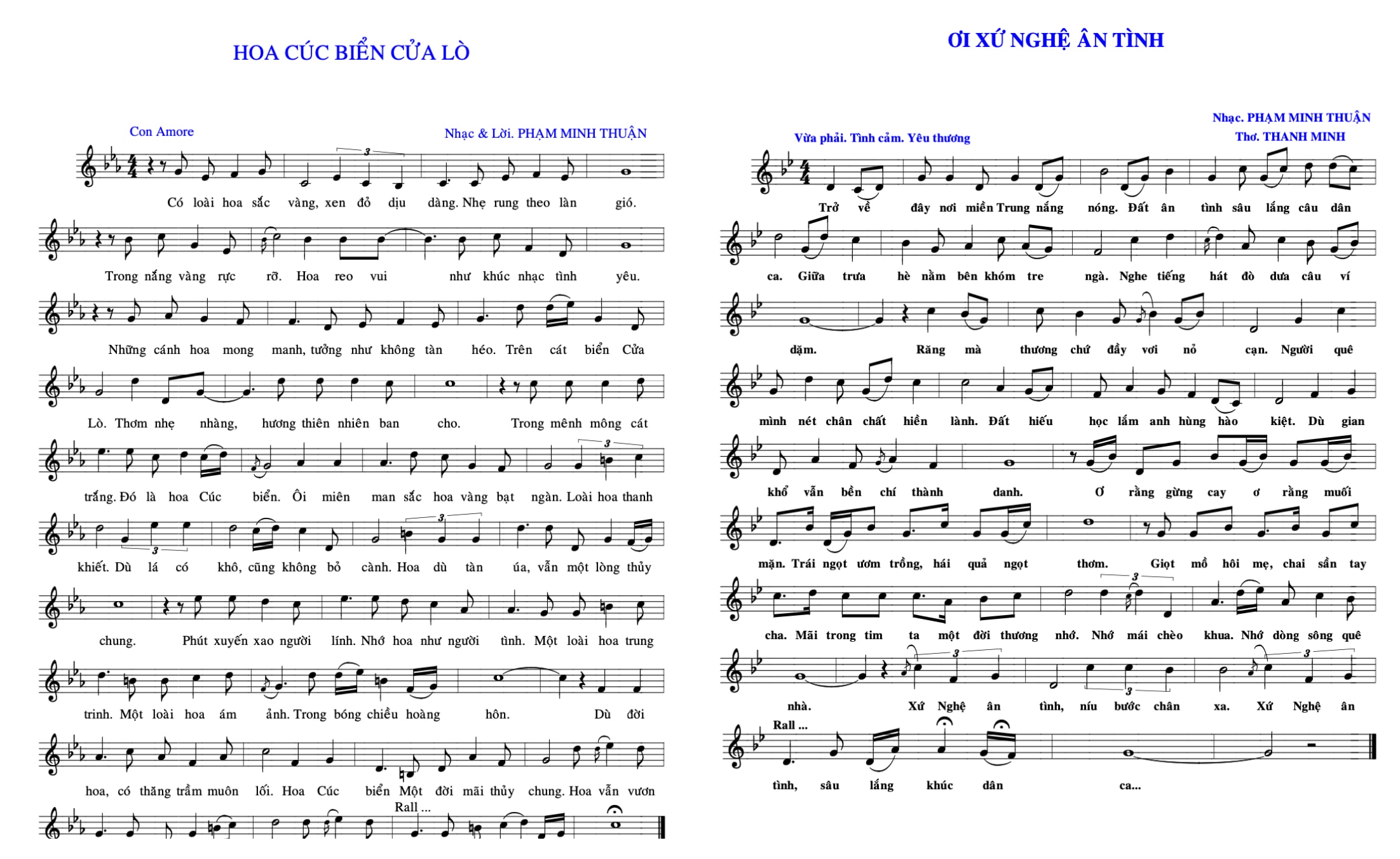
In the song, right from the first line:"There are flowers with delicate yellow and red hues..."That's an image I observed very carefully. Yellow is the dominant color, but with a very subtle reddish tint, swaying in the breeze. And in conclusion, it conveys a very ordinary yet truthful idea:"Despite life's many ups and downs, the sea daisy remains faithful throughout its life..."I want to say that, despite the storms and tempests, that flower still clings to the sea, still rises up, still..."Smiling in the morning sun"It's not just flowers; it's an image of the people, of the Cua Lo coastal area in particular, and Nghe An province in general.
"Sea Chrysanthemums of Cua Lo" and "Oh, the Beloved Land of Nghe An" are two spiritual gifts that composer Pham Minh Thuan wrote for his beloved Nghe An province.
PV:GrandfatherDknown for many innovationsauthorabout the LordticketHo Chi MinhGiven that there are already famous songs about him, why did he still choose to dedicate his efforts to exploring this particular theme?According to him, what was the biggest challenge when writing about President Ho Chi Minh, and how did he "refresh" the emotions in his works?
Composer Pham Minh Thuan:It's true that there have been many great and excellent works about President Ho Chi Minh. However, in my opinion, each person has their own way of expressing it, and a work will truly resonate with the public when the musician writes from the heart.
The biggest challenge when composing songs about Uncle Ho is maintaining accuracy. Writing about him, even a single inappropriate word or musical note can easily lead to misunderstandings or even strong negative reactions. I have several songs about him, such as "Because He Is Ho Chi Minh," "His Unbuttoned Coat," "Gratitude to Ho Chi Minh," "The Man Who Sought the Image of the Nation," "The Century Named After Ho Chi Minh,"... and I was fortunate enough to win high awards in the national-level campaigns for composing and promoting literary, artistic, and journalistic works on the theme of "Studying and Following the Ideology, Morality, and Style of Ho Chi Minh." However, I always believe that awards are only a measure, not the ultimate goal of a musician.
Regarding "reinventing" something new, there's really no formula. Sometimes I think for a long time but can't come up with any musical idea, but other times inspiration comes unexpectedly.
I remember once writing a song about Uncle Ho for days without finishing it. That night, around 9 PM, I started concentrating on it, and around 1 AM, the melody suddenly "burst forth." I quickly got up and wrote continuously until almost 3 AM, finally completing it. If I had waited until the next day, the inspiration would surely have faded. That's how music is; it doesn't wait for you.
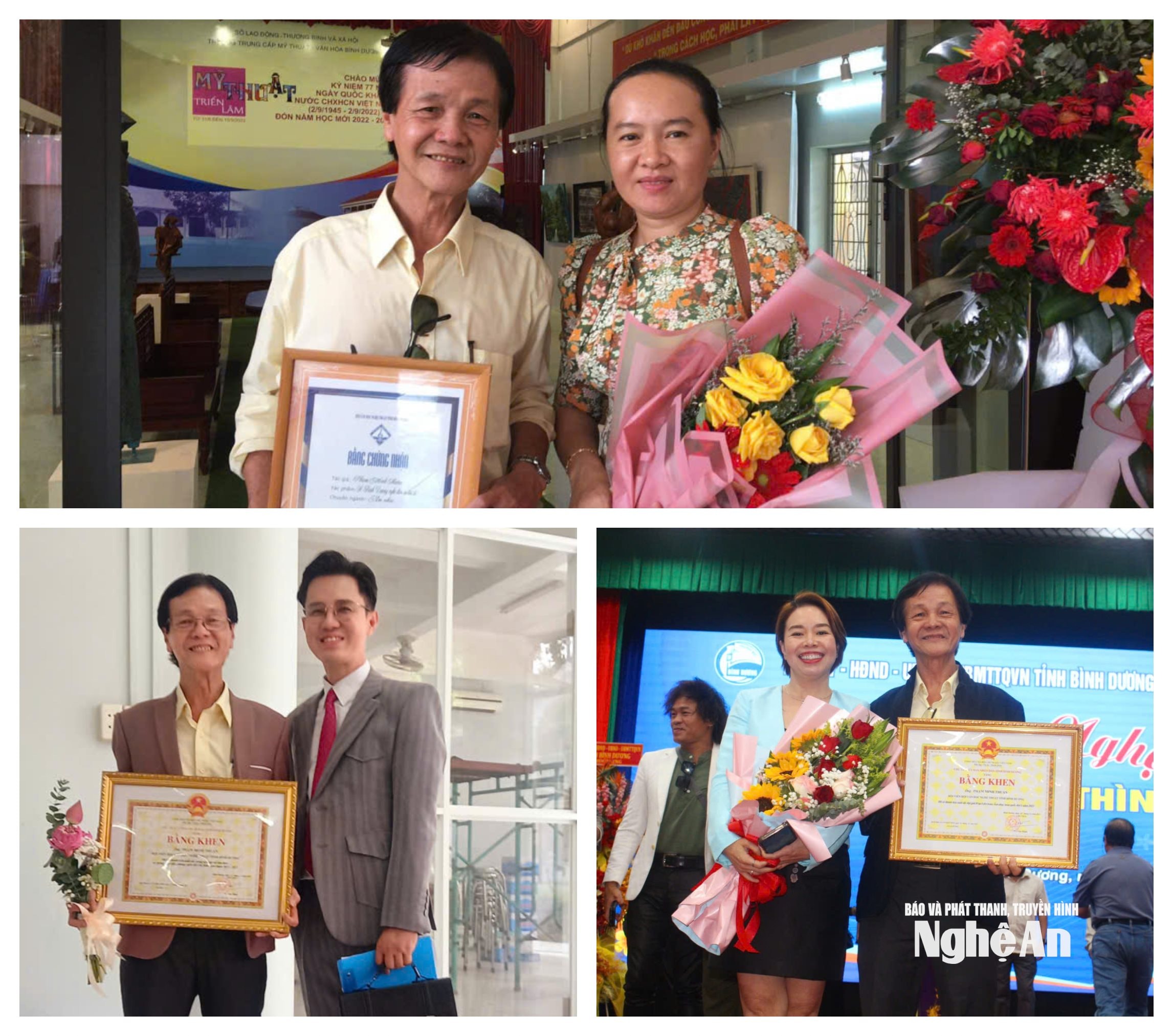
Composer Pham Minh Thuan has been honored with numerous awards through various songwriting competitions. Photo: Provided by the artist.
PV:LabourThey also remember musician Pham Minh Thuan with...Songs written about DaigeneralVo Nguyen Giap,For example, "The Great Tree in the People's Hearts," "The Snow-Covered Volcano," etc. Could you share more about the context of its creation and the special inspiration behind this series of works?
Composer Pham Minh Thuan:When General Vo Nguyen Giap passed away, it was a very significant event. I had the opportunity to visit Vung Chua - Yen Island (Quang Tri province) and his grave, about a year after his death. About 10 days after returning, I wrote three songs:"A snow-covered volcano," "A towering figure in the hearts of the people," "A humble man has passed away."
I have read many documents and stories about the life and career of General Vo Nguyen Giap. He was a man who lived among the people, loved by them to the point that when he passed away, millions of people – including those who had never met him – shed tears as they bid him farewell. For me, writing about President Ho Chi Minh and General Vo Nguyen Giap simply stems from the heartfelt desire to "remember the source of the water you drink."
PV: OhHe also has songs associated with programs rich in humanitarian values such as "As If There Had Never Been a Separation" or "Returning from Memory". These compositions areoriginating fromfeelingany, and he realizedStarWhat is the role of music in healing and connecting people?
Composer Pham Minh Thuan:For me, the theme songs for programs like "As If There Had Never Been a Separation" or "Returning from Memory" weren't commissioned compositions, but were truly written from moments of intense and genuine emotion. I clearly remember the context for writing the song "No More Separations." One evening, while eating dinner, I turned on the TV and was captivated by the story of a little girl who was separated from her family at the age of four, wandered for over 20 years, drifted all the way to Cambodia, and lived in extreme poverty, losing all sense of self. I felt heartbroken and couldn't swallow my food, so I had to skip dinner.
That night, I wrote it right away. And the song was written in tears, literally. The opening line came very naturally:"Every parting is filled with tears / Every parting is full of pain."..."
It wasn't that I was trying to write something melodramatic; the emotions just flowed naturally into the lyrics. Three days later, singer Ha Anh Tuan performed it. While singing, the singer cried; when it was broadcast, the viewers cried too. I think that's when music fulfilled its role of touching people's hearts.
I've always believed that music isn't an "industrial factory." It can't be made to order without emotion. When you write from the heart, it will reach the hearts of others. But if you write with reason or some ulterior motive, it's very difficult to create empathy.
Through such humanistic programs, I clearly feel that music has a healing power. It doesn't change circumstances, but it helps people confront and understand pain, allowing them to share, empathize, and be forgiving… And above all, music connects strangers. The composer, the performer, the listener – all meet at a common point: emotion. That is what creates the deepest humanistic value of music.
PV:Looking back a bitn 35years of composition with hundredsthousandRegarding the song, could you share your professional principles, work habits, and views on music and the responsibility of artists to society today?
Composer Pham Minh Thuan:To date, I have about 600 songs that have become popular, and if you include unreleased ones, it's over 2,000. However, for me, the number isn't as important as whether each song I write brings something meaningful to life.
My professional principle is very clear: the most important element is emotion, accounting for 70-80%. The rest is thinking and the message. But without genuine emotion, all techniques become meaningless.
Before becoming a musician, I was a teacher, so in my music, I always prioritize humanistic and educational values. Education isn't about grand gestures, but about small things, like respecting parents, teachers, friends, and even animals, trees, and grass... These are the things that shape character. In music, too, I prefer a gentle, intimate style. I also maintain the principle of writing from the heart and not letting any material pressures influence me. Music is not a tool for pursuing profit; it is an integral part of spiritual life.
As for the artist's responsibility, I think it's simple: An artist is like a silkworm spinning its silk to weave a beautiful garment for life. There's no need to say anything profound; just do your job well, contribute a small part to making life better.
Music, ultimately, is culture. And culture begins at its roots, in the family, in a mother's lullaby, in the memories of one's homeland. Without these things, a person can easily lose themselves. Therefore, for me, composing music is also about quietly and enduringly preserving those cultural values.
PV: Thank you, musician Pham Minh Thuan, for this candid conversation!
"
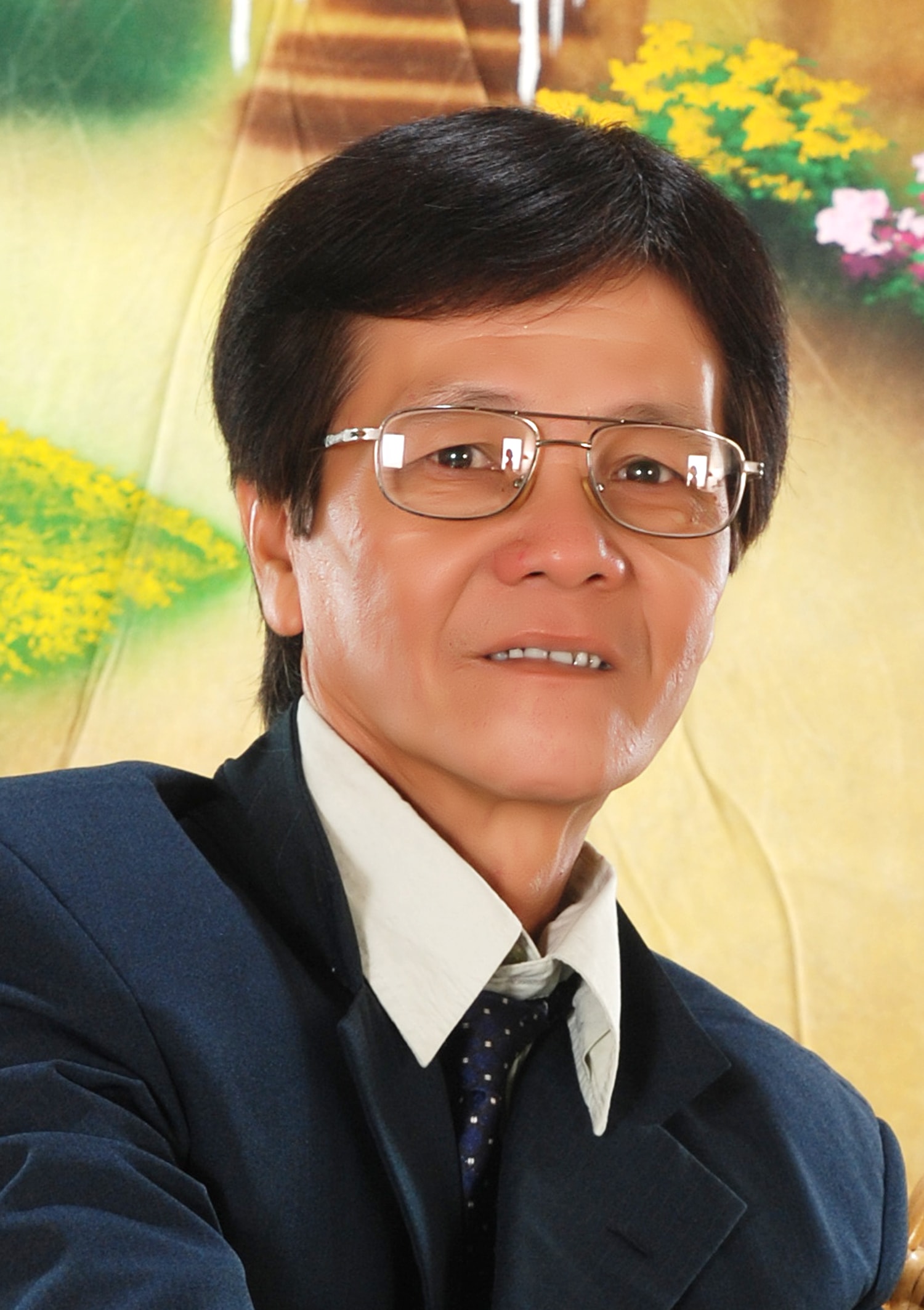
Composer Pham Minh Thuan was born in 1955 in Hanoi and lives in Ho Chi Minh City. He is the Vice Chairman of the Vietnam Musicians Association - Binh Duong Branch (now Ho Chi Minh City). He began composing in the 1990s with a serious and disciplined work ethic; he is famous for his lyrical compositions. Currently, he is the author of more than 2,000 songs, including about 300 children's songs.
Your comment has been submitted and will be displayed after being reviewed by the editorial team. The editorial board reserves the right to edit comments to comply with the newspaper's content guidelines.