
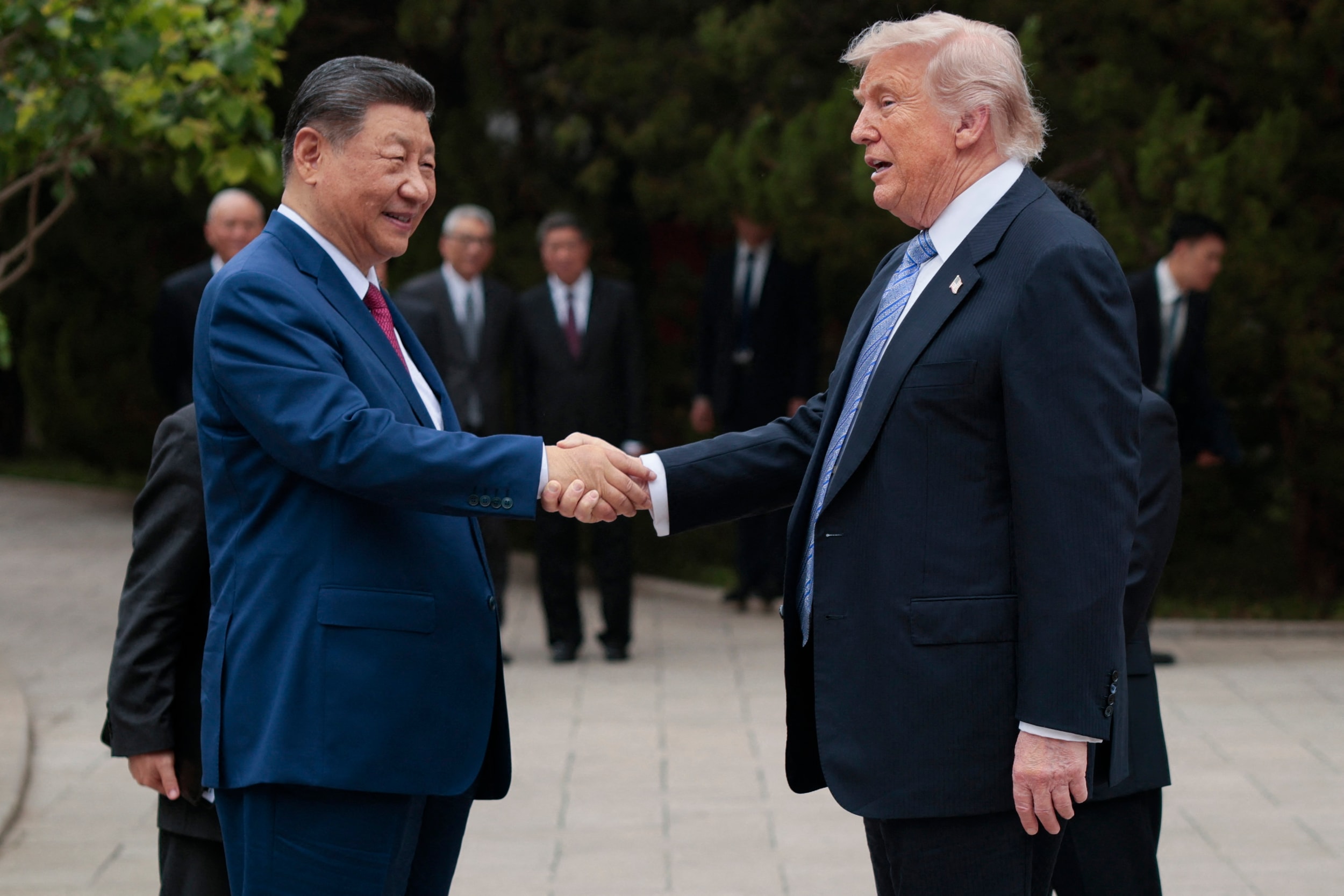
On the occasion of the US President's visit to Beijing, reflecting on China's 'Dual Circulation' doctrine.
2020 marked a major shift in China's development thinking when it officially launched its "dual circulation" strategy.
The emergence of the "double circulation" theory
This concept was first put forward at the Standing Committee meeting of the Politburo of the Chinese Communist Party on May 14, 2020, and quickly became the central idea of the 14th Five-Year Plan (2021–2025).
At this time, China is simultaneously facing unprecedented pressures: a trade and technology war with the United States, the trend of decoupling from global supply chains, the severe impact of the COVID-19 pandemic, and the declining efficiency of its growth model, which relies heavily on exports and investment.
Throughout more than four decades of reform and opening up, China's development has been driven by a model of cheap labor, exports, large-scale investment, and active global integration.
This model transformed China into the "world's factory." However, as geopolitical competition intensified and strategic vulnerabilities became apparent, China realized that an economy overly reliant on external markets and technology would be highly vulnerable.
From there, the "dual circulation" emerged as a strategy to both develop the economy and ensure national security.
The core concept of "double circulation"
This strategy consists of two cycles:
First, domestic circulation: This is the main pillar and the top priority.
The goal is:
- Using the domestic market as the main driver of growth;
- Develop domestic consumption;
- Develop domestic supply chains;
- Increase technological self-reliance;
- Reduce dependence on the West.
In short, China wants to create an economy capable of "self-sustaining" even under lockdown conditions or external pressure from geopolitical factors and global crises.
Secondly, regarding international circulation: China does not advocate for "closing its doors" or returning to the old model of self-isolation. On the contrary, it continues to maintain exports, attract foreign investment, and expand global trade.
However, the role of the international factor has changed significantly: from being the "main driving force" to a "supporting driving force".
While China previously relied on the global market for its growth, it now wants the domestic market to become its central foundation.
Beyond achieving economic goals, this Chinese strategy also carries national security implications. In other words, this economic doctrine must be framed within the context of national security.
China recognizes that semiconductor chips, AI, energy, finance, logistics, and supply chains can all become tools for exerting geopolitical pressure. Therefore, they are willing to sacrifice some economic efficiency in exchange for long-term self-reliance.
Thus, the "dual circulation" is not only an economic policy but also carries the meaning of a superpower competition strategy, a technological strategy, and a geopolitical strategy.
The conditions that enable China to pursue this strategy.
Not every country can build a strong "domestic circulation." Doing so requires enormous economic and social scale. And China is one of the very few countries in the world that has the necessary conditions.
a) Huge population size
With a population of approximately 1.4 billion and a middle class of hundreds of millions, China possesses a massive domestic market. This creates significant purchasing power, the ability to consume goods domestically, and a favorable environment for businesses to thrive without being entirely dependent on exports.
For example, a Chinese technology or electric vehicle company could achieve world-leading scale solely through its domestic market, without expanding its reach internationally—something most other countries cannot do.
b) Large territory and diverse resources
China possesses vast reserves of coal, rare earth elements, numerous strategic metals, an extensive agricultural system, and diverse natural conditions.
In particular, their rare earth resources give them a strategic advantage in industries such as batteries, electric vehicles, electronics, renewable energy, and defense.
c) A complete industrial ecosystem
This is China's most significant advantage. Currently, China is almost the only country with a complete industrial chain: metallurgy, chemicals, electronics, machinery, shipbuilding, logistics, digital technology, and consumer goods manufacturing.
It is often said that China houses almost the entire global supply chain within a single country. As a result, they have a very high level of production localization.
d) Infrastructure and resource mobilization capabilities
China possesses the world's largest network of expressways and high-speed railways, massive seaports, integrated logistics infrastructure, and a developed digital payment network.
Furthermore, given its political characteristics as a state led by the Communist Party, China has the ability to mobilize resources very effectively in capital coordination, industrial planning, supporting strategic enterprises, and focusing investment on core technologies. This allows China to pursue long-term goals at a pace that many free market economies struggle to achieve.
The challenges that China is facing
Despite its many advantages, this strategy also faces numerous challenges, such as:
a) Domestic consumption is not strong enough.
Chinese people still tend to save heavily due to job insecurity, an aging population, a real estate crisis, and pressure on the social security system.
This means that the "domestic circulation" cannot yet completely replace the role of exports.
b) Core technology remains externally dependent.
Despite rapid progress in many areas such as electric vehicles, AI applications, batteries, and renewable energy, China still faces difficulties in manufacturing advanced semiconductor chips, lithography machines, and chip design software.
This remains a "strategic bottleneck" in the competition with the West.
c) The global trend of “risk reduction”
Many Western countries are not completely "decoupling" from China, but are diversifying their supply chains, shifting production to other countries, and trying to reduce strategic dependence. This makes China's international environment more challenging.
Impact on Vietnam and Southeast Asia
The "dual circulation" strategy has a significant impact on Vietnam and ASEAN because the region is located close to China and is closely linked to its supply chain.
As a country with an extremely open economy, diverse and rich foreign relations, and deep integration into international processes (foreign relations with all 193/193 member states of the United Nations, 17 free trade agreements (FTAs) with 65 partners, including major partners such as CPTPP, EVFTA, RCEP, and trade relations with over 220 markets), Vietnam must certainly make long-term and flexible calculations in its steps to maximize advantages and minimize negative impacts.
Regarding opportunities: As international companies adopt the "China + 1" strategy, many manufacturing operations are shifting to Southeast Asia, particularly Vietnam. We have the advantage of proximity to China, competitive labor costs, political stability, and participation in numerous free trade agreements. As a result, the electronics, components, textile, logistics, and technology assembly industries are all developing rapidly. We have the opportunity to attract large, selective investments, upgrade our industries, become a major logistics hub, and participate more deeply in the global value chain. In fact, Vietnam is emerging as a crucial link in this new global supply chain.
Regarding the difficulties, challenges, and "paradoxes" to consider: Many products still utilize semi-finished goods, raw materials, machinery, and components from China. Domestic production may become heavily dependent on imports, stuck in the position of low-cost processing, and facing pressure to balance supply and demand. This problem arises because China is not withdrawing from globalization but is reorganizing its supply chains around itself. Without careful planning, Southeast Asia could merely play the role of an assembly hub, a manufacturing satellite region, or an extension of China's industrial ecosystem.
Looking back at the recently concluded visit to China by the US President (with its delegation of top billionaires, diplomatic protocol, and statements from the leaders of the two most powerful nations in the world), we see new signs, unlike the harsh statements of Mr. Trump before: that China is the number one rival, even considered an enemy, and that China must be contained with the toughest and strongest measures, etc. Instead, they sent signals about being partners, promoting solutions for even stronger mutual development, that America will be "great again," and that China will also be... China.
Clearly, although it was only a two-day visit, it raised very important strategic questions not only for Southeast Asia or Asia, but possibly for the whole world in this century.


