
Identifying the driving forces behind Nghe An's development.
(Baonghean) - After Nghe An Newspaper announced the opening of a new section to convey readers' opinions and contributions to the development of Nghe An, it received a positive response from readers with many heartfelt articles. Nghe An Newspaper has successively published these articles in the section "Contributions to building our homeland Nghe An".
As is well known, Nghe An is a large province in terms of population and area, but it is not yet a rich and strong province in terms of resources. Nghe An's area and population are among the largest in the country, but looking at its export figures or tax revenue, it's truly concerning!
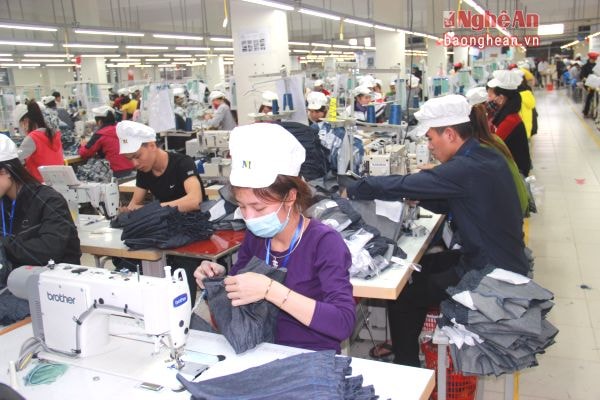 |
| Garments for export at Minh Anh Garment Company - Bac Vinh Industrial Park. Photo: Hoang Vinh |
According to the General Department of Customs, Nghe An's total merchandise export value for 2015 was only US$526 million, representing a tiny 0.32% of the national total. This is significantly lower than the US$730 million export value of Minh Phu Seafood Company in Ca Mau in 2014 alone. While export figures reflect the level of openness of a locality, budget revenue is an indicator of prosperity, signaling the development of businesses, industry, and trade in that locality.
As a large province with a border, a seaport, and an international airport, Nghe An started from a relatively low base, but its total budget revenue is at risk of falling out of the top 20 provinces and cities. Worryingly, Nghe An's budget revenue growth rate over the past 4-5 years has been significantly lower than many other localities, especially compared to its two neighboring provinces, Thanh Hoa and Ha Tinh, both of which have more than doubled their growth rates.
The major challenge for Nghe An in the coming period is the future of its revenue sources. What exactly should Nghe An's breakthrough strategy rely on? This is a big question.
The take-off of any national or local economy typically relies on four main "engines": I) State-owned enterprises, II) The agricultural sector, III) Foreign-invested enterprises, and IV) Domestic private enterprises. The potential for an economy to soar and reach great heights depends heavily on the impetus provided by these crucial "engines." Let's examine the current state of these "engines" in Nghe An province.
First, regarding the state-owned enterprise sector. Nghe An province in particular, and Vietnam in general, cannot rely heavily on the effective development of the state-owned enterprise sector. Despite receiving significant resources and favorable policies, this sector has proven to be inefficient. Many large-scale projects have been envisioned by state-owned corporations in the locality, but not a single major project has actually come to fruition.
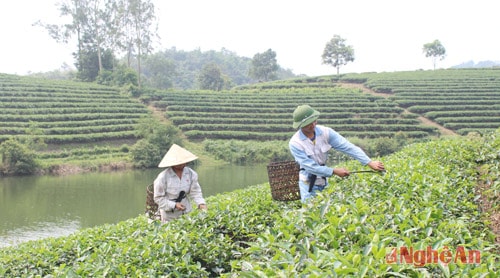 |
| Tea harvesting in Thanh Thinh commune, Thanh Chuong district. (Photo: Archival image) |
The agricultural sector in Nghe An, as well as throughout the country, is currently inefficient and is predicted to be the most negatively impacted by the opening up and integration process in the coming years. The fragmentation, inefficiency, and low productivity of the province's agriculture make it very difficult to compete with the high-tech agricultural systems of other countries when the country opens up. Nghe An is a barren land, mostly mountainous (although it is a large province, agricultural land accounts for only about 17% of the total area), prone to drought and natural disasters, making it even more challenging to develop its agricultural strengths.
Regarding foreign investment, despite being the economic hub of the North Central region, Nghe An is attracting very modest amounts of foreign investment. According to the Ministry of Planning and Investment, by the end of 2015, Nghe An had 69 licensed foreign investment projects, accounting for only 0.34% of the total number of projects and 0.58% of the total registered capital nationwide. Of particular concern is the fact that the growth rate of foreign investment projects in Nghe An over the past four years (2012-2015) has been significantly slower than that of neighboring provinces.
Foreign investors tend to focus on locations near international seaports and airports, where infrastructure is already in place (such as developed industrial zones). Large foreign investors also tend to invest in locations with a large existing investment community to exploit advantages in supply chain connectivity (such as proximity to suppliers of supporting products, availability of high-quality investment support services, etc.).
Given these characteristics, it's clear that in this race to attract foreign investment, Nghe An will not find it easy to secure a significant share of the pie, at least in the medium term.
Thus, the main driving force for the province's development in the coming period will be private enterprises, from household businesses to officially operating enterprises under the Enterprise Law. However, according to data from the General Department of Taxation as of December 31, 2015, the number of operating enterprises in Nghe An is still quite modest, at 7,532 enterprises.
Most private businesses in Nghe An are small and medium-sized, with many being micro-enterprises. With a population of over 3 million, Nghe An has approximately 24 businesses per 10,000 people. This rate is significantly lower than the national average of 53 businesses per 10,000 people and many other provinces and cities.
The low number of businesses and weak competitiveness are worrying signs for the future because they do not guarantee jobs for the people. Data from the General Statistics Office shows that from 2012 to 2014, the emigration rate (i.e., the number of people leaving their localities) was consistently higher than 10%, exceeding the average of 6-7% in the North Central and Central Coastal regions.
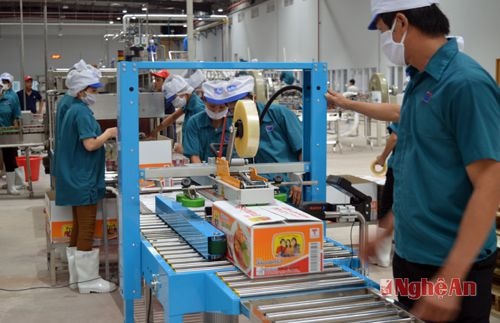 |
| Canned fish production at Royal Foods factory, Nam Cam industrial park. (Photo: Archival image) |
Ensuring employment must be a top priority and a crucial criterion for the government in the coming period. As a densely populated province with a large number of young workers entering the labor market annually, and a high number of workers shifting from the agricultural sector, where else will jobs be created if not in private enterprises, both formal and informal?
Of course, young workers can leave their hometowns to seek employment in other localities, or even work abroad, but if this rate becomes too high, it is a worrying situation. The province has invested heavily in education at all levels (and the quality of education in Nghe An is considered relatively high), but development resources are not created when workers reach working age. "Good land attracts good people," but if there aren't enough jobs, after each migration, the villages will be "empty," leaving only the elderly and children burdened with social welfare costs.
 |
| Coastal tourism is one of the economic development directions of Nghe An province. (Photo: Archival image) |
When people have jobs, it boosts consumption and services, creating new jobs. More jobs and higher incomes also contribute to the development of healthcare and education, and reduce social ills. Therefore, creating quality jobs should be a top priority and a central task for provincial leaders and all levels of government.
To develop businesses or attract investment, it is necessary to develop infrastructure, train human resources, and especially improve the quality of governance. However, in the Provincial Competitiveness Index (PCI), a set of indicators assessing the quality of governance and the level of administrative procedure reform for business development published annually by the Vietnam Chamber of Commerce and Industry (VCCI), Nghe An consistently ranks among the lower-ranked provinces and cities out of 63, reaching position 32 in 2015.
In the upcoming integration process, to avoid the risk of falling behind, Nghe An needs to make greater efforts and move faster than other provinces and cities. To attract investors, Nghe An cannot simply move closer to Ho Chi Minh City and Hanoi to gain an advantage, nor can it improve infrastructure or human resources quickly in a day or two. What Nghe An needs to do is improve the quality of governance rapidly; this doesn't require excessive resources or time.
Dau Anh Tuan
(VCCI Vietnam)


