
Many policies support people in 44 poor communes 'near' the 30a program.
(Baonghean.vn) - In order to achieve the target of reducing poverty by 2-3% each year, and 3-4% in mountainous areas, the second session of the 17th Provincial People's Council, term 2016-2020, issued a policy to support 44 poor communes "near" Decree 30a.
Nghe An province has 11 mountainous and high-mountain districts and towns with difficult socio-economic conditions; in particular, many communes have a high poverty rate of 30% or more but are not among the three districts eligible for the Government's 30a policy. To create balanced development among localities in the province, the 15th Provincial People's Council, term 2005-2011, issued Resolution No. 319/2010/NQ-HĐND on mechanisms and policies for support.
After 5 years of implementation, this policy has revealed several limitations, most notably that only 227 people received support for labor export. This is due to the indirect support mechanism, channeled through labor export companies, while the payment procedures involve multiple steps and levels; furthermore, the low level of support received by businesses has made them unenthusiastic about the policy.
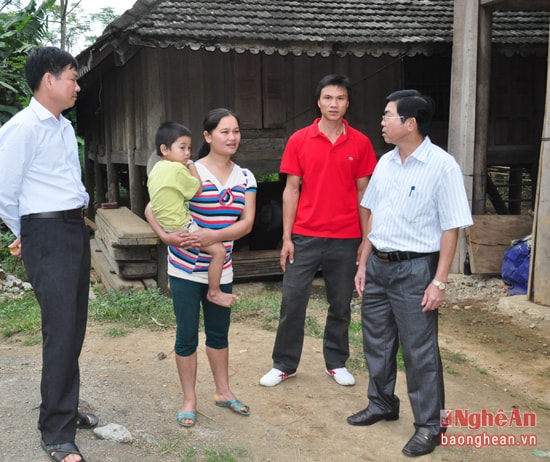 |
| Leaders of Quy Chau district exchanged views and encouraged poor households in Chau Binh commune to strive to escape poverty. |
To address these shortcomings, at its second session, the 17th Provincial People's Council, term 2016-2021, considered, decided, and issued Resolution No. 25/2016/NQ-HĐND, dated August 4, 2016, on a number of mechanisms and policies to support poverty reduction in communes with a poverty rate of 30% or more, in addition to Resolution 30a/2008/NQ-CP, in the province, for the period 2016-2020.
Accordingly, households, workers residing in, and officials and civil servants transferred or assigned to work in 44 communes across 6 districts with a poverty rate of 30% or higher according to the multidimensional poverty approach are eligible beneficiaries of this policy.
Specifically, support of 12 million VND/hectare is provided for unused land with the potential for exploitation through reclamation and restoration for agricultural production; 8 million VND/hectare is provided for land restoration, and an initial subsidy of 1 million VND/hectare is provided for purchasing seeds, materials, and fertilizers to organize production. A one-time subsidy of 1.6 million VND/household is provided to poor households for building livestock shelters.
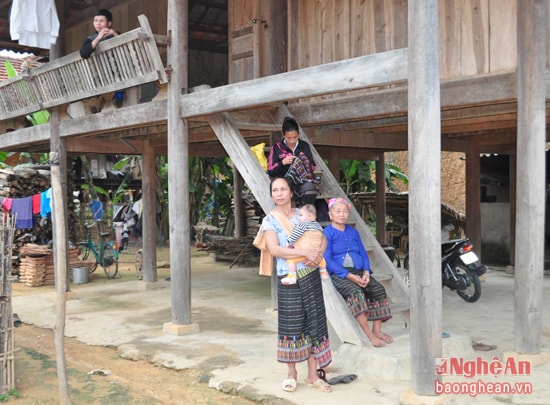 |
| The support policy aims to create opportunities for poor households in communes "near" the 30a program to find employment, improve their living standards, and avoid idleness. |
The policy will also provide one-time support for workers from poor households going abroad for employment, with a maximum support of 6.5 million VND per worker; support for foreign language learning costs, knowledge enhancement, health check-up costs, passport and visa issuance costs, with a maximum of 3 million VND per person; and support for food, accommodation, travel and living expenses during foreign language learning and knowledge enhancement, with a maximum of 3.5 million VND per person.
The policy supports the rotation and assignment of district-level officials and civil servants to assume key leadership positions in poor communes for a period of 3-5 years. This includes an annual allowance of 10 million VND per person in the first year and 7 million VND per person per year from the second year onwards. In addition, these officials and civil servants will retain their salaries, position allowances, other benefits, and staffing at the agency, organization, or unit that assigned them. If the assigned area has higher attraction allowances, regional allowances, or special allowances, they will receive the higher allowance. After the rotation and assignment period, they will be given priority consideration for appointment to suitable leadership and management positions when the agency, organization, or unit has a need.
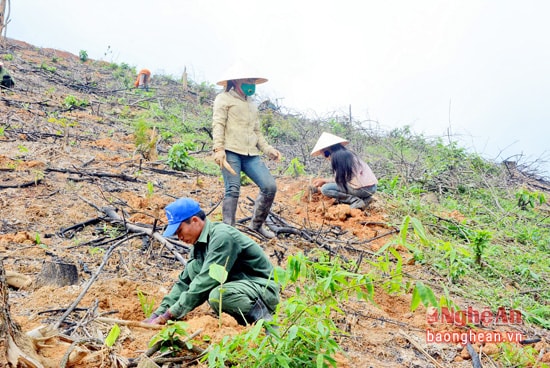 |
| Planting forests for raw materials in the Western region. Photo by Huu Nghia. |
In addition to the specific policies mentioned above, Resolution No. 25 of the Provincial People's Council also clearly stipulates that in these poor communes, existing policies and projects on poverty reduction support under the Government's and the province's poverty reduction programs will continue to be implemented. Priority will be given to allocating investment resources to target groups in these poor communes, focusing on investing in the construction of essential infrastructure, vocational training for rural laborers, agricultural, forestry, and fisheries extension, industrial promotion, and preferential credit from the Social Policy Bank.
Minh Chi


