
Large areas of agricultural land are left fallow in Vinh City.
(Baonghean) - While urbanization is progressing rapidly and infrastructure development is being strongly implemented, a significant amount of agricultural land in Vinh City is being left fallow.
"Inspect and revoke slow-moving projects in Vinh City."
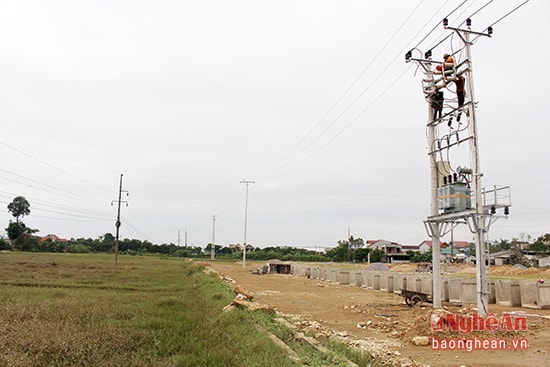 |
| Land in Hung Dong commune is left fallow due to the 72m road resettlement project. |
This season, walking along the fields of the communes and wards of Hung Dong, Hung Hoa, Vinh Tan, Nghi Phu... one can see quite a lot of agricultural land left fallow, overgrown with trees and weeds. Along the intersection of Xo Viet Nghe Tinh and Ho Tong Thoc roads (Nghi Phu commune), there are still many abandoned rice paddies that have been left fallow for many years. The reason is that since the construction of the Xo Viet Nghe Tinh highway, these areas no longer have reliable irrigation. Deeper into the hamlets bordering Nghi Duc commune, there is a considerable amount of abandoned land for winter crop cultivation.
Locals say that previously, several real estate investors came to meetings with residents to register for investment in an urban area, but they have since disappeared. Most of the fields in Hung Dong and Hung Hoa only produce one crop per year, and some areas are completely abandoned. Some areas have been reclaimed for resettlement. Most of this land was previously rice paddy land. It is evident that construction projects are underway on the abandoned land, some are unfinished, and some are planned for urban development.
These factors have resulted in agricultural land here lacking reliable irrigation, or have made farmers hesitant to invest in production. The large sums of money offered by people when their agricultural land is reclaimed have led many to switch professions or deposit their money in banks for interest, further discouraging them from agricultural production. Mr. Nguyen Hung from Hamlet 15, Nghi Phu Commune, said that his family has long since stopped farming. He used the compensation money from the land to buy a truck as his main source of income and to invest in his children's education.
Mr. Vo Hoang Thach, Vice Chairman of the Vinh City Farmers' Association, added: During the period from 2011 to 2016, especially in the last three years, the rate of agricultural land reclamation in Vinh City has been quite strong. In 2016, agricultural land decreased from 4,700 hectares to approximately 4,000 hectares. Agricultural land has been ceded to key state projects for urban beautification, the construction of the 72-meter road from Vinh to Cua Lo, and the 35-meter road from National Highway 46 to the Lam River embankment... Due to infrastructure investment, irrigation and transportation for agricultural production have been disrupted, many areas are flooded during floods, and there is a lack of irrigation facilities.
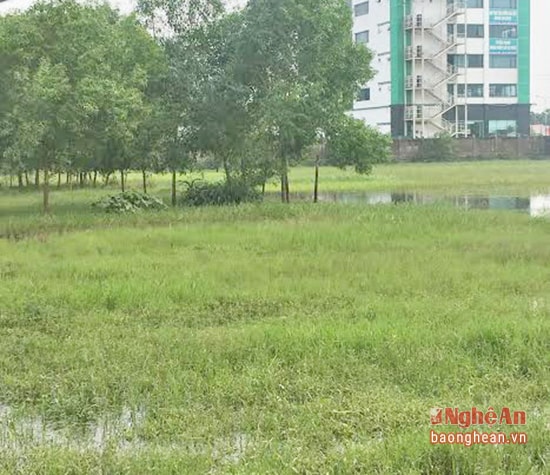 |
| Agricultural land along the Soviet-Nghe Tinh road is being left fallow. |
Over the years, the city has developed agricultural development plans for crops such as vegetables, flowers, livestock, and farms. Many communes are striving to achieve the New Rural Area (NRA) status; however, due to infrastructure investment and a shortage of manpower, agricultural production plans are sometimes disrupted, resulting in inefficient and fragmented production in many communes. Only a few communes, such as Nghi An, Nghi Kim, and Nghi Lien, have developed agriculture to serve the suburban areas, while many others experience unstable production, dependence on weather conditions, and unprofessional practices.
In Hung Hoa commune, due to the environmental impact of the city, low-lying areas are prone to shrimp diseases. In Hung Dong, vegetable production is still affected by the landfill. In Nghi Phu, most agricultural land has been reclaimed for projects, leaving only scattered plots. The same is true in Nghi Duc, where land reclaimed for the 72m road lacks irrigation and is prone to flooding, making rice production precarious. In Nghi Kim commune, the construction of overpasses and Vinh airport has also isolated agricultural land in certain areas.
Currently, the city has a revised land use plan until 2020. For agricultural production in the city to be effective, the application of science and technology is necessary. Land management is being tightened, especially for reserve land and unused land for the development of important urban infrastructure and functional areas in accordance with the plan. In addition, a project to build a resettlement land fund in Vinh City is being implemented to resettle people affected by key transportation projects such as the 35m and 72m roads.
Pearl


