
Numerous apartment building projects are putting pressure on infrastructure in Vinh City.
(Baonghean.vn) - Vinh City currently has hundreds of apartment buildings, but most are low-rise housing, with some projects interspersed within residential areas, lacking social infrastructure and public services.
Currently, in Vinh City, there are approximately 107 projects by businesses investing in urban areas, housing complexes, and apartment buildings, covering a total area of about 1,094 hectares; the total estimated investment is 60,000 billion VND, comprising over 45,000 villas, townhouses, and apartment units (accounting for over 80% of investment projects in Nghe An province).
If we consider only apartment buildings, Vinh City currently has 71 projects with a total of 123 constructions, including 12 projects for the construction of independent apartment buildings. However, the investment scale of these projects is mostly small.
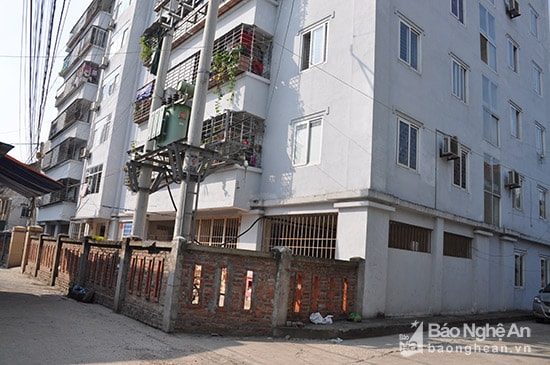 |
| The low-income housing complex in Trung Do ward, Vinh City, built by Trung Do Joint Stock Company, is nestled within a residential area. Photo: Thu Huyen |
Most are low-rise housing or independent apartment buildings, with some projects interspersed within residential areas, lacking accompanying social infrastructure and public services. These include the Trung Duc Shopping Mall and High-End Apartment project; the Nghe An Oil and Gas Building in Quang Trung ward; and the Sao Nghe Commercial Service and Apartment project in Hung Binh ward…
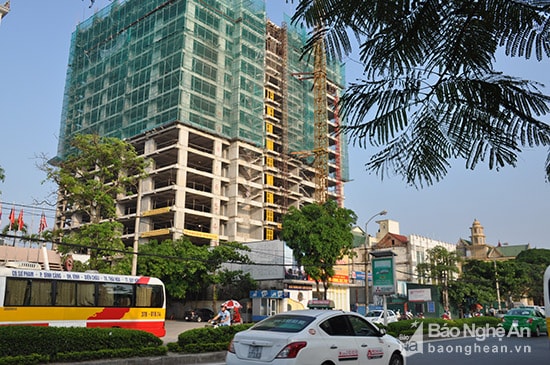 |
| The high-end apartment and commercial building project on Le Loi Street, Hung Binh Ward, Vinh City, by Bao Son Investment, Construction and Tourism Group Joint Stock Company, uses tower cranes near roads, existing residential areas, and public facilities... Photo: Thu Huyen |
Notably, land allocated for housing construction accounts for a large proportion, while planning targets for parking lots, public facilities, cultural institutions, green spaces, and transportation routes are still at minimum levels. This inadequacy is leading to difficulties in constructing infrastructure such as water supply, electricity supply, drainage, public lighting, and green spaces along roads. For example, the housing projects of Vinaconex 9 Construction Joint Stock Company in Nghi Phu commune and Dai Thanh Investment and Construction Joint Stock Company in Trung Do ward...
Some urban areas and residential zones, such as the Hotel Complex, Supermarket for Pharmaceutical and Medical Equipment and Housing Project in Nghi Phu commune by Minh Khang Co., Ltd.; Cua Tien Urban Area… have undergone numerous adjustments during the planning process; these adjustments often involve increasing building density, reducing green space and public areas, thereby altering the original planning objectives and nature.
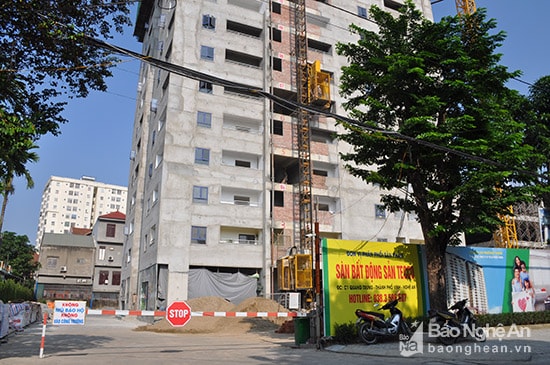 |
| The Truong Thinh apartment complex project on Vo Thi Sau Street, Truong Thi Ward, Vinh City, is developed by Tecco Central Vietnam Company. Photo: Thu Huyen |
Mr. Le Sy Chien, Vice Chairman of the Vinh City People's Committee, said that some investors are prioritizing profit over overall social benefits; they do not conduct thorough research and surveys before investing. Furthermore, the financial capacity of some investors does not match their financial statements, relying mainly on bank loans and capital raised from customers; many businesses lack experience in real estate operations.
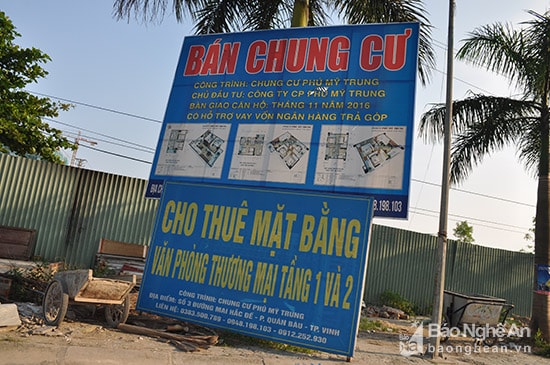 |
| Vinh City currently has many apartment building projects under construction; however, developers are prioritizing profit over overall social benefits. (Photo: Thu Huyen) |
"We propose that the Provincial People's Committee and relevant departments and agencies support the Vinh City People's Committee in requiring investors to comply with regulations on architectural design agreements, landscape lighting, infrastructure systems, and green spaces; and to uniformly apply average planning indicators during the appraisal and approval process of urban development, housing, and apartment projects in the city. It is necessary to gradually limit the investment in the construction of small, scattered apartment complexes without accompanying infrastructure in the inner city; especially the conversion of land use from other purposes to apartment construction if the technical and social infrastructure in the area does not truly meet the requirements," Mr. Le Sy Chien emphasized.
Thu Huyen


