
Many students received hundreds of millions of dong in reimbursement from the health insurance fund.
(Baonghean) - Students participating in health insurance will provide peace of mind for themselves and their families in case of injury or illness. However, many parents are still not fully aware of this.
According to statistics, in the 2015-2016 school year, the entire province had 499,877 out of 544,044 students participating in health insurance (reaching a rate of 91.9%), of which 305,768 students participated in health insurance through their schools, and 194,109 students participated in health insurance under other categories.
Some localities and schools have done a good job of promoting and encouraging students to participate in health insurance, resulting in a high participation rate, such as Vinh City, Cua Lo Town, Nam Dan and Quy Chau districts, and universities, colleges, and vocational schools.
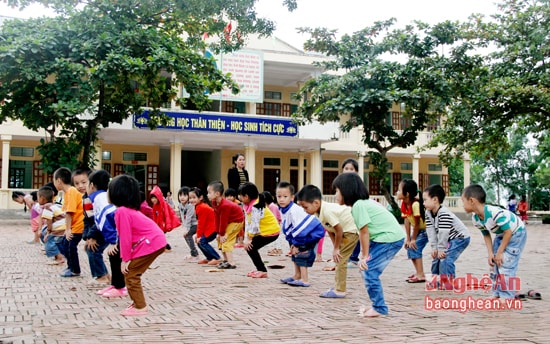 |
| Students at Hop Thanh Primary School (Yen Thanh) during their physical education class. |
Although the results achieved by Nghe An in the student health insurance program are very encouraging, there are still shortcomings, as the participation rate of students in health insurance is uneven across localities, with some districts having very low rates such as Quynh Luu (80.13%), Hoang Mai (78.60%), and Hung Nguyen (80.56%).
In particular, some schools have very low rates of student participation in health insurance, ranging from only 20-40%, such as Cu Chinh Lan Private High School (20.43%), Ly Tu Trong Private High School (26.83%) in Quynh Luu district; Quynh Lien Secondary School (30.95%), Quynh Vinh Secondary School (47.64%) in Hoang Mai town; Hung Yen Secondary School (20.51%), Hung Yen Bac Primary School (22.25%), Hung Yen Nam Primary School (28.64%) in Hung Nguyen district… These are areas with a large Catholic population, many large families, and many disadvantaged families…
In Hung Nguyen district, investigations at several schools revealed that low student participation in health insurance often stems from both subjective and objective reasons. These include reluctance to seek medical treatment using health insurance, the low quality of medical care at the grassroots level, and even the belief that "insured medicine is not as good as purchased medicine." Furthermore, some schools haven't fully engaged in the process, viewing health insurance premium collection as solely the responsibility of the insurance company, with schools merely acting as intermediaries – a completely inaccurate perception.
Mr. Tran Duy Son, Director of the Social Insurance Department of Hung Nguyen district, said: "Most schools with low student participation rates in health insurance are located in areas with a large Catholic population, where people's understanding of health insurance policies is not yet fully grasped."
However, during the awareness campaign, we found that in some cases, school principals believed that health insurance was the responsibility of the Social Insurance sector, which is completely wrong. Because health insurance is mandatory, schools have the responsibility to promote and encourage students to participate in health insurance and to collect health insurance premiums from them. If schools simply leave this responsibility to the Social Insurance sector, they will not be able to achieve high results.”
In reality, wherever the government, departments, and mass organizations coordinate well with the Social Insurance agency in this activity, the health insurance work will see positive changes. Despite being one of the districts with a large Catholic population, Yen Thanh has a relatively high rate of student participation in health insurance (reaching 95%). In particular, some schools have achieved a 100% participation rate for many consecutive years, such as Hop Thanh Primary School and Phu Thanh Primary School…
Ms. Hoang Thi Chin, Director of the Social Insurance Office of Yen Thanh District, said: “Yen Thanh is one of the poor districts with a large population, and the Catholic community often has many children. Therefore, we are always aware that promoting health insurance for children is one of our key tasks. We are fortunate that the Education sector and local authorities have actively participated, setting performance targets for schools and intensifying propaganda through the public address system…”
In communes with a large Catholic population and many families, the commune authorities have coordinated with the district's Social Insurance agency to arrange meetings and discussions with priests to encourage parishioners to understand and take greater responsibility in participating in health insurance. During these awareness campaigns, we used specific examples, such as the case of Nguyen Thi Tan, to demonstrate the significant benefits of participating in health insurance.”
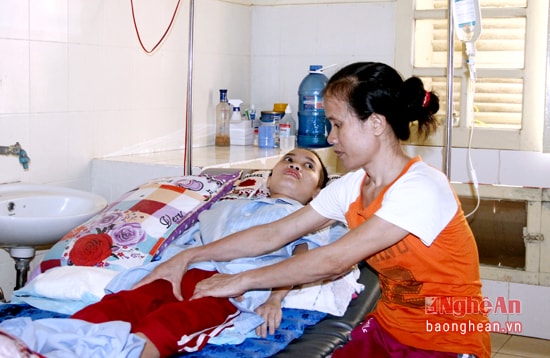 |
| For more than seven months after the accident, Nguyen Thi Tan has been hospitalized. |
It can be said that Nguyen Thi Tan from Nhan Thanh commune is a very special case. In 2015, on her way home from school, she was injured by a buffalo goring her, leading to meningitis. She had to go to many central and provincial hospitals for treatment, which was very expensive; the cost of treatment at the Central Tropical Diseases Hospital alone amounted to over 217 million VND.
Mr. Nguyen Van Binh (Tan's parent) said: "My family isn't well-off, but every year I buy health insurance for my children. Honestly, without health insurance, I don't know how we would be able to afford hospital fees and medication, especially given the current high cost of hospital fees and medicine."
Clearly, the benefits of student health insurance are evident, because not only Nguyen Thi Tan, but also many other students would face significant difficulties for their families in paying hospital fees and medication costs if they did not participate in health insurance. For example, Nguyen Ba Hoc (born in 2007) in Nghi Kieu (Nghi Loc) had over 162 million VND covered by health insurance; Doan Huu Khanh (born in 2005) in Quy Hop town had over 352 million VND covered by health insurance...
Implementing health insurance for students is also a responsibility to ensure the health of the students themselves and subsequently of the community and society. However, for this humane policy to be truly more effective, it requires the joint efforts of the entire political system in disseminating information, mobilizing support, and raising public awareness of health insurance policies; improving the quality of health insurance-covered medical examinations and treatments in collaboration with the social insurance sector; and facilitating the issuance of cards and the handling of health insurance procedures.
Canh Nam


