
Many obstacles exist in the handling of administrative violations.
(Baonghean) - The Law on Handling Administrative Violations came into effect on July 1, 2013, and after more than three years of implementation, many difficulties and shortcomings still remain, significantly affecting state management as well as various aspects of life.
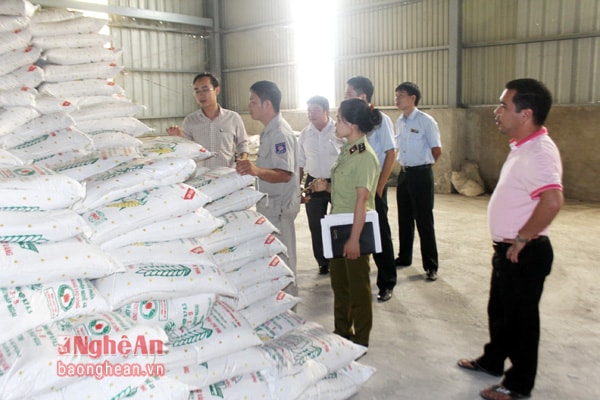 |
| The inter-agency inspection team of the province checked the quality of fertilizers at the fertilizer production plant of Nghe An Agricultural Materials Joint Stock Company. |
Institutional obstacles…
In recent times, the enforcement of laws regarding the handling of administrative violations in Nghe An province has been given significant attention. This has had a positive impact on various aspects of social life, serving as a deterrent and preventive measure against violations, and raising legal awareness among the people.
Statistics show that common violations subject to administrative penalties include: commercial activities, road transport, food safety, medical examination and treatment activities; tax evasion, etc.
Although many forms of violations require administrative penalties, some regulations in the Law on Handling Administrative Violations still have many obstacles, causing difficulties in the implementation process. The Law on Handling Administrative Violations of 2012 and Government Decree No. 81/2013/ND-CP do not stipulate the delegation of authority from the head to the deputy head regarding the temporary seizure of evidence, vehicles, and documents according to administrative procedures, the inspection of transport vehicles according to administrative procedures, and the inspection of places where evidence and vehicles involved in administrative violations are concealed. This leads to the fact that many cases cannot be processed due to the lack of participation from the head.
According to Mr. Vo Quang Lan, Head of the Professional Department (Provincial Market Management Sub-Department), when encountering violations, a vehicle inspection can only be conducted in the presence of the head of the department. However, the head of the department is not always present; when they are absent, attending meetings, or on leave, the deputy head does not have the authority, which can lead to difficulties in conducting vehicle inspections.
Clause 1, Article 126 of the Law on Handling Administrative Violations stipulates: “For seized items and means of transport that are being temporarily detained due to misappropriation or illegal use in committing administrative violations and are subject to confiscation, they shall be returned to the owner, manager, or lawful user. In this case, the individual or organization committing the violation must pay an amount equivalent to the value of the seized items and means of transport into the State budget.”
This regulation is currently causing confusion and difficulties in its practical application because Decree 81/2013/ND-CP and other decrees on administrative penalties in specific fields do not provide detailed regulations or guidance on the procedures and application of this measure. The law also does not define this as a form of punishment or a remedial measure. Furthermore, in practice, most transport vehicles are of high value, and the majority of drivers are employed with low incomes, so they do not have an equivalent amount of money to pay.
According to a representative from the Traffic Police Department of the Provincial Public Security, the regulations stipulate fines for some violations that are higher than the value of the impounded vehicle, so violators do not come to resolve the issue... As a result, many violators have not complied with the penalty decision but instead gone to apply for the re-issuance of the temporarily confiscated documents...
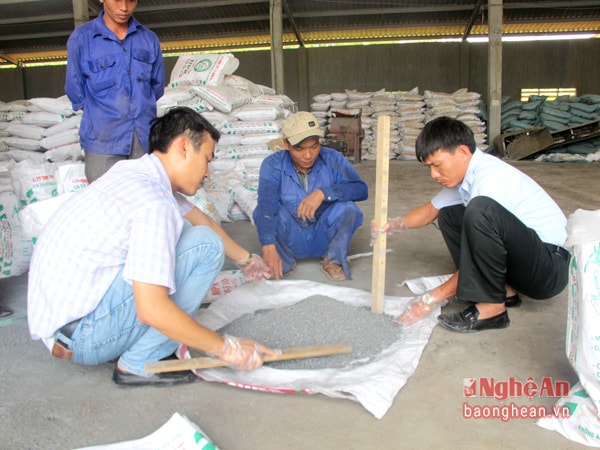 |
| The inspection team took fertilizer samples from the Fertilizer Production and Agricultural Services Plant (Nghe An 1/5 One-Member Limited Liability Company) for quality testing. |
...to implement
According to Mr. Le Ba Thieu, Head of the Department of Inspection, Handling of Administrative Violations and Monitoring of Law Enforcement (Department of Justice), in addition to institutional obstacles, many other difficulties have arisen during the implementation of the law.
One of the crucial conditions for ensuring the enforcement of the law is funding and resources in terms of human resources, infrastructure, and technology. However, currently, the equipment serving professional activities such as inspection, testing, and analysis is insufficient and does not meet the requirements for accuracy and speed, leading to difficulties in inspecting, detecting, and promptly handling administrative violations.
Furthermore, the handling of administrative violations in sectors related to food safety and hygiene, environment, and the economy still has many shortcomings. Government Decree 179/2013/ND-CP restricts the authority of the police force to impose administrative penalties for certain violations of environmental protection laws, but some regulations reduce the effectiveness of the police force's efforts in combating and handling environmental pollution. To identify production and business establishments containing toxic substances, authorities are required to take samples for testing. However, the time it takes to send samples for testing is usually 10-15 days, making enforcement difficult.
According to Colonel Tran Huu Hong, Head of the Environmental Police Department of the Provincial Public Security, sometimes inspectors find the products very dirty and foul-smelling, but testing is mandatory before any action can be taken; during that time, the products must be allowed to circulate on the market. And regardless of the results, consumers suffer significant health consequences if they eat these foods.
According to the Department of Justice, the organizational structure and staffing for the state management of administrative violations at district-level Justice Departments are still insufficient to meet the assigned tasks. With only 3-5 staff members performing over 26 specialized tasks, assigning dedicated staff to intensive research and training in administrative violation management is difficult. Staff at the commune level are insufficient and lacking in expertise, and the heavy workload results in ineffective implementation of this work. Furthermore, the legal staff at departments and agencies are understaffed and have to handle multiple tasks, leading to inadequate investment and failure to achieve the required effectiveness in managing and handling administrative violations.
 |
| Traffic police in Cua Lo town issued a fine to the traffic violator. |
According to Mr. Hoang Quoc Hao, Director of the Department of Justice, in order for the enforcement of laws on handling administrative violations to be effective, competent authorities need to quickly improve the institutional framework for handling administrative violations, adjusting the contents that are still inadequate or problematic in practice to make the handling of administrative violations more effective and contribute to improving the effectiveness of state management.
In addition, relevant ministries and agencies need to organize in-depth training on handling administrative violations, focusing on research, exchange, and proposing effective solutions to address difficulties and obstacles in the practical implementation of laws on handling administrative violations in localities.
| Faced with difficulties in the Law on Handling Administrative Violations, the Prime Minister assigned the Ministry of Justice to lead and coordinate with relevant agencies to research and propose amendments and additions to the Law on Handling Administrative Violations to address the difficulties, obstacles, and inadequacies in the implementation of the law on handling administrative violations; and to develop a Decree amending and supplementing several articles of Decree No. 81/2013/ND-CP detailing some articles and measures for implementing the Law on Handling Administrative Violations. Following the guidance of the Ministry of Justice, the Nghe An Department of Justice compiled and submitted the difficulties, inadequacies, and proposed solutions. |
Nguyen Hung


