
Gaps in the management of reporters and freelance journalists.
(Baonghean) - The proliferation of "representative offices" and resident reporters of industry newspapers, magazines, and online news sites, coupled with lax management, has led to violations in the reporting process and the publication of information...
The "gaps" in management
As one of the four major press centers in the country, in addition to 7 local press agencies, Nghe An has 43 central and sectoral press agencies with representative offices and resident reporters… and hundreds of collaborators operating in the province. Many representative offices and resident reporters operate effectively, helping press agencies to provide objective, truthful, complete, and comprehensive information on current events, politics, economics, and social issues of the locality, making many positive contributions to the socio-economic development of the province.
However, alongside this, there are still some cases of journalistic activity that are like "a rotten apple spoiling the barrel," as mentioned in the previous installment. In reality, it is very difficult to keep track of the number of reporters and collaborators from central and sectoral press agencies operating in the province, as this workforce is constantly changing.
Representative offices usually only register the chief representative, while reporters and collaborators are often contracted by the chief representative on a "seasonal" basis. Some representative offices have dozens of collaborators, who are issued letters of introduction but mainly... to "do advertising work".
Or there are organizations that, although not authorized to issue press cards according to regulations, have "deceptively" issued reporter cards with a design similar to press cards, as in the case of the Knowledge and Development Magazine...
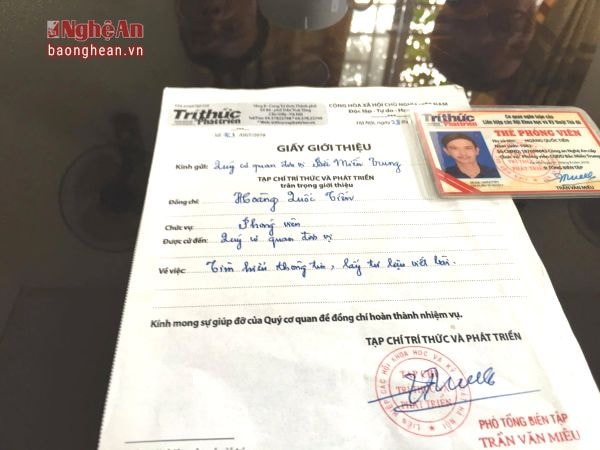 |
| Press card and letter of introduction from the Knowledge and Development Magazine. |
To intimidate institutions and organizations, reporters and collaborators are often introduced as "investigative reporters" or "investigating wrongdoings based on reader complaints," such as the case of Tri An online magazine issuing a "investigative reporter" introduction letter to reporter PVH; and the Vietnam Law Newspaper online issuing introduction letters to reporters to "verify information on financial and social insurance irregularities occurring at the unit over a long period"...
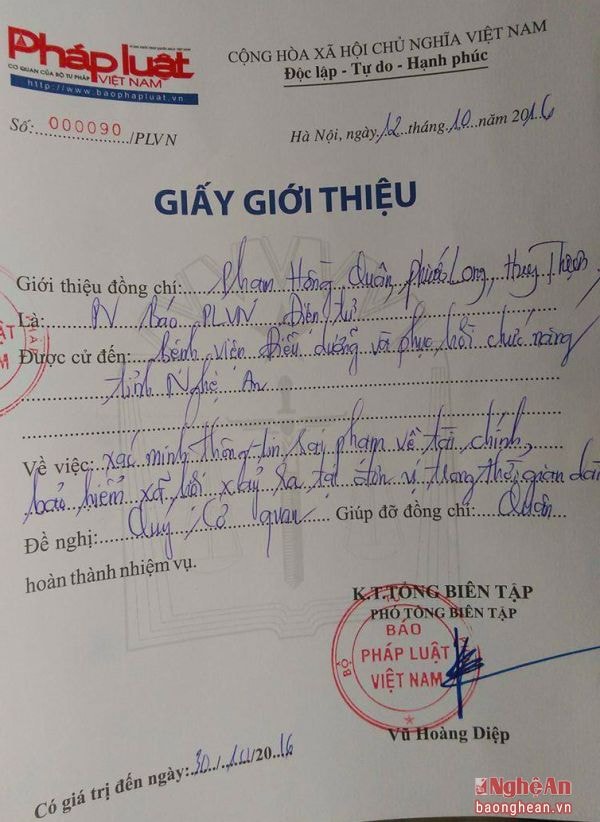 |
| A letter of introduction from the Vietnam Law Newspaper was sent to "verify information regarding long-term financial and social insurance irregularities at the unit" at the Nghe An Rehabilitation Hospital. The letter listed three people, but the section requesting "assistance from your agency" only listed one. Some believe that the original letter of introduction only referred one person, but "someone" later arbitrarily added two more. |
According to the Press Law, “The Government uniformly manages the state administration of the press; the Ministry of Information and Communications is responsible to the Government for implementing state administration of the press; the People's Committees at the provincial level, within their duties and powers, are responsible for state administration of the press in their localities.” The Department of Information and Communications is a specialized agency with the function of advising and assisting the Provincial People's Committee in state administration of the press in the province.
However, in reality, managing local press remains challenging. Mr. Nguyen Ba Hao, Deputy Director of the Department of Information and Communications, stated: “Currently, there is a situation where representative offices independently recruit collaborators and probationary reporters, then issue letters of introduction. Some graduates apply for probationary positions, interning for one newspaper this month and another the next, but some media outlets still issue letters of introduction for these individuals to work at various locations. Some media outlets, when changing their representative reporters, are required to notify the Department of Information and Communications 5 days in advance, but very few comply. Some newspapers publish inaccurate information, and the Department of Information and Communications and the Provincial People's Committee have requested relevant media outlets to correct the information, but they are slow or even fail to do so.”
Furthermore, Nghe An province has over 2,000 domain names, with hundreds of websites registered within the province. However, some operate in violation of regulations regarding the management, provision, and use of information on social media websites. Some personal websites have domain names that are easily confused with those of official news agencies. These online news aggregators also independently produce news articles, sending staff to localities, organizations, and businesses to gather information for articles, just like news agencies, causing confusion and eroding trust among local authorities, organizations, and readers.
Recently, the Department of Information and Communications proposed the closure of the website tinnghean.net, which was previously the website with the domain names tintucnghean.vn and ngheannews.vn, and was temporarily suspended for 45 days according to Official Letter No. 811/VNNIC dated September 21, 2016, from the Vietnam Internet Center.
This situation arises because some "reporters" understand that agencies, organizations, and businesses often show deference or reluctance to confront the press; some establishments or officials make mistakes, which the "reporters" become aware of, leading to "bargaining." In addition, many media outlets establish representative offices and assign resident reporters to local areas but do not comply with the regulations in Circular No. 13/2008/TT-BTTTT dated December 31, 2008, of the Ministry of Information and Communications guiding the establishment and operation of representative offices and resident reporters in the country; they neglect management, fail to educate resident reporters and collaborators on ethics and conduct, and lack strict management and supervision regulations... thus easily giving rise to negative behaviors, violations of the law, causing public outrage, and negatively impacting the reputation and prestige of genuine journalists.
Strict action is needed.
In response to this situation, on September 28, 2016, Deputy Minister of Information and Communications Hoang Vinh Bao signed Document No. 3366/BTTTT-CBC addressed to press agencies, requesting them to inspect, review, and rectify the issuance of documents and cards that could be confused with press cards.
The document states: Recently, there have been instances of many reporters and collaborators of media outlets using documents and cards that are easily confused with press credentials. There have been numerous cases of using these documents and cards to contact businesses, solicit advertising, causing inconvenience to agencies, organizations, and businesses, and negatively impacting the honor and professional reputation of journalists operating in accordance with the law. Media outlets are required to ensure that letters of introduction for reporters on assignment comply with regulations, clearly stating which agency or organization they are working with, the content of the assignment, and the specific timeframe.
 |
| Illustrative image |
In the coming period, the Ministry of Information and Communications will coordinate with the Departments of Information and Communications of provinces and centrally-administered cities and other relevant agencies to strictly handle cases of violations of professional regulations and the use of journalist cards.
On October 24, 2016, the Department of Broadcasting, Television and Electronic Information sent a document to the Departments of Information and Communications of provinces and centrally-administered cities, as well as organizations and businesses that have established comprehensive electronic information websites, requesting them to improve the effectiveness of these websites.
This document also clarifies that: In recent times, a significant number of general news websites have committed serious violations such as operating outside the scope of their granted licenses, and not complying with regulations on general news websites... Organizations and businesses are required to strictly adhere to the regulations on information sources in Decree 72 regarding information aggregation: They are not allowed to independently produce news articles like online newspapers or magazines.
Strictly handle violations, especially those involving activities not in accordance with the granted license, the misuse of general information websites to operate as online newspapers or magazines, and the impersonation of websites of press agencies, organizations, or individuals for personal gain...
At the briefing conference on November 1st, Minister of Information and Communications Truong Minh Tuan also noted that agencies and businesses need to be more proactive in providing information to the press. And when cases are handled and resolved, they must also provide information to the press so that newspapers can publish it for the public to know, thus ensuring transparency.
At the same time, the Minister also requested the Press Department to coordinate in strictly handling violations of press regulations and to intensify the review of press agencies that are not operating in accordance with their stated purpose in order to rectify the situation.
To prevent such situations from occurring, agencies and units need to raise their vigilance, promptly detect and report acts of exploiting the name of journalists and reporters of media organizations for personal gain, and violations in the activities of representative offices, resident offices, and resident reporters of media organizations. But most importantly, the Department of Information and Communications needs to effectively fulfill its role as the agency assisting the Provincial People's Committee in managing state affairs related to the press in the province; it must preside over or coordinate with relevant agencies to strictly handle violations committed by those who exploit the name of journalists and reporters of media organizations to commit illegal acts in the province.
| Regulations on the establishment of representative offices and resident reporters of press agencies (excerpt from Article 22, Law on Press) + Conditions for establishing a representative office include: Having a suitable location for the representative office; the head of the representative office must possess a journalist's card issued by the media agency where the representative office is located and must not have received any disciplinary action ranging from reprimand upwards, as stipulated by the law on civil servants and labor laws, within the one year prior to establishing the representative office. + Independent resident reporters must possess a press card issued by the media agency that assigns them and must not have received any disciplinary action, from reprimand upwards, in accordance with the laws on civil servants and labor laws within the one year prior to their assignment. +The following documents are required: a list of personnel at the representative office; a resume and a copy of the press card of the head of the representative office; and a resume of the resident reporter of the representative office, certified by the press agency or a copy accompanied by the original for verification. + The activities of representative offices and resident reporters must be consistent with the principles and objectives of the press agency; fulfill the duties, powers, and responsibilities assigned by the press agency; and comply with the laws on journalism and other relevant laws... |
Reporters
| RELATED NEWS |
|---|


