
Billionaire farmers in Quy Hop
(Baonghean.vn) - With a daring spirit and willingness to act, many members of the Quy Hop District Farmers' Association have boldly invested in developing successful business models over the years, becoming exemplary figures in achieving economic success.
Becoming a billionaire thanks to orange trees.
A prime example is the household of Mr. Huynh Quang Trung in Minh Kinh hamlet, Minh Hop commune. Previously, his family had tried many different jobs, but life was not very stable. Finally, he decided to dedicate himself to farming. After leasing 5.5 hectares of land in 2004, and receiving a 40 million VND loan from the Agricultural and Rural Development Bank of the district, along with his family's own capital, Mr. Trung boldly developed a model of orange cultivation. With hard work and experience, by 2008, the first harvest yielded a profit of 60 million VND after deducting expenses. In 2009, the profit increased to 180 million VND, and by 2010, his family had earned a profit of 500 million VND.
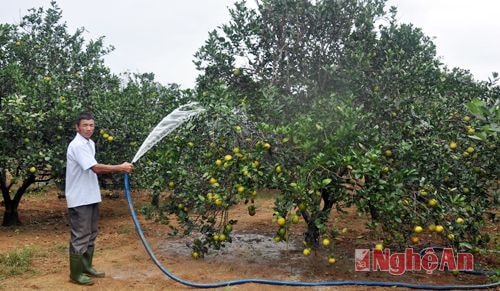 |
| Mr. Huynh Quang Trung is tending to his orange orchard, which is nearing harvest time. |
From their accumulated annual capital, in addition to expanding into sugarcane cultivation and fertilizer supply, and recognizing the strong growth of orange cultivation among people in the commune and surrounding areas, while the supply of seedlings was limited, in 2011 his family expanded their model into grafting orange varieties to both serve their own family and sell to other farmers.
With an initial investment of 225 million VND and selling 30,000 seedlings in two batches at 20,000 VND per seedling, his family earned 600 million VND, resulting in a net profit of 375 million VND after deducting expenses.
Mr. Trung also stated that, after deducting expenses, the profit from oranges was over 600 million VND, from sugarcane 140 million VND, and from the nursery and fertilizer services over 400 million VND. In total, his family earns over 1 billion VND per year.
Focus on the farm model.
Similarly to the Huynh Quang Trung family, in 2012, after being leased 2 hectares of land in the hilly area of the commune by the government, plus more than 2 hectares of land leased from local people and his own family, Mr. Phan Dinh Hieu, from Quang Vinh hamlet, Chau Quang commune, mobilized all resources to invest over 1 billion VND to develop a livestock farming model.
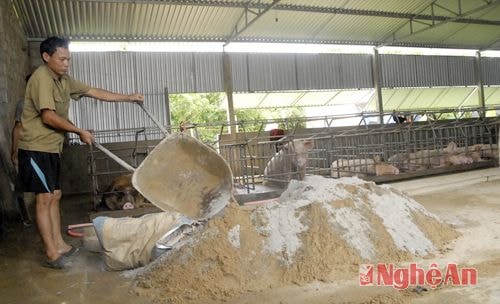 |
| Mr. Phan Dinh Hieu is renovating his livestock farm to further expand his animal husbandry. |
On an area of over 3000m2, he invested in building a solid system of livestock pens, including pig pens, cow pens, and chicken coops. At its peak, he raised nearly 20 sows, 250 fattening pigs, 20 cows, and over 300 chickens… In addition, utilizing the waste from livestock farming, he dug a 2000m2 pond for fish farming, and planted fruit trees such as bananas, guavas, and elephant grass around the pond to feed the cows. Every month, his family has livestock ready for sale, so after deducting expenses, he earns 500-600 million VND per year.
Not only Trung and Hieu's families, but currently, with the development orientation of distinctive models, focusing on building farm-based economic models, many farmers in Quy Hop district have succeeded with various types of farming, from crop cultivation to livestock breeding, earning incomes from 150 million to over 1 billion VND per year.
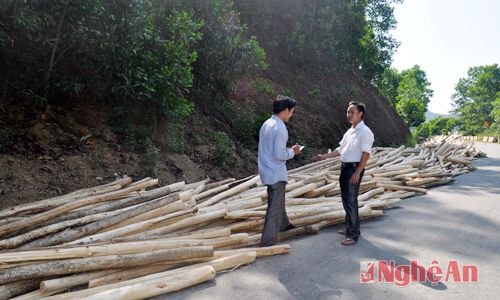 |
| Many members of the Chau Thanh Commune Farmers' Association also earn a significant income from planting acacia trees. |
Speaking with us, Mr. Nguyen Quy Hung, Chairman of the Quy Hop District Farmers' Association, said: The results from 42 economic models implemented by association members have made a positive contribution to poverty reduction in the area, creating jobs for over 100 local workers with an average income of 3 million VND per person per month. However, to ensure the sustainable development of these farmers' farm models, Mr. Hung expressed concern that, both in the short and long term, it is necessary to form inter-regional commodity production zones; banks should facilitate long-term loans for households, ranging from 5 to 7 years. In addition, besides organizing training on the application of science and technology and professional management skills, the farms need a product distribution system to prevent price manipulation during bumper harvests.
Dang Nguyen
| RELATED NEWS |
|---|


