
Mistakes to avoid when driving an automatic car.
Using both feet to operate the accelerator and brake, or failing to use semi-automatic gear when descending a hill, are dangerous mistakes when driving an automatic car.
Automatic cars have the advantage of being much simpler to operate than manual cars, due to the elimination of the clutch pedal. Drivers only need to focus on the accelerator and brake pedals; "get in the car and press the gas pedal" to drive, without worrying about stalling or shifting gears.
However, because of this advantage, many drivers of automatic cars become complacent or "lazy," not fully utilizing the design features. Below are some dangerous mistakes to avoid when driving an automatic car.
1. Use both feet
While manual transmission cars require drivers to use both feet, automatic transmission cars only require the right foot to control both the accelerator and brake. Many people, however, find their left foot unnecessary and, for convenience, use both feet – right for the accelerator and left for the brake. This is actually a mistake that needs to be corrected, as it can lead to many dangers.
 |
The accelerator and brake pedals should be positioned directly under the right foot, ensuring the most stable and secure driving posture. Trying to reach the brake pedal with the left foot can cause the driver to twist their body, damaging the spine and resulting in an unstable driving position and increased fatigue.
More importantly, using both feet in unexpected situations can cause drivers to frantically press both pedals. Because of the high throttle, the braking effect is greatly reduced, preventing the vehicle from stopping as intended, leading to a "runaway car" situation.
In reality, there are drivers who use both feet to control an automatic car, but these are race car drivers or those with special skills. There, they need to optimize acceleration and deceleration, and accelerate back smoothly. But only those who have been professionally trained for racing can do this proficiently, and only on a race track, not on public roads.
2. Do not switch to the brake pedal when releasing the accelerator.
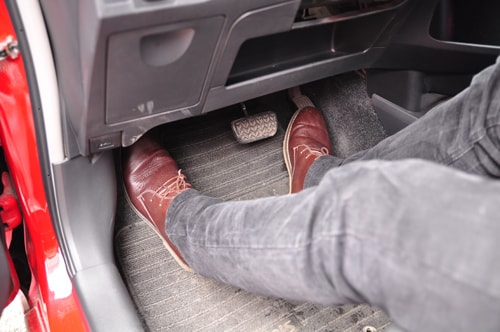 |
Also related to the use of the right foot, many drivers, due to laziness, leave their foot on the accelerator pedal instead of the brake pedal. The safety principle is "if not accelerating, then braking," so if you're not accelerating, immediately move your foot to the brake pedal. If you keep your foot on the accelerator, in a dangerous situation, the driver's reflex will cause them to press the pedal forward, and the car won't stop as expected but will lurch forward due to the sudden acceleration. This is also a major cause of reckless driving incidents today.
This bad habit is dangerous even when driving a manual transmission car. However, while manual transmission cars have a clutch pedal to help disengage the transmission, manual transmission cars lack this feature, increasing the danger many times over.
3. Do not use sports numbers.
Sport mode, manual mode, and semi-automatic mode are common terms for the manual gear shifting feature on automatic transmissions. In this mode, the car doesn't automatically shift up based on speed; instead, the driver manually shifts gears according to their needs and preferences.
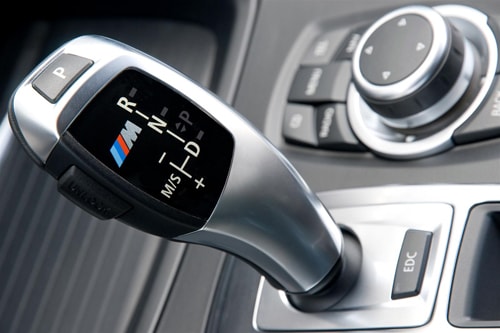 |
This mode is usually indicated on the gear lever with symbols +, -, or M1, 2, L1, L2... In sports cars or luxury cars, and even many mainstream cars today, there is more convenience in integrating paddle shifters on the steering wheel. Aside from the driver's preference for controlling gear changes, manual shifting is often used when overtaking other vehicles or going downhill.
When climbing a hill, the car automatically shifts gears to ensure sufficient traction and speed. However, when descending a hill, due to the car's rapid acceleration by inertia, the gearbox will shift to a higher gear, thus losing the ability to use engine braking. At this point, to ensure the car descends the hill at a safe speed, the driver must manually shift to gears 1, 2... to suit the slope and length of the hill to a safe level.
Without using a manual transmission, drivers are forced to rely heavily on the brakes to slow down. However, braking alone cannot be as smooth and consistent as engine braking. Furthermore, subjecting the brakes to continuous, harsh conditions for extended periods can cause brake failure and render the hydraulic system ineffective.
However, not every slope requires switching to this mode. Drivers need to consider the slope, the length of the slope, and the vehicle's operating condition to decide whether or not to use it.
According to VnExpress
| RELATED NEWS |
|---|


