
Accidents that occur when customers test drive cars in Vietnam.
The cramped test drive space, the advanced technology in new vehicles, and customers lacking sufficient skills are the reasons why accidents occur.
The rapid growth of the Vietnamese automotive market has also led to increasingly fierce competition among manufacturers. Customers, especially young people, no longer buy cars based solely on word-of-mouth recommendations as before. Everyone wants to test drive a new car before deciding whether or not to buy it.
Recognizing this trend, manufacturers are increasing the number of test drive programs. Besides having vehicles readily available at dealerships for customers to test drive during visits, they are also organizing centralized test drive events with intensive exercises and expert training from the manufacturer. However, alongside the effectiveness in marketing and promoting the vehicles, an undesirable consequence is test drive accidents.
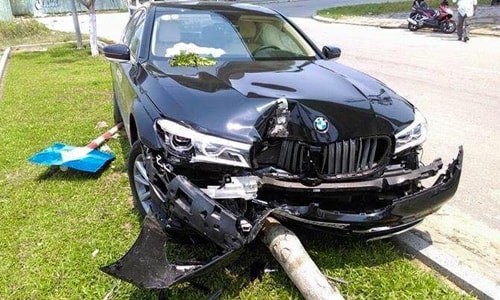 |
A BMW 7 Series was severely damaged at the front while a customer was test-driving it in Da Nang. Photo: Pham Dinh Khanh. |
To date, Vietnam has recorded numerous cases of customers being involved in accidents while test driving cars, but fortunately, all drivers escaped injury, only their vehicles were damaged. In 2012 at the Vietnam Motor Show in Hanoi, a Civic and a Focus collided due to a driver mistaking the accelerator for the brake. Following that, there were several isolated incidents, such as a customer driving a Mercedes crashing into a wall in Long Bien (Hanoi), and a customer driving an old BMW plunging into the To Lich River.
Recently, accidents have been occurring at large-scale events. The first was a Mini test drive in Long Bien. During a practice maneuver involving sudden steering and applying the handbrake, a driver lost control and crashed into the median barrier, stunning the passenger and damaging the front of the car.
In late March, Porsche held its first World Roadshow in Vietnam, featuring instructors from Germany. Those participating were potential customers who received invitations from the company; registration was not open to the general public. However, during the public road driving test, a customer lost control of their Porsche Cayman GTS and crashed into a water tanker, causing the passenger airbag to deploy and damaging one side of the car. The driver was unharmed.
Most recently, on the afternoon of April 10th in Da Nang, a customer test-driving a BMW 7 Series lost control, crashing into a tree and a signpost, causing significant damage to the front of the car. Fortunately, the driver was not injured.
The cause of these accidents is always attributed by the drivers to losing control of the vehicle. Customers participating in a test drive program register, present a valid driver's license, and sign a waiver. The content of most waivers relates to safety principles, such as requiring test drivers to follow the arrangements and instructions of the company's staff, or stating that the company is not responsible for personal injuries unless the accident is caused by a vehicle malfunction.
In reality, most accidents cause damage to the vehicles, but the participants in the test drive remain safe. Customers also don't need to worry about vehicle damage, as the vehicles used for testing are insured, and the insurance company will cover the repair costs.
A representative from a German luxury car brand organizing a test drive program in Vietnam stated that many participants had recently obtained their driver's licenses, or had licenses a long time ago but had never owned a car or driven in real-world situations. Therefore, when faced with challenging exercises in unfamiliar vehicles with advanced technology, they lacked the experience to control the accelerator and steering wheel effectively, leading to accidents.
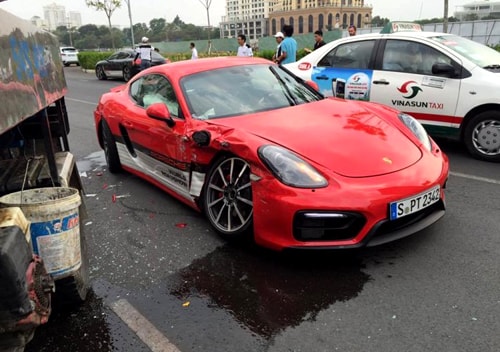 |
The Cayman GTS was involved in an accident while driving on a public road. Photo: Xebiz. |
Besides subjective factors from the driver, this expert also believes that the infrastructure conditions in Vietnam are a drawback. When organized in other countries, the chosen location is always a race track or an isolated area built with dedicated lanes. These locations are far from public traffic and have ample space, helping to minimize serious consequences even if a driver loses control.
In Vietnam, it's different; the venues are often spacious areas in new urban developments like Long Bien (Hanoi) or Phu My Hung (Saigon). However, the roads there aren't designed for testing vehicles, leading to a constant risk of accidents. For example, accelerating at full throttle on narrow urban roads feels terrifying and much harder to control than accelerating on an open race track.
The companies stated that if better track conditions were available, such as the newly constructed racetrack in Long An, combined with stricter screening of participants in test runs, unnecessary accidents could be minimized.
According to VNE
| RELATED NEWS |
|---|


