
The pain of a false pregnancy
For various reasons, some women experience false pregnancies. According to doctors, whatever the reason, they are more to be pitied than blamed.
Absolutely refused to allow an ultrasound.
"The image of a 40-year-old woman with tears streaming down her face and her voice breaking because she found out she had a fake pregnancy broke my heart," said Dr. Bui Thanh Van, Head of the Outpatient Department at Tu Du Hospital (Ho Chi Minh City).
Dr. Vân recounted: “The woman in question, named H., lives in Ho Chi Minh City. After 10 years of marriage, she and her husband still had no children, despite seeking treatment in many places. Following advice from a neighbor, she traveled to the Mekong Delta to seek treatment from a traditional healer.”
After giving Ms. H. the medicine, the "healer" instructed her not to go to the hospital for prenatal checkups, ultrasounds, or hormone tests because any contact with her by a doctor would cause the pregnancy to fail. "Four months later, Ms. H. felt signs of 'fetal movement' and was overjoyed, telling everyone. She prayed and thanked God and Buddha for letting her meet this skilled 'healer.' Following the 'healer's' advice, she didn't set foot in the hospital for a prenatal checkup," Dr. Vân said.
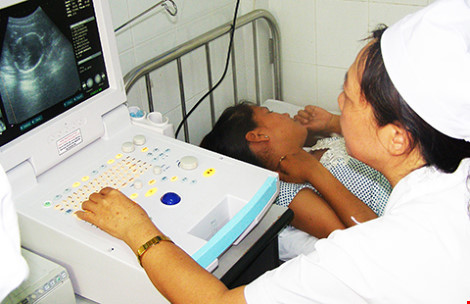 |
| Many women mistakenly believe they are pregnant, only to discover they have a false pregnancy upon ultrasound (illustrative image). Photo: TRAN NGOC |
A few days later, Ms. H. experienced bleeding and reluctantly went to the hospital. However, she only asked the doctor for medication and absolutely refused to have her abdomen touched. “I explained everything to her, but Ms. H. wouldn’t allow a pregnancy test or an ultrasound. Only then did she clearly recount the story about the traditional healer. I requested that Ms. H. be admitted to the hospital for both health monitoring and to determine the pregnancy,” Dr. Vân said.
The next day, Dr. Van suggested that Ms. H. call the "healer" to tell him she was pregnant. She also asked for the doctor's permission to examine the fetus to see how it was developing. Hearing Ms. H. say she was pregnant, the "healer"'s voice brightened considerably. After saying, "The medicine I gave you is very effective," the "healer" agreed to let the doctor examine Ms. H.'s pregnancy.
“I performed an ultrasound and hormone tests, but no fetus was detected in the uterus. Without letting me fully explain the situation, Ms. H. started yelling and blaming the ultrasound machine for being wrong. Ms. H. even claimed that I wanted to abort the fetus in her womb and had fabricated the story,” Dr. Vân recounted.
“After listening to my detailed explanation, Ms. H. gradually regained her composure. Suddenly, she covered her face and cried, saying that her family happiness was in danger of falling apart because her husband's family was convinced she was pregnant. As a mother of two, I sympathized with Ms. H.'s pain. I comforted her, and tears flowed down my face as well,” Dr. Vân said softly.
Because I loved my husband so much.
Besides women who fake pregnancies due to their excessive faith in the "miracle cures" of traditional healers, there are also women who want to fake a pregnancy to save their husband's reputation.
Dr. Vân recounted: “Ms. T., 30 years old, lives in Dong Nai. After four years of marriage, her house was devoid of the babbling of children. She constantly heard harsh words and criticism from her husband's family. Thinking the problem was with her, Ms. T. went for a check-up, but the results were normal. Meanwhile, her husband had no sperm.”
Out of love for her husband, Ms. T. wanted the doctor to keep the information confidential. She even suggested that the doctor give her husband medication, then conduct tests and announce that his sperm was normal so that he wouldn't feel ashamed. However, the doctor couldn't fulfill Ms. T.'s request. I asked, "For example, if the doctor does as you requested and announces that your husband still has normal sperm, but you can't get pregnant, how will you explain that to your husband's family?" Ms. T. sobbed for a while before saying resolutely, "I will fake a pregnancy, whatever happens, happens." Because she didn't want her husband to be ashamed, Ms. T. accepted the disadvantage herself. Ms. T.'s situation is more pitiable than blameworthy, Dr. Van shared.
"I advise Ms. T. and her husband to face the truth so that she avoids being accused of 'deceiving' her husband's family later on. If she wants to have children, Ms. T. can still apply the in-vitro fertilization method," said Dr. Van.
Morning sickness symptoms are real.
Having worked in the obstetrics field for many years, Dr. Nguyen Ngoc Thong, Director of the Ho Chi Minh City Reproductive Health Care Center, said he has encountered many women who are not pregnant but claim to be pregnant and exhibit symptoms of morning sickness. "This is called pseudopregnancy (also known as imaginary pregnancy). It's essentially an unconscious imitation by the woman experiencing pseudopregnancy of a real pregnancy," Dr. Thong explained.
According to Dr. Thong, married women experiencing infertility often fall into a state of pseudopregnancy due to their intense desire to have children, coupled with negative public opinion from various sources, creating immense psychological pressure. This psychological impact causes abnormal changes in the endocrine system of infertile women, leading to symptoms that easily give the impression of pregnancy. "After confirming they are not pregnant, women experiencing pseudopregnancy often feel disappointed, even unwilling to accept the reality. However, all hormonal changes in the body will eventually return to normal," Dr. Thong noted.
False pregnancy is also known as pseudocyesis. According to the International Classification of Diseases, 10th Edition (ICD10), false pregnancy is classified as a mental disorder. The Institute of Mental Health (Vietnam) once treated a woman diagnosed with pseudopregnancy after 10 months of pregnancy without giving birth. The patient was diagnosed with pseudopregnancy hysteria and was cured through psychotherapy. According to US data, in the 1940s, the incidence of this condition was approximately 1 in 250 pregnant women. This rate is declining sharply, currently around 1-6 in 22,000 pregnant women. More than two-thirds of those affected are married, and one-third have been pregnant at least once. After experiencing a false pregnancy, the woman and her husband should go to hospitals with infertility departments for counseling and guidance on treatment options. This will help reduce the woman's psychological burden. Dr. Nguyen Ngoc Thong, Director of the Care Center Reproductive health in Ho Chi Minh City |
According to Online Law
| RELATED NEWS |
|---|


