
Concerns about agricultural product consumption: A planning and management challenge.
(Baonghean) - In agricultural development, the government's guiding principle is to enhance the value chain of agricultural products, creating a closed loop from cultivation and livestock farming to processing and consumption. However, there are still many uncertainties regarding planning management and the connection between production, processing, and consumption.
"A bad harvest is fatal, but a good harvest is also fatal!"
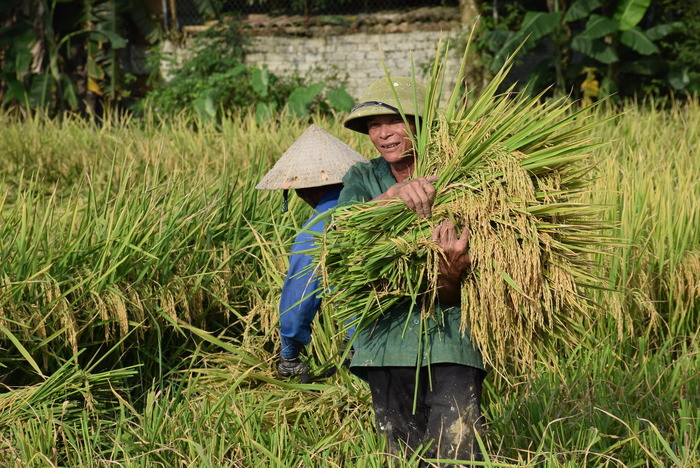 |
| Farmers in Yen Thanh district harvest the spring rice crop. Photo: Xuan Hoang |
"Lax" in management
With the application of technological advancements, many types of crops and livestock have been identified as key drivers for the development of agricultural and rural economies. Basically, all of the province's major crops, such as oranges, sugarcane, cassava, peanuts, and rice, have been planned according to specific regions. In addition to rice cultivation, which is determined based on the available land and targets set by the central government, the remaining crops are calculated based on climatic and production conditions. Livestock such as buffaloes, cattle, pigs, and poultry are also included in annual plans, with their scale determined accordingly.
Diversifying crops and livestock is essential to meet market demands and increase production value. This further requires strict planning management. However, in reality, many localities are unable to manage planning effectively. This is one of the reasons why the situation of "supply exceeding demand" frequently occurs, both for national products such as rice, meat, and peanuts, and for local products such as vegetables.
Explaining this issue, Mr. Nguyen Van Lap, Deputy Director of the Department of Agriculture and Rural Development, shared: “For national-level products, the surplus is often not due to bumper harvests or overproduction exceeding planned targets, but depends entirely on the market and production in other localities. For example, with pork and pork products, many localities have been raising pigs in large quantities recently, coinciding with the control of informal exports to the Chinese market, leading to a surplus… As for local-level products, the surplus is mainly temporary, occurring during peak harvest seasons such as vegetables, chili peppers, carrots, tomatoes, shallots… For these products, each locality has specific plans for the area allocated to each type of vegetable, but it is not uncommon for farmers to “follow” the trend, producing excessively, exceeding the planned targets for products that had good harvests and prices the previous year, leading to periods when the amount of goods produced is too large.”
Clearly, the planning and organization of production according to the plan have not met expectations. The main reason is that people, seeing immediate profits, have arbitrarily invested in production and livestock farming that deviates from the plan, such as cassava, oranges, and poultry. The most worrying aspect is that this rapid development leads to a lack of strict control over plant and animal breeds; or farmers do not consider the climate and weather conditions of each region, resulting in low yields. A prime example is Nghia Dan district, where in recent years, farmers have been massively planting guava and oranges, with many families even clearing large areas of rubber trees to plant oranges. According to statistics from the Nghia Dan District Department of Agriculture, in just the last three years, the total area of guava in the district has reached nearly 100 hectares and about 700 hectares of oranges. These areas of orange and guava cultivation are entirely spontaneous and lack any planning.
Mr. Lam Van Thang, Head of the Agriculture Department of Nghia Dan District, expressed his concern: “When a few households earn high incomes from guava trees, many households rush to plant them. Currently, although we don't need to 'rescue' them like some other crops and livestock, with the rapid expansion of guava and orange cultivation areas, I fear that at some point, supply will exceed demand, and we will face the same 'rescue' situation as with pigs, ducks, and shallots…”
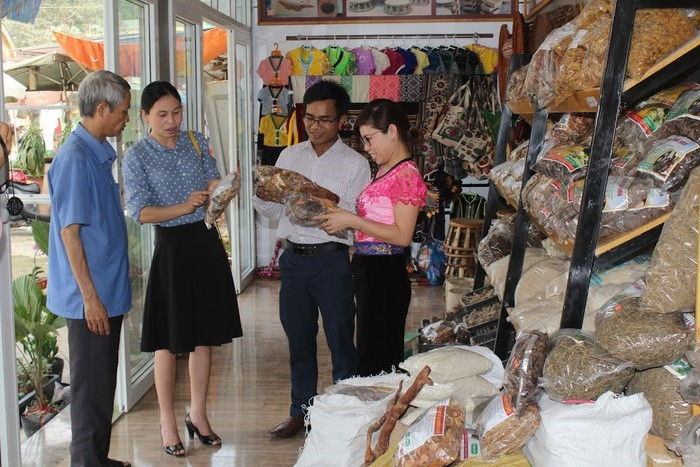 |
| A stall helping local people sell their agricultural products in Que Phong district. Photo: Nguyen Son |
Mr. Le Trung Kien – Vice Chairman of the People's Committee of Nghia Lam commune (Nghia Dan district) added: “In recent years, due to the sharp drop in rubber prices, many households have spontaneously cut down rubber trees and switched to planting oranges and guavas, without following the local direction or planning. Recently, the commune government has advised people to choose suitable land and seedlings to ensure efficiency and not to plant indiscriminately, but many households did not listen. The government also cannot order or force them to plant certain crops on the land allocated to them…” This is also a common situation in many other localities. A costly lesson for many households in Tan Ky district is that a few years ago they rushed to plant small-scale rubber trees. Then, low rubber prices for several years and a lack of connection with purchasing units led many households to cut down their rubber trees after only 1-2 years of harvesting.
Lack of connection between production and processing.
While the management of crop and livestock planning in the province remains lax, the linkage between production and processing has not yet met the requirements. For example, rice, one of the province's main products, despite a planned area of over 186,000 hectares with a production of more than 1 million tons per year and projected yields increasing year after year thanks to the application of new varieties and efficient farming techniques, still lacks any large factories or facilities to guarantee the purchase of the product.
According to estimates, more than half of the province's rice production is sufficient to ensure food security for the entire year. The remainder is either sold on the market, used for making cakes and noodles, or for animal feed, except for some areas where Vinh Hoa Science and Technology Co., Ltd. (Yen Thanh) has committed to purchasing the seeds they provide to farmers, but this area is still too small. In this sector, Nghe An Agricultural Materials Joint Stock Corporation and some companies in Thai Binh and Thanh Hoa provinces also operate, but mainly provide input services, only committing to a very modest portion when selecting and purchasing rice seeds.
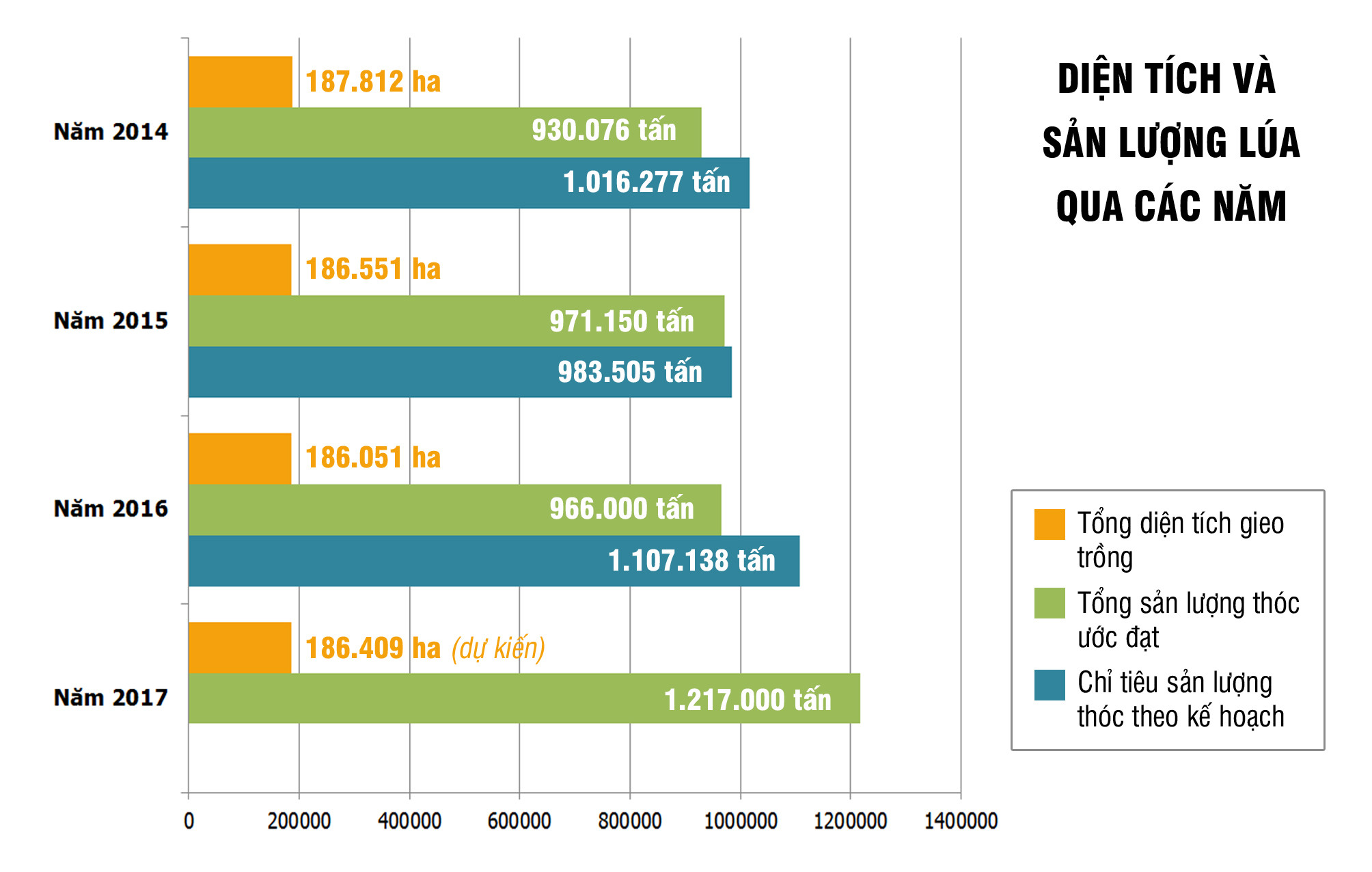 |
| Rice production is increasing annually, but the province lacks processing facilities and factories to guarantee the purchase of the product, while approximately 50% of the rice remains "surplus". (Graphic: Huu Quan) |
In Yen Thanh district, there are 12,500 hectares of intensively cultivated rice fields, producing 160,000 tons of rice annually. Of this, approximately 60,000 tons are used by local farmers, leaving 100,000 tons as a surplus. Significantly, this surplus rice is primarily used for livestock feed, resulting in low value and difficulty in selling it. If farmers store the rice for extended periods after each harvest, it will affect the quality of the rice. According to Mr. Nguyen Vuong Ngoc, Vice Chairman of the Yen Thanh District People's Committee, the solution being implemented in Yen Thanh is to develop large-scale model rice fields and establish linkages to produce high-quality rice seeds and other commodities, aiming to build a "Yen Thanh rice" brand. However, the success of this project depends on agreements signed with businesses, the active participation of agricultural cooperatives, and the willingness of farmers in the district to embrace change.
A concerning reality is that our agricultural products have virtually no official export markets, relying instead on informal channels due to quality, price, and food safety standards that do not meet the requirements of most global markets, especially demanding ones like Japan, the US, and South Korea. A few products that have been officially exported, such as tea and rice, are dependent on the global market and struggle to penetrate high-value markets. This situation stems from the fact that production is largely small-scale, household-based, and lacks coordination in both production and processing.
| In the livestock sector, Nghe An is considered a strong province with a total herd of over 736,500 cattle and buffaloes, 888,702 pigs, and 21.16 million poultry. However, to date, there is not a single processing plant in this sector within the province… |
In reality, sugarcane is one of Nghe An's stable agricultural products, with three efficiently operating sugar factories in the province. The core issue now is that the province, along with local authorities and factories, need to effectively manage planning, introduce new high-yield varieties, and apply technology to all stages to increase value and reduce labor for farmers. Similarly, tea, cassava, rubber, and timber plantations in the province also promise stability when linked to factories and processing plants. However, most other agricultural products in the province are marketed in raw form, lacking proper packaging, labeling, and product information.
To develop crops and livestock according to plan, it is essential to link them with processing and consumption. To solve this problem, relevant sectors such as agriculture, industry and trade, and local authorities, along with farmers, must "sit down together" to build a strong production linkage along the value chain, in which businesses play an extremely important role.
(To be continued)
Reporters' Team


