
Farmers are worried about integration.
Approximately 10 million farming households across the country are having to struggle on their own against numerous challenges in the coming period as Vietnam integrates more deeply into the global economy.
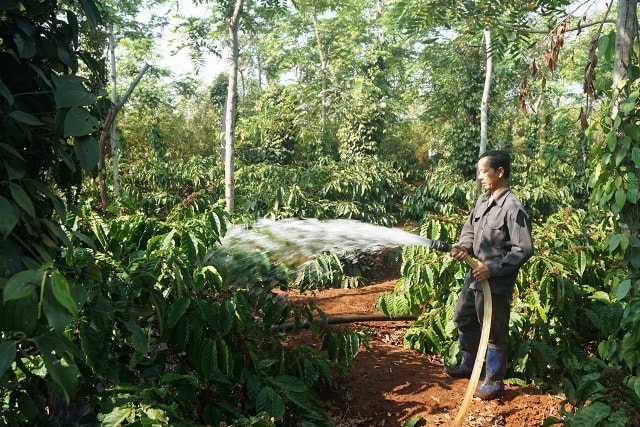 |
| Online Investment Photo |
Recent research on public investment in agriculture, published by the Central Institute for Economic Management (CIEM) and ActionAid, reveals concerning figures showing that investment in agriculture remains extremely low. A few days prior, another meeting chaired by the Minister of Agriculture and Rural Development to promote agricultural restructuring also confirmed that the biggest worry for Vietnamese agriculture remains the lack of capital.
In the context of numerous free trade agreements (FTAs) that have been and are about to be signed, the agricultural sector is facing the urgent need for restructuring. However, how to secure the resources for restructuring and how to enable individual farmers to successfully integrate into the global market remains a difficult problem.
Historically, the growth drivers of Vietnam's agricultural sector have varied considerably depending on the period.
Specifically, in the late 1980s, agriculture surged thanks to institutional reforms. By the 1990s, agriculture flourished due to increased investment. From 2000 to 2008, agriculture leaped forward thanks to increased productivity.
However, from the end of 2008 until now, agriculture has almost failed to find a growth driver because productivity has reached its limit, and investment capital is decreasing even though some "big players" want to pour more capital into this sector.
Research by ActionAid shows that public investment in agriculture is a crucial strategy for increasing agricultural efficiency and reducing poverty in rural areas. However, public investment in agriculture is gradually declining. Another study by the Organization for Economic Cooperation and Development (OECD) shows that while the proportion of state support for farmers in total producer income during the 2011-2013 period in South Korea, Japan, Switzerland, etc., accounted for 55-60%, in Vietnam this figure was less than 10%. With such modest support, it is very likely that farmers will be exhausted in the process of integration, and sustainable poverty reduction will become an increasingly significant challenge for Vietnam.
Adequate public investment will help the agricultural sector increase its ability to take advantage of opportunities from integration. In the context of integration, FTAs will only be a driving force if Vietnam can seize the opportunities within them. To anticipate and take advantage of these opportunities, agriculture first needs a crucial lever: public investment. Therefore, public investment in agriculture needs to be viewed thoroughly.
Firstly, it is necessary to quantify the role of public investment in agricultural growth, thereby making investments more appropriate. In addition, policies are needed to encourage the participation of the private sector and farmers in investing in rural infrastructure development.
Secondly, in public investment for agriculture, priority should be given to small-scale farmers, and public services should be implemented to support them.
Thirdly, in addition to public investment, the government also needs to issue more policies to directly support farmers, especially policies to subsidize interest rates and prices for farmers, helping them access modern machinery and technology, and vocational training. All these support measures must also be carefully studied to avoid violating integration commitments.
According to Investment


