
Farmers earn over 10 billion VND by growing corn for Australian cattle farms.
(Baonghean.vn) - In the early winter crop season of 2016, Nghi Loc district planted 350 hectares of corn. Currently, farmers are entering the harvest season to sell to Australian cattle farms. With an estimated yield of 30 tons/ha and a selling price of 1,000 VND/kg, Nghi Loc farmers are expected to earn over 10 billion VND from selling corn this early winter crop season.
To meet the feed needs of the Australian cattle farm located in Nghi Lam commune, since 2014, Nghi Loc district has converted and expanded the area for growing red corn (also known as biomass corn) for sale to the Australian cattle farm. Nghi Lam district has the largest area of biomass corn cultivation in the district, with 100 hectares.
Mr. Phan Van Hieu, Chairman of the Nghi Lam Commune People's Committee, said: "For Nghi Lam commune, the Australian cattle farm has signed a contract to purchase all the biomass corn produced by farmers. Therefore, last year we only planted in hamlets 4 and 5, with 80 hectares, but this winter we have expanded to hamlets 12 and 13, reaching 100 hectares. The estimated yield for this winter corn crop is 30 tons/ha. Thus, in this early winter crop of 2016, Nghi Lam farmers earned 3 billion VND from selling biomass corn to the Australian cattle farm."
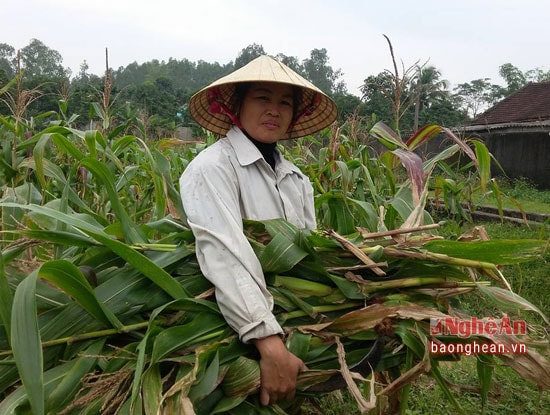 |
| Ms. Pham Thi Luc, residing in Hamlet 14, cultivated 5 sao (approximately 0.5 hectares) of biomass corn, earning 7.5 million VND after 75 days. |
According to farmers, growing biomass corn has many advantages: it shortens the growing season because biomass corn only takes 75 days to harvest; it allows for higher planting density, resulting in higher yields and eliminating concerns about market demand. Growing biomass corn can guarantee three harvests per year. Compared to growing potatoes or rice previously, growing biomass corn doubles the economic efficiency.
Ms. Pham Thi Luc from Hamlet 14, Nghi Lam Commune, said: “Previously, due to the high elevation of the land and the lack of reliable water supply, we could only grow one crop of sweet potatoes per year, resulting in very low economic returns. This year, the local authorities encouraged us to plant corn, so my family switched to planting 5 sao (approximately 0.5 hectares) of corn, estimated to yield 7.5 tons of biomass. This early winter crop will bring my family about 7.5 million VND.”
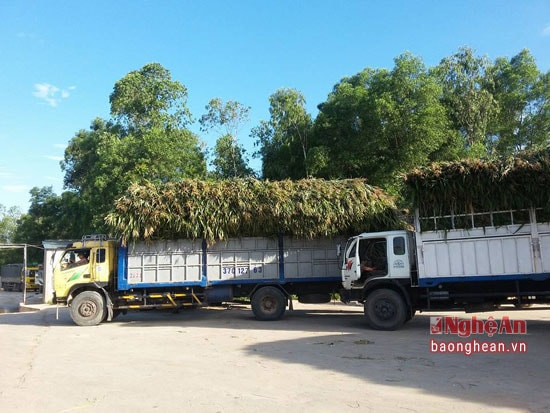 |
| Transporting corn to the farm. |
Not only Nghi Lam, but also other semi-mountainous communes such as Nghi Van, Nghi Kieu, Nghi My, Nghi Dong, Nghi Hung, and Nghi Phong – areas often experiencing drought and water shortages for cultivation – have converted their previously rice-growing land to growing corn for fodder. On average, each household cultivates 2-5 sao (approximately 0.25 hectares). The red corn varieties grown by farmers to feed cattle are CT888, CT919, CT999, CT989… These varieties have the outstanding advantage of a short growing season (75 days), 1.5 months shorter than grain corn; higher plant density, and higher biomass yield. In fact, farmers are very enthusiastic about switching to growing corn for fodder to supply Australian cattle farms.
The Australian beef fattening farm in Nghi Lam commune is developing quite rapidly, with a total herd of over 6,000 head (an increase of 3,000 head compared to last year). Besides purchasing corn stalks, creating a stable market and high economic value for local people, the Australian beef farm also provides a large quantity of manure, facilitating farmers' production; reducing investment costs and increasing crop yields.
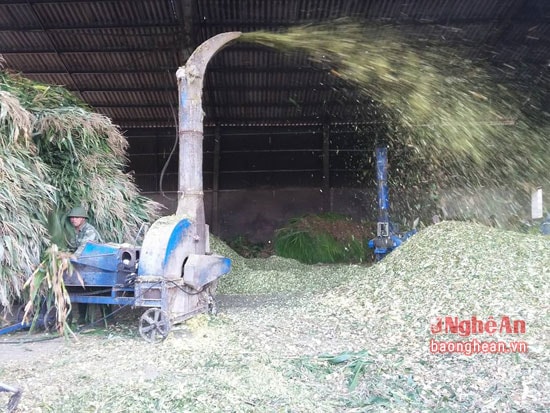 |
| Processing corn stalks for use as feed for Australian cattle. |
The development of the Australian cattle farm has opened up a new economic development direction for farmers in the semi-mountainous areas of Nghi Loc district. Mr. Nguyen Xuan Quang, Head of the Agriculture and Rural Development Department of the district, said: “This early winter season, Nghi Loc planted 350 hectares of biomass corn. The method of harvesting corn stalks to supply the Australian cattle farm has opened up a direction for the district to transform its crop structure to combat drought in the western communes of Nghi Loc, semi-mountainous areas that often lack water for production. Therefore, the agricultural sector is encouraging farmers to convert areas of land that are often dry and lack reliable water sources to growing biomass corn.”
Thu Hien
(Nghi Loc Radio Station)


