
Volcanic eruptions helped dinosaurs dominate the Earth.
High concentrations of mercury in sediments support the hypothesis that dinosaurs rose to dominate the Earth after a series of volcanic eruptions 200 million years ago.
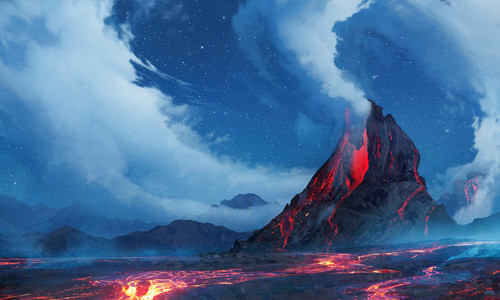 |
| Scientists believe that a series of volcanic eruptions caused the mass extinction event, paving the way for the rise of dinosaurs. Graphic: Conversation. |
New research by Tamsin Mather, professor of Earth Sciences at the University of Oxford, UK, strengthens the hypothesis of a powerful volcanic eruption in...200 million years ago, global climate change occurred, leading toThe mass extinction event at the end of the Triassic period paved the way for the rise of dinosaurs.,RecessNews reported on June 21st.
Geologists previously discovered that the Earth's crust contains large amounts of volcanic rock from the late Triassic period. Fossil data suggests that during this time, a large number of species on Earth became extinct, paving the way for the emergence of dinosaurs and other surviving species.
According to scientists, volcanic activityIt occurred over a period of about one million years.Global climate change led to a mass extinction event. The missing link in the hypothesis is evidence of such a global-scale event.
Study 6 sediment data setsrelated to the mass extinction event at the end of the Triassic period,across four continents in both hemispheres,Mather and colleagues discovered an increase in mercury concentrations, produced by volcanic eruptions, due to mSediment samples in Morocco contain volcanic rocks from large lava flows.(CAMP).
CAMPbornFollowing a series of powerful volcanic eruptions on the supercontinent Pangaea, which existed during the Mesozoic Era and once contained all of today's continents before breaking apart approximately 200 million years ago.
High concentrations of mercury have also been found between sediments associated with the mass extinction event and sediments marking the beginning of the Jurassic period, which occurred approximately 100,000–200,000 years later.
The correlation between the amount of mercury released into the atmosphere and deposited in sediments with the increase in atmospheric CO2 at that time strengthens the previous hypothesis that the CO2 causing the mass extinction event at the end of the Triassic period originated from volcanoes.
Modern volcanoes, when erupting, produce large amounts of SO2, CO2, and mercury. Mercury can persist and travel through the atmosphere for 6-24 months before settling in sediment layers at the bottom of lakes, rivers, and seas.
According to VNE
| RELATED NEWS |
|---|


