
NVIDIA GeForce RTX 6000: Rubin Architecture Revealed and DLSS 5 Technology Breakthrough
NVIDIA's GeForce RTX 6000 generation GPUs are expected to utilize the Rubin architecture on a custom 3nm process, promising double the Path Tracing performance and support for DLSS 5.
The RTX 6000 series is the successor to NVIDIA's RTX 5000 series graphics cards, expected to utilize the Rubin architecture on a 3nm process to optimize AI performance and intensive graphics processing. According to leaked information from RedGaming Tech, NVIDIA will maintain its pace of releasing new products every two years, despite fluctuations in the current global market demand for AI processors.
Rubin architecture and the strategy of using a custom 3nm process.
Contrary to expectations of a move to the 2nm process, NVIDIA seems to be taking a more cautious approach by choosing an improved version of TSMC's 3nm process for the Rubin architecture. This architecture is already geared towards GPUs for data centers and artificial intelligence (AI). Using this process allows NVIDIA to maintain its leading position in the high-end segment while optimizing manufacturing costs and chip output.
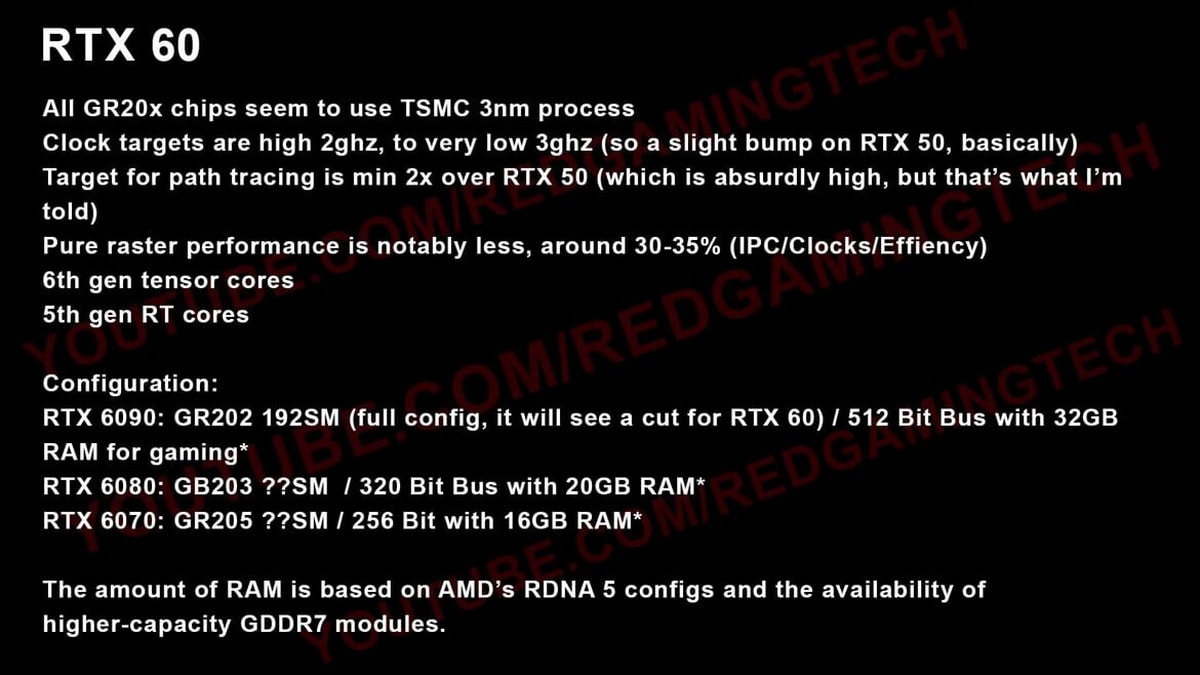
Notably, NVIDIA is likely to collaborate with TSMC to develop a proprietary process node, similar to what they did with the 4N node on the Blackwell architecture. This refinement allows the GPU to reach clock speeds exceeding 3.0 GHz, resulting in more stable performance and better energy efficiency compared to its predecessors.
A breakthrough with 6th generation Tensor cores and AI graphics processing capabilities.
The most significant technological highlight of the RTX 60-series lies in the 6th generation Tensor cores and the 5th generation RT cores. The new Tensor cores are designed to accelerate neural processing tasks, paving the way for the introduction of DLSS 5. This is a next-generation AI rendering technology expected to revolutionize how graphics work on mainstream cards by minimizing hardware strain while maintaining high-quality images.
Regarding Ray Tracing capabilities, NVIDIA aims to double the real-time Path Tracing processing power compared to the RTX 5000 series. Although the current test version of DLSS 5 requires the power of two RTX 5090 cards, NVIDIA is committed to optimizing it so that the technology can run smoothly on a single graphics card upon official release.
Expected specifications and configurations for GDDR7 memory.
Based on available information, the traditional image processing performance of the RTX 6000 series will increase by approximately 30-35% compared to the RTX 5000 series in the same segment. This improvement comes from an increase in IPC (instructions per cycle) and improvements in memory bandwidth. NVIDIA continues to use the GDDR7 standard but will expand the memory bus width on mid-range and high-end models to meet the demands of large AI data sets.
| Model | Graphic Designer | Expected memory | Bus width |
|---|---|---|---|
| RTX 6090 | GR 202 | 32GB GDDR7 | 512 bit |
| RTX 6080 | GR 203 | 20GB GDDR7 | 320 bits (25% increase) |
| RTX 6070 | GR 205 | 16GB GDDR7 | 256 bits (33% increase) |
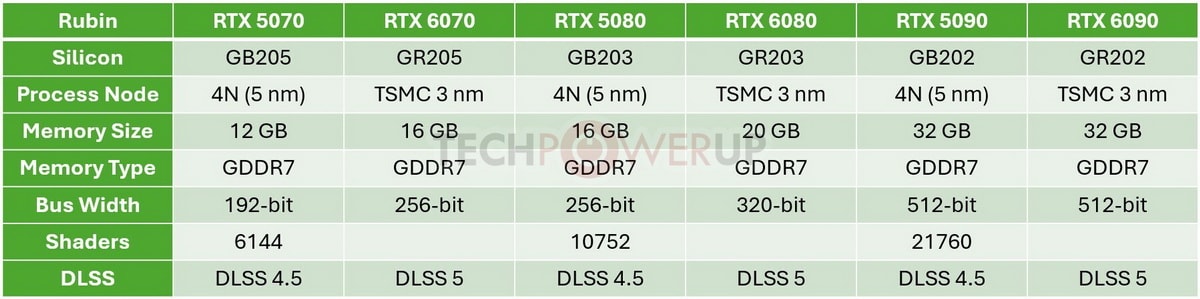
The flagship RTX 6090 is expected to retain the 512-bit bus but will be equipped with faster GDDR7 memory chips, boosting overall bandwidth. These specifications not only make the RTX 6000 an ideal 4K gaming device but also a powerful tool for mainstream users to run AI models at home. However, users may have to wait until 2027 or later to officially own this generation of graphics cards.


