
Wrongful convictions due to procedural violations?
Wrongful convictions have a significant negative impact on public opinion, affecting people's trust in the judicial authorities.
During a discussion in the National Assembly on October 28th, delegate Mai Khanh - Chief Justice of the Ninh Binh Provincial People's Court - representing the Ninh Binh National Assembly delegation, stated that wrongful convictions have persisted for many years, representing a small percentage of the hundreds of thousands of cases tried by the two levels of courts.
However, wrongful convictions have a significant negative impact on public opinion, affecting people's trust in the judicial authorities.
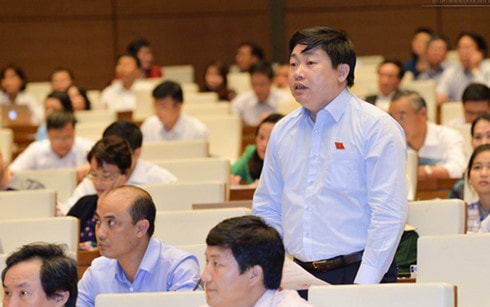 |
| Representative Mai Khanh - Ninh Binh National Assembly Delegation, delivered a speech in the assembly hall. |
"Miscarce convictions essentially stem from subjective causes, human error, not objective ones," said a representative from Ninh Binh province. The Chief Justice of the Ninh Binh Provincial People's Court stated that while the three central judicial branches have addressed the causes of wrongful convictions and proposed solutions, their findings remain vague and unclear.
According to Mr. Mai Khanh, in a number of cases, the cause of wrongful convictions stems from the awareness of the prosecuting authorities regarding the supremacy of law and the strict implementation of procedural rules.
"In many cases, the court has identified serious procedural violations and pointed them out, but the general view of some investigators is that these are shortcomings but do not affect the essence of the case," Representative Mai Khanh stated.
According to Mr. Khanh's statement, under the provisions of procedural law, only procedural violations are determined, not "deficiencies" in the proceedings. The question is whether procedural violations are serious enough to affect the determination of the objective truth of the case.
"That's why there are differing interpretations of this procedural viewpoint, leading to many cases having to be reviewed multiple times, and there are still no results to this day," Mr. Khanh said.
The Chief Justice of the Ninh Binh Provincial People's Court stated that procedural violations in investigation, prosecution, and trial activities need to be addressed not only to ensure the supremacy of law but also to protect citizens' rights and human rights. Therefore, according to Mr. Khanh, regulations on procedural matters in litigation must be strictly implemented.
Regarding the issue of wrongful convictions, Mr. Nguyen Thai Hoc – Head of the Internal Affairs Committee of the Provincial Party Committee and a member of the Phu Yen delegation – stated that the self-inspection and verification of legal violations and wrongful convictions by judicial bodies are still limited. "It can be said that there is still a tendency to hesitate and shift responsibility," Mr. Hoc pointed out.
According to the representative from Phu Yen province, in reality, there are cases that the President has requested, the Central Internal Affairs Committee, and the National Assembly's Judicial Committee have proposed to relevant agencies for review, yet many cases still drag on without conclusion. "This shows there is a tendency to pass the buck and avoid responsibility," Mr. Hoc stated.
In fact, there are cases where citizens have not violated the law or committed any crime, but the prosecuting authorities do not declare them innocent; instead, they issue decisions to temporarily suspend the case or temporarily suspend the defendant.
Or, during the trial, instead of declaring the defendant not guilty, the court might impose a sentence equal to the time already spent in detention. "I think such a situation is not good," Mr. Hoc stated.
Therefore, National Assembly deputies proposed the need to improve the performance of law enforcement agencies in investigation, prosecution, and trial, while also meeting the necessary conditions for the operation of judicial bodies.
Representative Hoc argued that the current situation where 25 district-level courts and 23 district-level procuratorates have to rent premises is unacceptable. It is necessary to consider meeting the minimum requirements for the operation of these prosecuting agencies.
According to VOV


