
Orange Pi 6: The new SBC monster boasts 45 AI TOPS and a 12-core chip, challenging the Raspberry Pi.
With its powerful 12-core processor and AI processing capabilities reaching 45 TOPS, the Orange Pi 6 surpasses the conventional limits of single-board computers to handle demanding tasks.
The world of single-board computers (SBCs) is witnessing a fierce performance race. Following the unveiling of the Orange Pi 6 Plus variant, the standard Orange Pi 6 continues to attract attention with specifications far surpassing its competitors in the same segment, especially the Raspberry Pi. With a configuration focused on artificial intelligence (AI) and high-speed storage capabilities, this is considered a major step forward for the manufacturer Orange Pi.
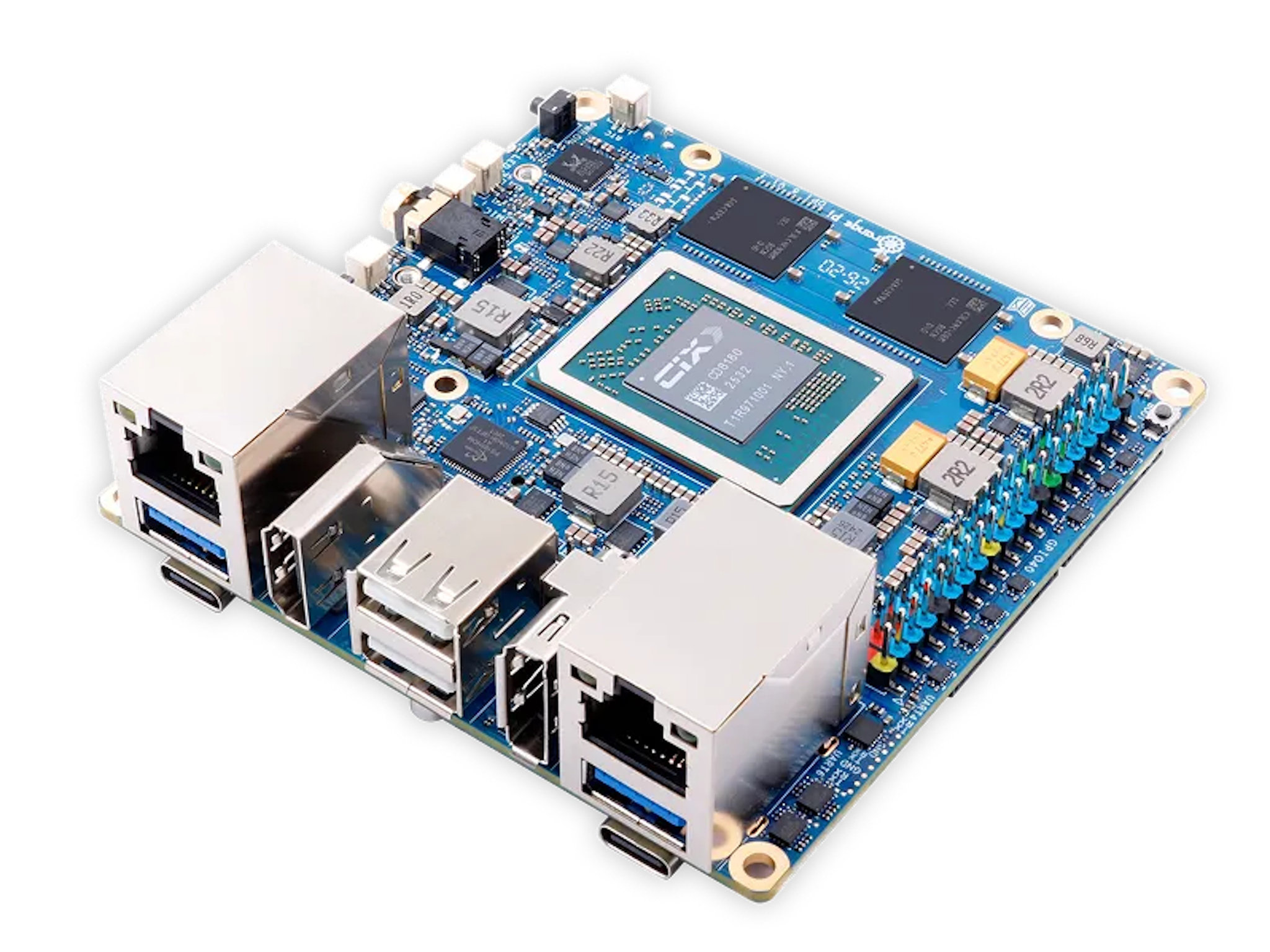
Power from a 12-core chip and superior AI processing capabilities.
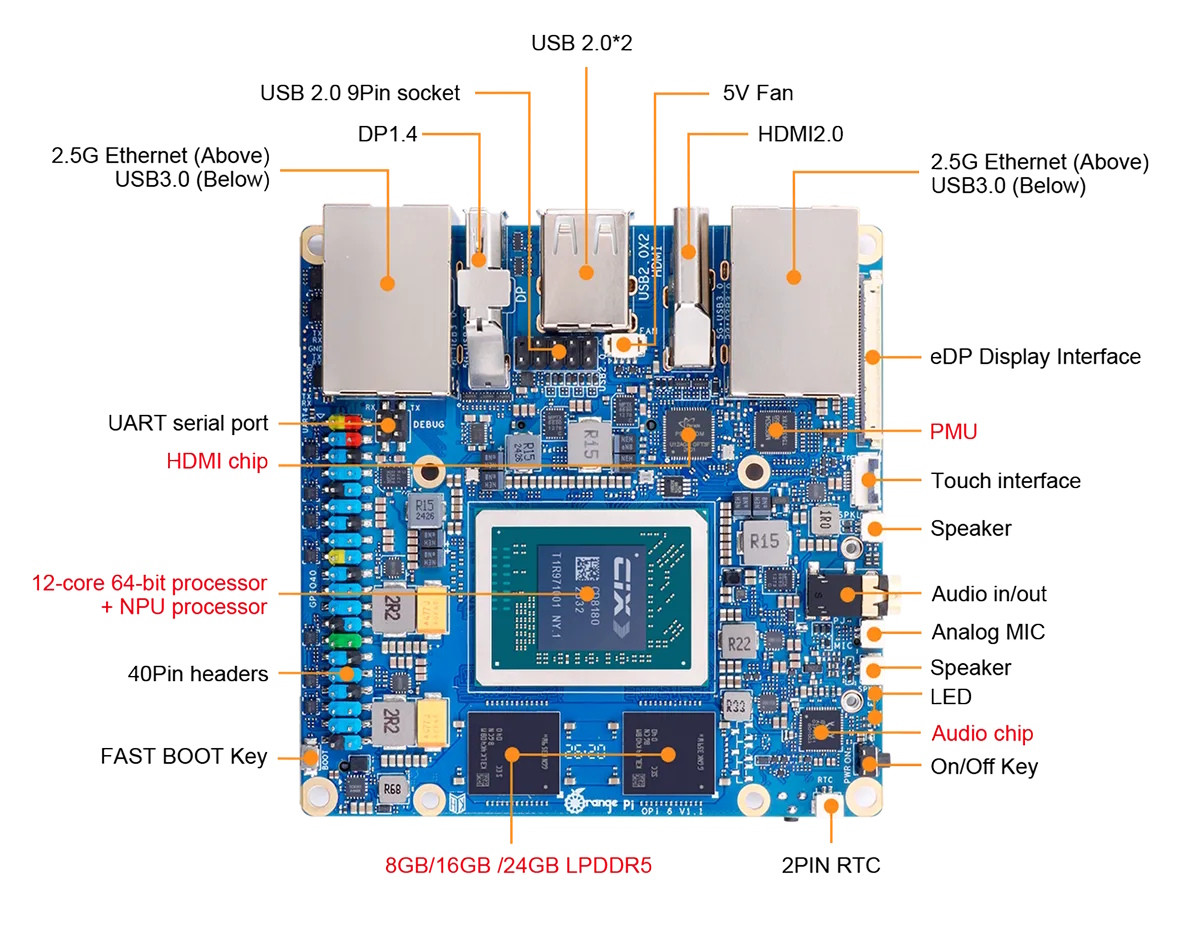
At the heart of the Orange Pi 6 is the CIX CD8180 system-on-a-chip (SoC) with 12 processing cores. The most notable highlight is its AI computing capability of up to 45 TOPS (trillion operations per second). However, users should note that this 45 TOPS figure represents the combined performance of the CPU, GPU, and NPU (neural processing unit). The dedicated NPU alone contributes 28.8 TOPS to AI tasks.
Pushing the system to its maximum of 45 TOPS can reduce energy efficiency because both the CPU and GPU have to operate at full capacity. Even so, the 28.8 TOPS from the NPU is still an extremely impressive figure for an SBC device, opening up the possibility of deploying complex machine learning models at the edge computing.
LPDDR5 memory and unlimited storage capacity.
Unlike many competitors that still use the older RAM standard, the Orange Pi 6 is equipped with LPDDR5 memory with capacity options of 8 GB, 16 GB, or up to 24 GB. The large RAM capacity combined with the new speed standard allows the device to handle multitasking smoothly and meet the demands of large data bandwidth.
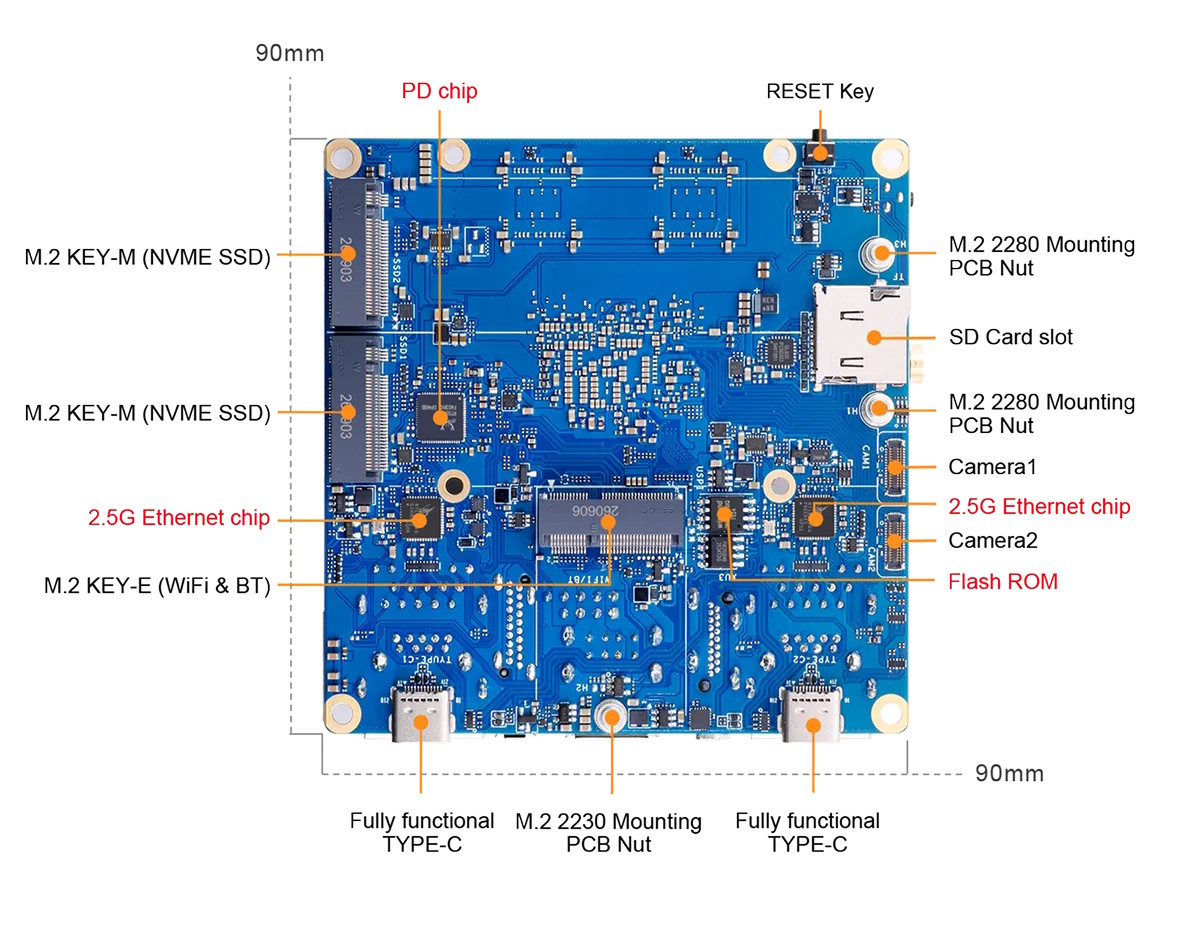
In terms of storage, besides the traditional microSD card slot, the Orange Pi 6 surprisingly supports two M.2 2280 SSD slots. Both slots use the PCIe 4.0 protocol with 4 lanes, allowing for extremely fast read/write speeds. For network attached storage (NAS) systems, users can use additional SATA adapters to expand storage space.
High-speed network connectivity and diverse interface ports.
The Orange Pi 6 is optimally designed for networking and data transmission applications. It features two Ethernet ports with speeds up to 2.5 Gbit/s each, significantly faster than the commonly used 1 Gbit/s standard. Wireless connectivity such as Wi-Fi and Bluetooth can be added via a dedicated M.2 (Key E) module.
The system of peripheral communication ports is also very diverse, including:
- 2 USB 3.0 Type-A ports and 2 USB 2.0 ports.
- Two versatile USB 3.0 Type-C ports, supporting video output.
- DisplayPort 1.4 supports 4K video output at a refresh rate of 120 Hz.
- The HDMI 2.0 port supports 4K at 60 Hz.
- Supports MIPI CSI interface for cameras.
Comparison table of basic technical specifications
| Parameter | Details on Orange Pi 6 |
|---|---|
| System-on-a-Chip (SoC) | CIX CD8180 (12 cores) |
| AI performance | 45 TOPS (Total System) / 28.8 TOPS (NPU) |
| RAM | 8 GB / 16 GB / 24 GB LPDDR5 |
| Storage | 2x M.2 2280 (PCIe 4.0 x4), microSD |
| Network connection | 2 x 2.5 Gbit Ethernet |
| Size | 90 × 90 mm |
Despite its powerful specifications, the manufacturer has yet to announce the official price and release date for the Orange Pi 6. With its compact size of 90 x 90 mm but possessing the power of a mid-range mini PC, it promises to be a formidable competitor that Raspberry Pi should be wary of in the high-end single-board PC segment.


