
Authorities busted a ring that forged "bank vehicle" documents to defraud and misappropriate assets.
They hired people to act as nominees for car loans, fabricated employment and income records, and prepared a "scenario" to deceive the bank's appraisal process. After the loan was disbursed and the car was delivered, the perpetrators immediately sold the car, while the nominees failed to fulfill their repayment obligations. Ho Chi Minh City police have exposed this organized operation.
On the afternoon of September 7th, the Criminal Police Department of Ho Chi Minh City Police announced that it had issued a decision to initiate a criminal case for "Fraudulent appropriation of property"; and simultaneously issued decisions to prosecute and arrest the defendants for temporary detention: Le Hien Anh, Nguyen Tran Bao Tran, Nguyen Thanh Hai, Nguyen Hoang Nam, Dao Thanh Sang, and Le Quoc Khanh for the crime of "Fraudulent appropriation of property," with Le Quoc Khanh being the person whose name appeared on the loan application for purchasing a vehicle.
Transform ineligible individuals into financially capable customers.
Recently, the Criminal Police Department has focused its efforts and applied a comprehensive range of investigative measures to verify a group of individuals suspected of exploiting the installment loan policy for purchasing automobiles to defraud credit institutions.
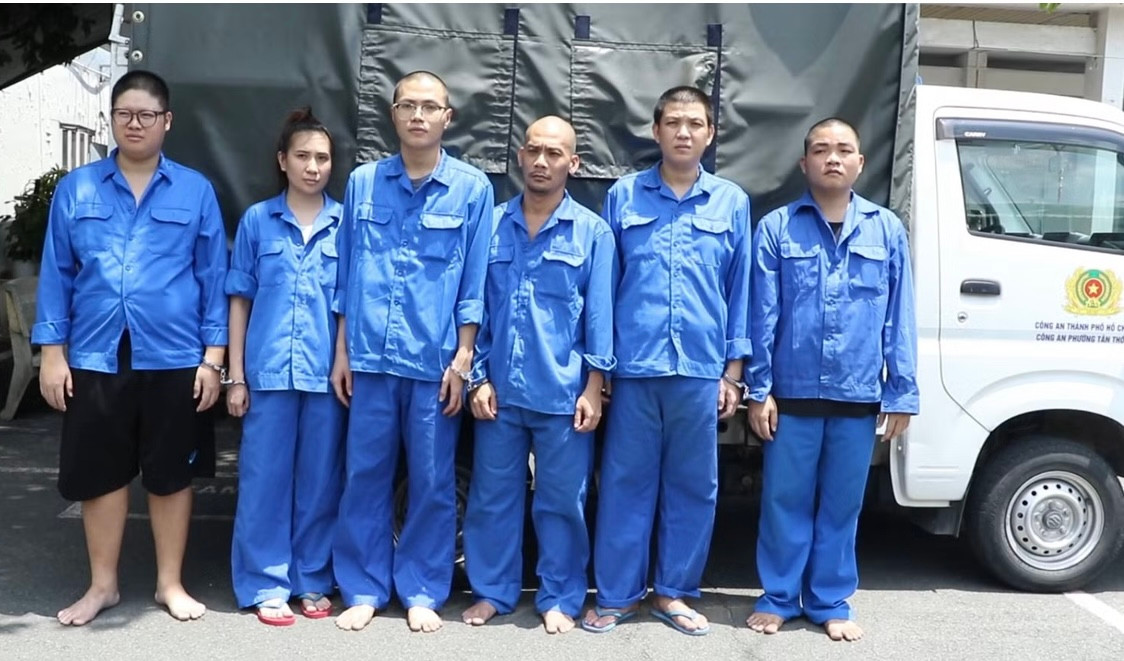
In late July 2026, the Criminal Police Department uncovered a case, initially clarifying that the group led by Le Hien Anh (born in 1998, residing in Khanh Hoa province) and her accomplices organized and carried out the act of "fraudulent appropriation of property".
Initial investigations revealed that, starting around the end of 2025, the suspects, through social media, became acquainted and connected with each other to commit illegal acts. The group sought out people interested in buying "bank-owned vehicles" by advertising them at low prices because the vehicles lacked original registration papers as they were collateral for loans from credit institutions; they would agree in advance on the make, model, and purchase price of the vehicle. Buyers would transfer money to cover approximately 30% of the vehicle's value, taxes, registration fees, a portion of the principal and interest for the first three months, and a "commission" for those involved.
After finding a buyer for the car, this group would then find someone to act as a nominee for a car loan. In exchange for having their name on the loan, they were promised 80 to 100 million VND after the car was delivered. Those hired to act as nominees were often unemployed and lacked the financial means to secure a bank loan. To get the loan approved, the perpetrators fabricated a series of false details about the nominee.
This group prepares false information about workplace, occupation, and income; rents or borrows business premises to take photos for the verification process; and uses payroll records, employment contracts, salary confirmations, bank statements, and other documents that do not accurately reflect reality.
In addition to preparing the necessary documents, these individuals also developed a pre-planned "verification script." When bank employees called or in person to verify their address, workplace, loan purpose, and repayment ability, the borrower was instructed to respond according to the pre-agreed content.
From their job, income, business location to the purpose of buying the car, everything was meticulously prepared by the applicants to create the image of a customer with a genuine need for a loan, a stable income, and sufficient ability to repay the debt. Based on this deliberately prepared information and documents, the bank believed the loan application was legitimate and disbursed the loan to the car dealer.
The car was sold as soon as it was delivered.
Immediately after receiving the vehicle, the person whose name is on the loan agreement does not directly manage or use the vehicle for the purpose of the loan, but instead hands it over to the group of accomplices. The vehicle is then taken to the location specified by the previously agreed-upon buyer and continues to be bought, sold, and circulated as a "bank vehicle"—a slang term referring to vehicles linked to a loan at a credit institution, so the buyer usually does not retain the original vehicle registration certificate. The money obtained from the sale of the vehicle, after deducting expenses, is used to pay the person whose name is on the loan agreement and distributed among the participants.
Notably, this group also proactively paid the principal and interest to the bank for the first three months. Through investigation, the police determined that the suspects believed that maintaining repayment during the initial period could prevent the loan from immediately showing signs of irregularities. They thought that once the bank transferred the case to the debt recovery process, it would take more time, allowing the vehicle to be transferred.
The investigating agency initially determined that the suspects had a relatively clear division of tasks. Le Hien Anh, Nguyen Thanh Hai (born in 2003, residing in Tay Ninh province) and Nguyen Tran Bao Tran (born in 1992, residing in Tan Son Nhat ward) were tasked with finding people to act as guarantors for loans.
Whoever finds the person whose name is on the loan application will directly instruct that person to provide false information during the bank's assessment. Nguyen Hoang Nam (born in 1992, residing in Dong Nai City) and Nguyen Tran Bao Tran participated in contacting and carrying out the loan application procedures. Nguyen Tran Bao Tran prepared information about the applicant's job, workplace, employment verification photos, and contacted the business location to facilitate the assessment.
Nguyen Hoang Nam, due to his knowledge of the loan application process, drafted the response for the person named on the loan to use when dealing with bank staff. Le Hien Anh directly contacted the buyer, agreed on the type of vehicle and the resale price; received the money, organized the vehicle delivery, and distributed the money to the participants.
During the investigation, the police also seized and clarified several documents that appeared to have been forged to prove the borrower's financial capacity.
Ho Chi Minh City police are continuing to expand their investigation to clarify the involvement of related individuals; at the same time, they are reviewing individuals and groups with similar operating methods, identifying all vehicles, loan documents, and related cash flows to strictly handle the case according to the law.


