
Finland is developing a new generation of underground fortifications to counter the threat of UAVs.
In response to the proliferation of UAVs on the battlefield, Finland is strengthening its network of underground fortifications and adjusting its defense doctrine to protect its infantry.
The Finnish Defence Forces are deploying a new generation of underground fortifications to enhance infantry survivability against the increasing presence of unmanned aerial vehicles (UAVs). This move marks a significant shift in the Nordic nation's defense doctrine to adapt to modern battlefield conditions.
The challenge posed by UAVs and the shift in combat doctrine.
Recent conflicts, particularly in Ukraine, have shown that reconnaissance and suicide drones have made traditional open trench lines extremely dangerous. Any movement of infantry, vehicles, and logistical supply lines can be easily detected and accurately targeted from a distance.
During a major military reform in the mid-2010s, the Finnish army adopted a doctrine emphasizing high mobility. This doctrine prioritized surprise attacks, using mines and obstacles to inflict damage on the enemy before quickly withdrawing. However, the emergence of swarms of UAVs operating continuously over large areas significantly reduced the effectiveness of this approach, forcing Finland to refocus on holding defensive positions and protecting soldiers in fortified underground bunkers.
Scale and technical solutions of the new generation of fortifications.
To support training and testing, Finland built two military complexes, Base 25 and Base 26, for the Pori Brigade in Niinisalo and Säkylä. Each base was designed to accommodate a force of 30 to 50 soldiers, allowing them to survive, operate, and fight continuously for many days underground.
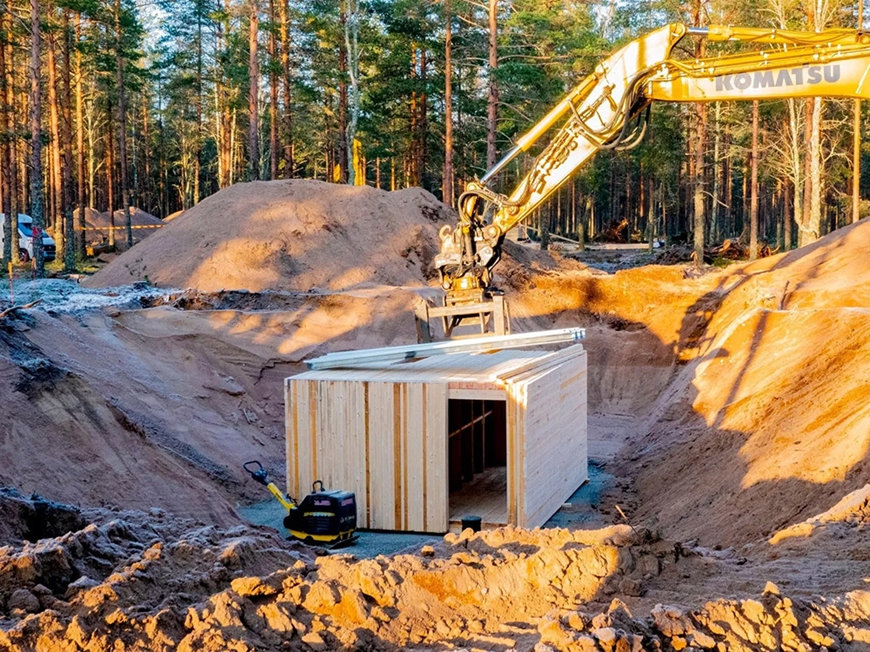
Unlike traditional reinforced concrete bunkers, Finland's new generation of underground fortifications primarily utilizes prefabricated, treated wooden frame structures to prevent mold and mildew. After excavators reach the required depth, the wooden components are lowered into position and compacted with soil and rocks. Stone slabs are then laid on the surface of the fortification to pre-detonate artillery shells or UAV warheads before the penetrating force can reach the main structure.
Infrastructure and camouflage capabilities
With forests covering approximately 70-75% of its land area, the Finnish army has made full use of the natural terrain to camouflage its fortifications. From the air, it is very difficult to detect these underground positions, except for a few signs such as trapdoors, ventilation shafts, or short, exposed trenches.
The underground network of fortifications comprises many synchronized technical components:
- Combat position:It is equipped with a protective steel gate and a separate UAV launch pit.
- Technical infrastructure:The connecting corridors are equipped with cable supports for installing field communication systems.
- Passive protective measures:The entrances, trapdoors, and trenches were all covered with steel mesh to prevent small UAVs from crashing directly into them.
In addition to testing new materials and construction methods at Bases 25 and 26, Finland is also restoring old coastal fortifications and building more concrete bunkers nationwide. The return of underground defensive structures highlights the importance of protecting forces from above in the context of increasingly sophisticated unmanned combat technology.


