
Analyzing Russia's new strategic quartet: Deterrence power in the 21st century.
Russia has deployed four strategic weapons systems—Burevestnik, Poseidon, Oreshnik, and Sarmat—all equipped with hypersonic technology, ensuring global nuclear deterrence capabilities.
Russia has successively unveiled and successfully tested four new-generation weapons systems, marking a major turning point in defense technology and nuclear deterrence capabilities. These strategic systems include the Burevestnik cruise missile, the Poseidon nuclear torpedo, the Sarmat ballistic missile, and the Oreshnik hypersonic missile. President Vladimir Putin asserted that these weapons will ensure global strategic balance throughout the 21st century.
Burevestnik: A cruise missile with unlimited range.
The Burevestnik missile (designation 9M730, NATO designation SSC-X-9 Skyfall) is considered one of Russia's most groundbreaking weapons due to its nuclear-powered propulsion. According to a report from the Chief of the General Staff of the Russian Armed Forces, Valery Gerasimov, during a test on October 21, 2025, the missile flew continuously for 14,000 km in 15 hours.
The Burevestnik's most notable feature is its ability to maintain a virtually unlimited flight path with constantly changing trajectory to evade defense systems. The missile can fly at extremely low altitudes, from 25-100 meters, at speeds ranging from 850-1,300 km/h. This capability allows the weapon to penetrate and attack heavily protected targets from the most unexpected directions. President Putin emphasized that this weapon cannot be intercepted by any current or potential air defense system.
Poseidon: A transcontinental unmanned underwater vehicle.
Dubbed the "doomsday torpedo" by the West, Poseidon (designation 2M39, NATO designation Kanyon) is an unmanned underwater vehicle carrying a nuclear warhead. This weapon is capable of traveling at great depths with intercontinental range, reaching speeds many times faster than even the most advanced submarines and torpedoes currently in existence.
The Poseidon's specifications reveal formidable power, with a length of 20 meters, a diameter of 1.8 meters, and a weight of up to 100 tons. The device can dive to a depth of 1,000 meters and travel at speeds of 110-130 km/h. The nuclear reactor equipped on the Poseidon is 100 times smaller than that of a conventional submarine but achieves significantly greater power. On November 1, 2025, Russia officially launched the Khabarovsk nuclear submarine, the vessel carrying this strategic torpedo.
Oreshnik: A Mach 10 hypersonic missile system.
The Oreshnik medium-range ballistic missile system is the latest hypersonic weapon unveiled in late 2024. The missile boasts a range of 1,000-5,500 km and reaches a maximum speed of Mach 10 (equivalent to 12,380 km/h). With this speed, Oreshnik is capable of striking targets in Europe in extremely short time: it takes only 11 minutes to reach Poland and 17 minutes to reach NATO headquarters in Brussels.
Each Oreshnik missile can carry 3-6 warheads, each containing sub-warheads with a total destructive power equivalent to 900 kilotons. In combat, Russia used Oreshnik missiles to attack the Yuzhmash plant in Ukraine on November 21, 2024, in response to Kyiv's use of Western long-range missiles. Currently, Russia has begun mass production of this weapon, which President Putin claims "no other country in the world possesses."
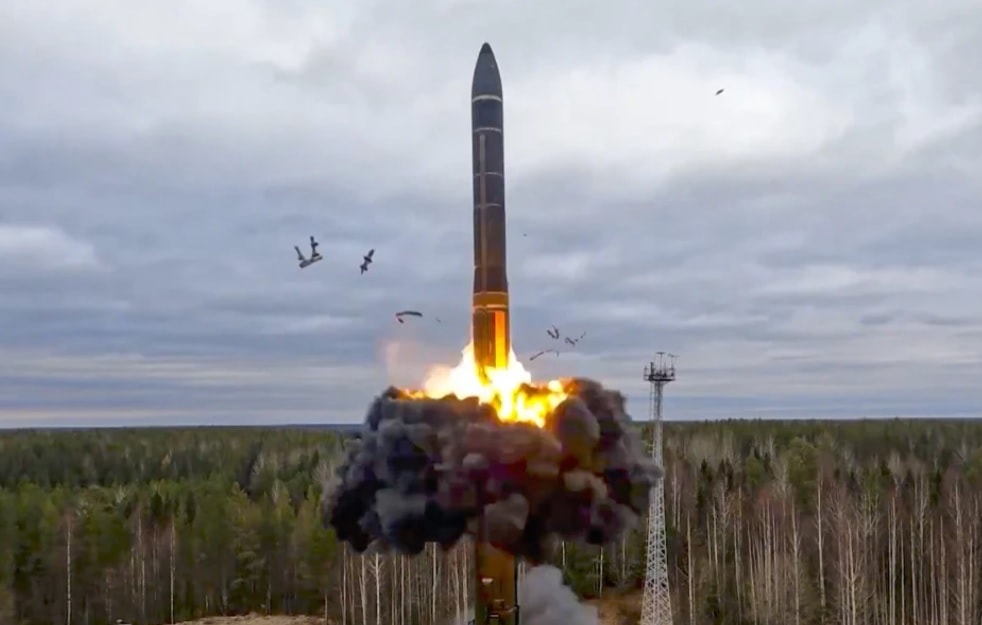
Sarmat: A fifth-generation intercontinental ballistic missile.
The RS-28 Sarmat (NATO designation SS-X-30) is a massive strategic missile system weighing over 208 tons and as tall as a 14-story building. It is a replacement for the older R-36M Voevoda, capable of carrying 10 megaton-class nuclear warheads. The Sarmat has a range of up to 18,000 km, allowing it to strike any target globally, including via a trajectory over Antarctica.
According to plan, Sarmat will officially enter combat service in 2026. Besides military purposes, Russia is also considering applying technology from projects such as Burevestnik and Poseidon to civilian sectors, including small-scale nuclear power in the Arctic and space exploration on the Moon.


