
Technical analysis of Russia's Oreshnik missile: Uses old components and technology from Belarus.
Analysis of the Oreshnik missile fragments revealed that the system used components manufactured between 2014 and 2016 and did not contain modern Western microchips.
Ukrainian technical experts have just published the results of a detailed examination of fragments from Russia's Oreshnik hypersonic ballistic missile. Based on the parts collected after the attack on the Lviv region in January 2026, experts conclude that this is not a completely new technological breakthrough as previously claimed.
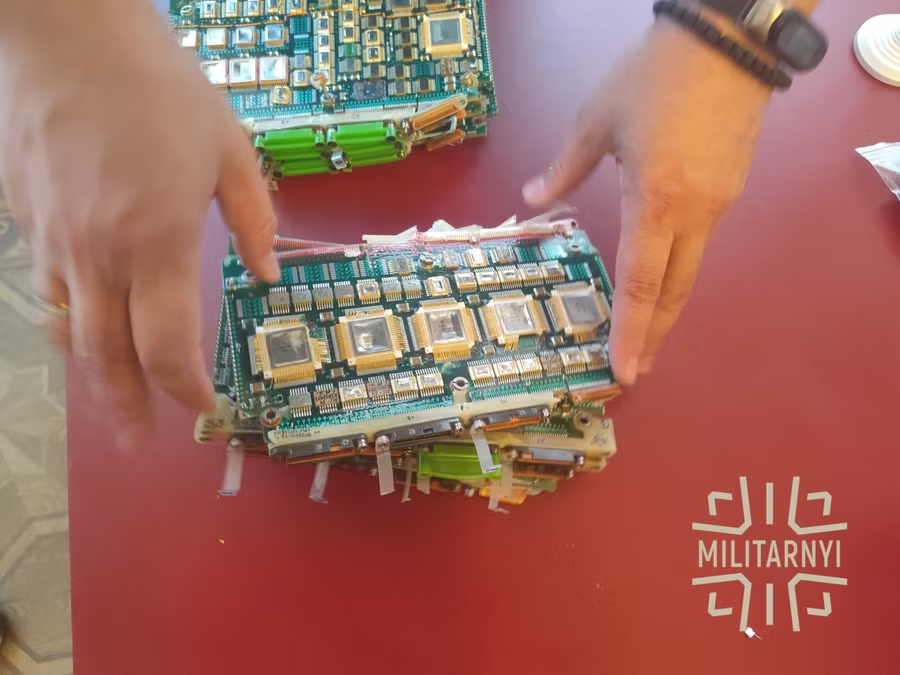
The origin of components and the absence of Western integrated circuits.
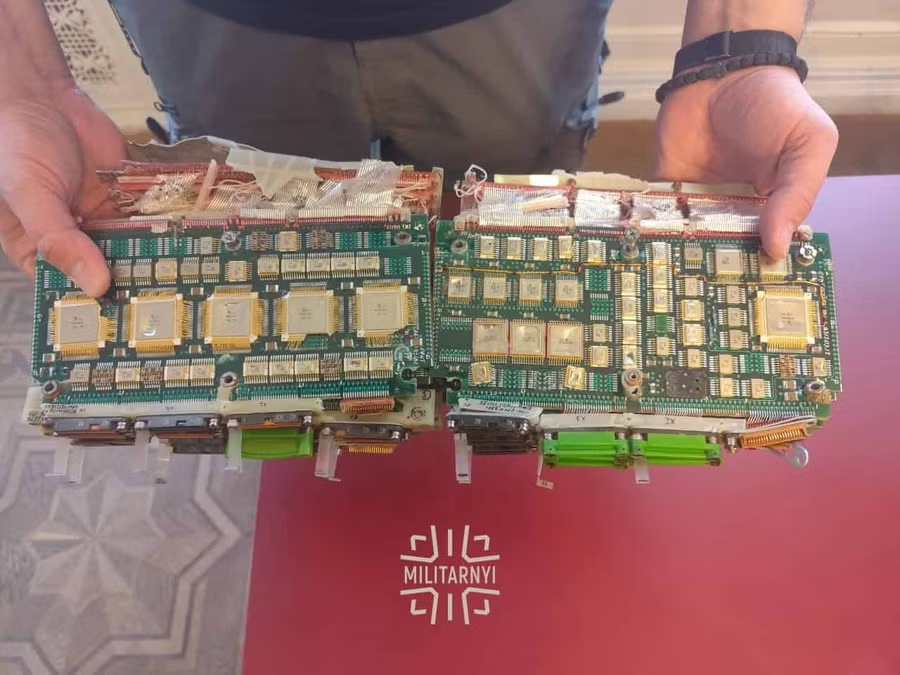
A closer analysis of the processor and motherboard – the components that control flight and transmit signals to the rudders – reveals that all electronic components were manufactured between 2014 and 2016. Unlike modern unmanned aerial vehicles (UAVs) that typically integrate newer foreign chips from 2024-2025, the Oreshnik uses entirely domestically sourced components from Russia and Belarus.
Notably, the circuit boards revealed the presence of equipment manufactured by the Integral plant in Minsk, Belarus. This is one of the largest microelectronics facilities in Eastern Europe, specializing in supplying integrated circuits and semiconductor components for military purposes. The majority of the remaining components were identified as originating from enterprises in Moscow and the surrounding area.
Technical specifications and navigation system
In terms of classification, the Oreshnik is a medium-range strategic ballistic missile with an estimated range of 3,000 to 5,000 km. However, because it was originally designed to carry a nuclear warhead, its guidance accuracy is considered to be lower compared to newer generation precision weapons.
The missile uses a completely passive inertial guidance system, based on a gyroscope module and pre-programmed coordinates in an integrated computer. This mechanism operates automatically in the stratosphere and does not rely on active satellite signals such as GPS, reducing the likelihood of interference from electronic warfare systems.

Warhead structure and air defense penetration capability
The distinguishing feature of the Oreshnik is its split warhead system. Before reaching its target, the missile splits into six guidance blocks, each containing six additional sub-warheads to simultaneously attack multiple locations. In its non-nuclear variant, these warheads are essentially hollow cast-iron blocks weighing approximately 50 kg, causing damage primarily through kinetic energy.
Intercepting the Oreshnik is considered a major challenge for conventional air defense systems like the Patriot PAC-3 due to the extremely high speed of the medium-range ballistic missile. To effectively counter it, military experts believe that specialized high-altitude missile defense systems like the US THAAD are needed. However, without a nuclear warhead, the actual destructive effectiveness of this system remains a matter of debate due to its high dispersion potential.


