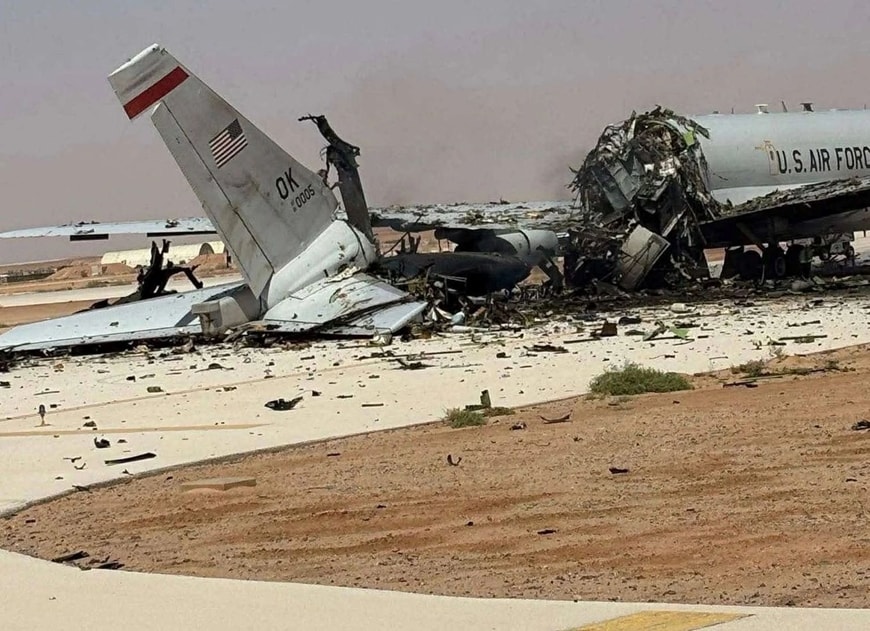
Analyzing the capabilities of the US E-3G Sentry airborne radar in a conflict with Iran.
Iran claims to have destroyed a US E-3G Sentry early warning aircraft in Saudi Arabia. This incident poses a major challenge to Washington's command and early warning system.
Amid escalating conflict in the Middle East, Iran claims to have destroyed a US E-3G Sentry airborne early warning and control (AWACS) aircraft. The attack reportedly took place on March 27 at Prince Sultan Air Base (Saudi Arabia) using missiles and suicide drones.
Although this information has only been released by Iran so far, images from the OSINTdefender account on the social media platform X show an E-3G with significant damage to its tail and AN/APY-2 phased-array radar system. If confirmed, this would be a serious strategic loss because the E-3G is the most modern variant in the AWACS family, serving as the "eye" coordinating all air operations of the US and its allies.
History and origins of the Sentry airborne radar series.
The E-3 Sentry AWACS aircraft was developed during the Cold War to overcome the limitations of ground-based radar, which is restricted by the horizon. Low-flying targets such as cruise missiles or UAVs often utilize terrain for concealment, making them difficult for ground-based radar to detect from a distance. The American solution was to move radar systems into the air to extend their range.
Boeing developed the E-3 based on the Boeing 707-320B commercial aircraft airframe. The first prototype took flight in 1972 and officially entered service with the US Air Force in 1977. Due to high production and operating costs, only 68 E-3s were built. Currently, the US military maintains approximately 16 to 31 active aircraft.
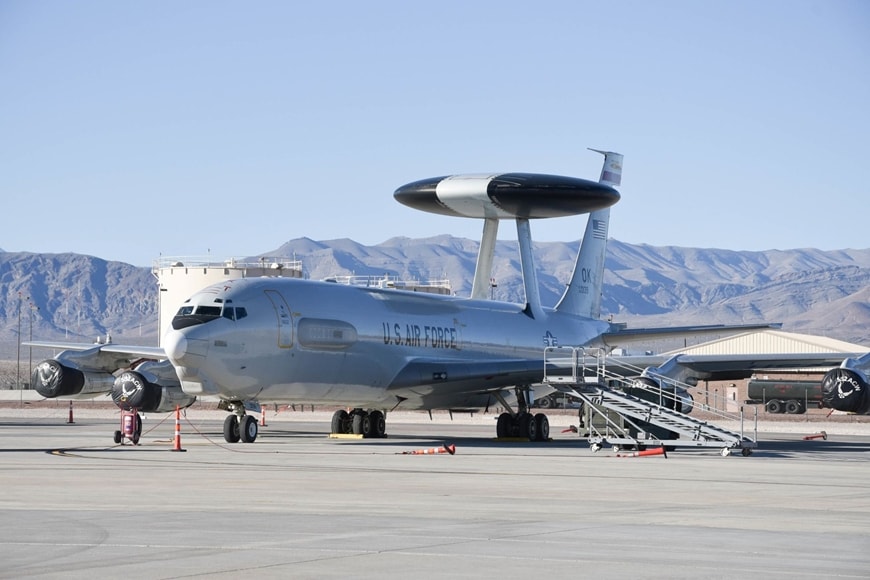
Technical specifications and upgrade capabilities of the E-3G variant.
The E-3G is a Block 40/45 variant that underwent extensive upgrades starting in 2014. This upgrade package focused on modern computer systems, a powerful active phased array radar, and next-generation avionics, reducing the crew size to 17-19 people. Experts estimate that each upgraded E-3G is worth approximately $500-600 million.
The most distinctive identifying feature of the E-3G is its rotating radar dome (rotodome) mounted on the aircraft's back, measuring 9.1m in diameter and 1.8m in thickness. This system is capable of:
- A low-flying target was detected at a distance of over 400km.
- Track targets at high altitudes within a range of up to 650km.
- Simultaneously monitor over 600 targets, accurately classifying and filtering out interference.
With a takeoff weight of over 150 tons, the E-3G can fly continuously for 8-12 hours on patrol at an altitude of 12km. The aircraft has a range of 7,400km and can be extended further thanks to its in-flight refueling capability.
Tactical roles in Operation Epic Fury 2026
In Operation Epic Fury 2026, E-3G Sentry aircraft were deployed to counter the threat from Iranian ballistic missiles and UAVs. The E-3G served as an airborne forward command post, providing real-time intelligence and conducting command and control (C2BM).
This system helps detect early signs of missile launches during the acceleration phase, while also providing target parameters for defense systems such as Patriot and THAAD, or guiding interceptor fighter aircraft. In addition, the E-3G supports the coordination of preemptive strikes using Tomahawk and JASSM cruise missiles, and monitors the operations of B-2 Spirit stealth bombers.
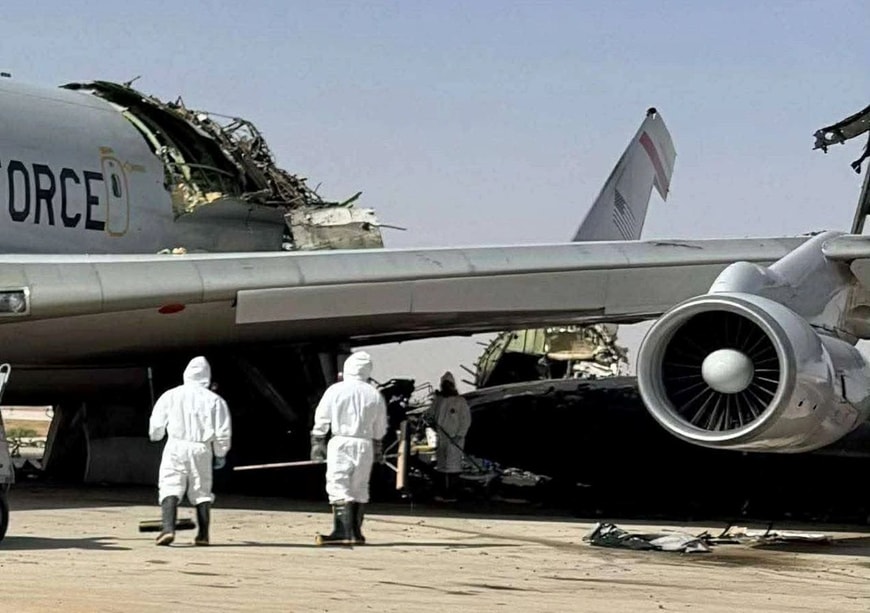
Strategic impact and adjustments by the US military.
The damage to an E-3G at Prince Sultan Air Base demonstrates Iran's precision strike capability against fixed targets. This incident forces the U.S. and its allies to consider repositioning their AWACS aircraft to be out of range of enemy missiles.
Notably, this strike could prompt the U.S. to enhance its alternative surveillance capabilities, such as E-7 Wedgetail aircraft, satellite reconnaissance, and other tactical aircraft platforms. It also sends a message from Tehran about its ability to threaten U.S. military bases in the Middle East with its existing missile and UAV technology.