Analysis of damage to US E-3G Sentry aircraft after airstrike in Saudi Arabia.
The destruction of the nearly $500 million E-3G early warning aircraft weakens the US radar network in the Middle East, creating a serious security vulnerability.
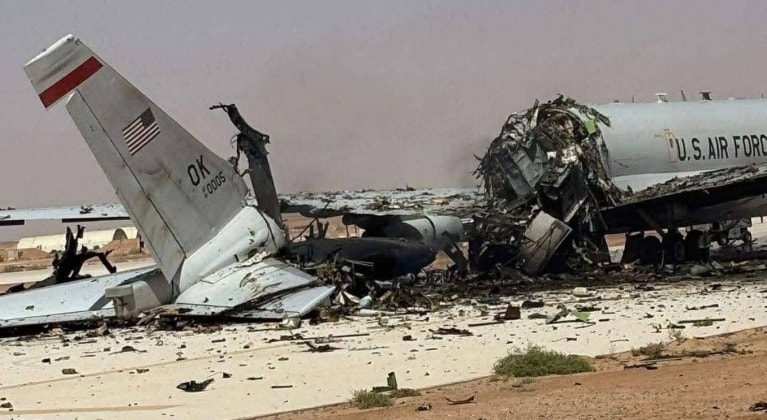
Evidence from the field has just confirmed a major loss for the U.S. Air Force, with an E-3 Sentry airborne early warning and control (AWACS) aircraft destroyed. The incident occurred during a precision strike on Prince Sultan Air Base in Saudi Arabia, targeting one of the most strategically important U.S. military assets in the region.
Details of the damage to the E-3G Sentry's "eye" radar.
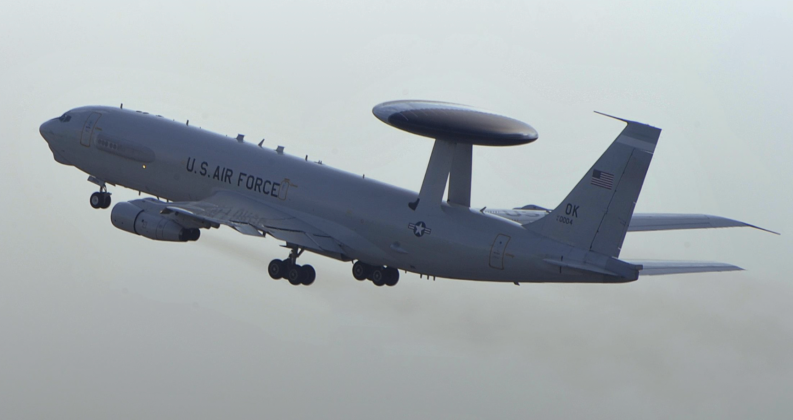
Based on imaging data from the scene, the destroyed aircraft was identified as an E-3G variant, serial number 81-0005. This aircraft belonged to the 552nd Air Traffic Control Wing, headquartered in Tinker, Oklahoma. At approximately $500 million, the E-3 Sentry is the second most expensive support aircraft in the US, surpassed only by the E-4B Nightwatch "doomsday plane."
Technical analysts say the attack struck the tail section of the aircraft, where the distinctive rotating radar dome is located – the most sensitive and expensive part of the system. While there is still debate about whether the explosive device was a ballistic missile or a suicide drone, the final result was that the E-3G was completely disabled.
Tactics to neutralize radar defense systems
The attack on the E-3G was part of a strategy to "blind" Western defense systems. Since the conflict escalated, radar networks – considered the "eyes and ears" of the US military – have consistently been priority targets. Previously, Iran destroyed extremely valuable ground-based radar systems, including the AN/FPS-132 system in Qatar ($1.1 billion) and two AN/TPY-2 systems in Jordan and the UAE (each worth between $500 million and $1 billion).
The loss of the E-3G Sentry had serious repercussions because it was a mobile platform used to compensate for gaps in ground-based radar systems. In total, a radar network worth approximately $2.7 billion was wiped out in a short period. Military sources acknowledged that this tactic increased the missile penetration rate through air defenses to hit targets by 80%.
Impact on refueling forces and the ability to maintain the pace of combat operations.
Besides the loss of early warning aircraft, aerial refueling – considered the "lifeline" of the US Air Force – also suffered heavy damage. At Prince Sultan Air Force Base, at least three KC-135 Stratotanker refueling aircraft (worth $53 million each) were completely destroyed and about 10 pilots were injured. Previously, five other KC-135s were also damaged by missiles.
The constant threat to forward bases forced American fighter jets to launch from more distant locations in Eastern Europe or outside the Middle East. This dramatically increased the need for aerial refueling, while the current KC-135 fleet was outdated and the replacement KC-46 aircraft still suffered from numerous unresolved technical issues.
Replacement challenges and the future of combat capabilities.
Replacing the destroyed E-3G is considered an impossible task in the short term. The successor aircraft, the E-7 Wedgetail, has only recently received budget approval, and the order list already extends into the 2030s. This creates a decades-long surveillance capability gap that the U.S. is unlikely to fill immediately.
This event raises serious questions about the survivability of decades-old aircraft like the E-3 Sentry against modern precision weapons. With traditional bases no longer providing safe havens, U.S. air superiority in the Middle East is facing unprecedented challenges in decades.