
Analysis of the Ukrainian attack on the S-400 system in Belgorod.
The 15th Independent Artillery Reconnaissance Brigade of Ukraine used UAVs to conduct artillery reconnaissance and attack two S-400 missile launchers of the 568th Regiment in Raievka, Belgorod region.
On December 14, the 15th Independent Artillery Reconnaissance Brigade of Ukraine conducted an attack on Russian air defense positions in Raievka, Belgorod region. The target was the 568th Air Defense Missile Regiment, the unit operating the S-400 long-range air defense missile system. Video released by Ukraine shows two S-400 launchers being attacked by drones while in motion.
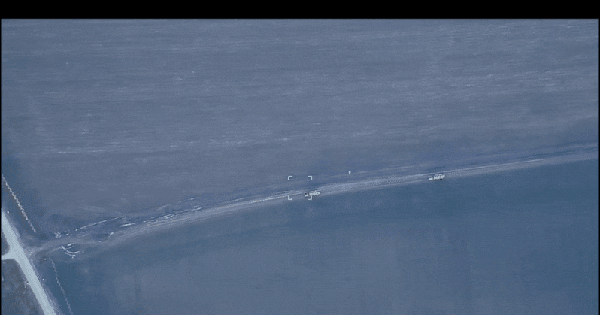
Overview of the attack on the S-400 system
According to Defense Express, the attack took place in Raievka, in the Belgorod region of Russia. This is the deployment area of the 568th Air Defense Missile Regiment, the force responsible for operating the S-400 system in the Russian air defense network.
Video released by Ukraine shows two S-400 missile launchers moving in open terrain when they were attacked by a UAV. One launcher burst into flames after being hit directly, while the other is believed to have been severely damaged. The exact extent of the damage was not provided in detail by the source.
Attack method: Coordination of UAVs and artillery reconnaissance.
Defense Express reported that the attack was conducted based on reconnaissance intelligence, combining artillery position identification and UAV surveillance. This method allowed the 15th Independent Artillery Reconnaissance Brigade to track the movement of S-400 launchers, choosing the timing of the attack when the target was exposed.
This coordination has two noteworthy tactical aspects. First, UAVs assume the role of reconnaissance, continuously monitoring and providing near-real-time data on the location and status of enemy air defense systems. Second, indirect fire is adjusted based on that information, enabling precise attacks on high-value targets while minimizing risks to the attacking side's personnel and equipment, as the source described.
Attacking while the launchers are in motion also shows that the attackers take advantage of the phase when the air defense system is least able to fully utilize its defensive capabilities, when the formation is not fixed and not in a fully deployed state.
The role and capabilities of the S-400 in Russian air defense.
The S-400 is described by sources as one of Russia's most advanced long-range air defense missile systems, capable of tracking multiple airborne targets at long distances. This system is considered among the most advanced air defense systems in the world, tasked with intercepting a wide variety of targets.
According to the information provided, the S-400 is capable of destroying airborne targets at long distances, including fighter jets, cruise missiles, and ballistic missiles. Thanks to its extensive range, S-400 systems often play a pivotal role in regional air defense networks.
S-400 battery structure
A typical S-400 battery, as described by the source, includes the following main components:
- Command and control system.
- Surveillance radar is used to detect and track targets at long range.
- Radar is used in combat to guide and direct missiles during the interception phase.
- Four Transporter Erector Launcher (TEL) units, each TEL carrying missile launch tubes.
Regarding target acquisition capabilities, the S-400 is stated to be able to track up to 300 targets simultaneously and shoot down 36 targets at the same time. This parameter demonstrates the system's highly concentrated combat capability, especially in situations where multiple types of targets approach at the same time.
The 48N6DM and 40N6 missile types.
Sources indicate that the S-400 system incorporates various types of missiles. Two specific types mentioned are the 48N6DM (48N6E3) and the 40N6:
- 48N6DM (48N6E3)The missile weighs 1.8 tons and has a 180 kg warhead. With a propulsion system described as powerful, this missile can destroy airborne targets within a range of 250 km.
- 40N6The missile has a range of 400 km and uses active radar guidance to intercept targets at very long distances.
| Missile | Weight (tons) | Warhead (kg) | Range (km) | Navigation style |
|---|---|---|---|---|
| 48N6DM (48N6E3) | 1.8 | 180 | 250 | Not specified in the source. |
| 40N6 | Not specified | Not specified | 400 | Active radar |
Military implications of the loss of the S-400 launcher in Belgorod
Sources indicate that the destruction or damage of S-400 launchers significantly weakens Russia's regional air defense capabilities. When the number of launchers in a battery or in a region is reduced, the density of air defense fire and the ability to simultaneously intercept multiple targets may be affected.
Defense Express suggests that damage to the S-400 launchers also impacts the ability to protect critical infrastructure and military positions in the Belgorod region. With its long range and ability to engage multiple targets, weakening a link like the S-400 will force the defending side to redeploy forces or acquire additional equipment from elsewhere if they want to maintain the same level of protection.
From an operational perspective, the attack demonstrated the effectiveness of a combat model based on reconnaissance, UAVs, and indirect fire targeting long-range air defense systems. This approach is built on real-time data and exploits weaknesses when the enemy is mobile or not in optimal deployment, as described in the Raievka incident.


