
France is developing a new nuclear-powered aircraft carrier, PANG, by 2038.
President Emmanuel Macron announced the new nuclear-powered aircraft carrier program, Porte-Avions Nouvelle Generation, with a capacity of 30 fighter jets and 2,000 crew members, expected to replace the Charles de Gaulle from 2038.
France will build a new nuclear-powered aircraft carrier, codenamed Porte-Avions Nouvelle Generation (PANG), with a displacement of approximately 78,000 tons, a length of 310 meters, and a capacity for 30 fighter jets and 2,000 crew members. The ship is expected to enter service in 2038, the year the Charles de Gaulle aircraft carrier is scheduled to be decommissioned, and is described as playing a central role in France's nuclear deterrence capabilities and efforts to enhance European defense autonomy.
Overview of the French statement on the aircraft carrier PANG
Speaking to soldiers stationed at a military base in Abu Dhabi, the capital of the United Arab Emirates (UAE), on Sunday (December 21), President Emmanuel Macron announced that France will build a new aircraft carrier with a capacity of 30 fighter jets and 2,000 sailors. This is the future aircraft carrier to replace the Charles de Gaulle, which is expected to be decommissioned in 2038.
President Macron emphasized that the project would benefit hundreds of French contractors, mostly small and medium-sized enterprises, demonstrating the large scale of the defense industry supply chain linked to the new aircraft carrier program.
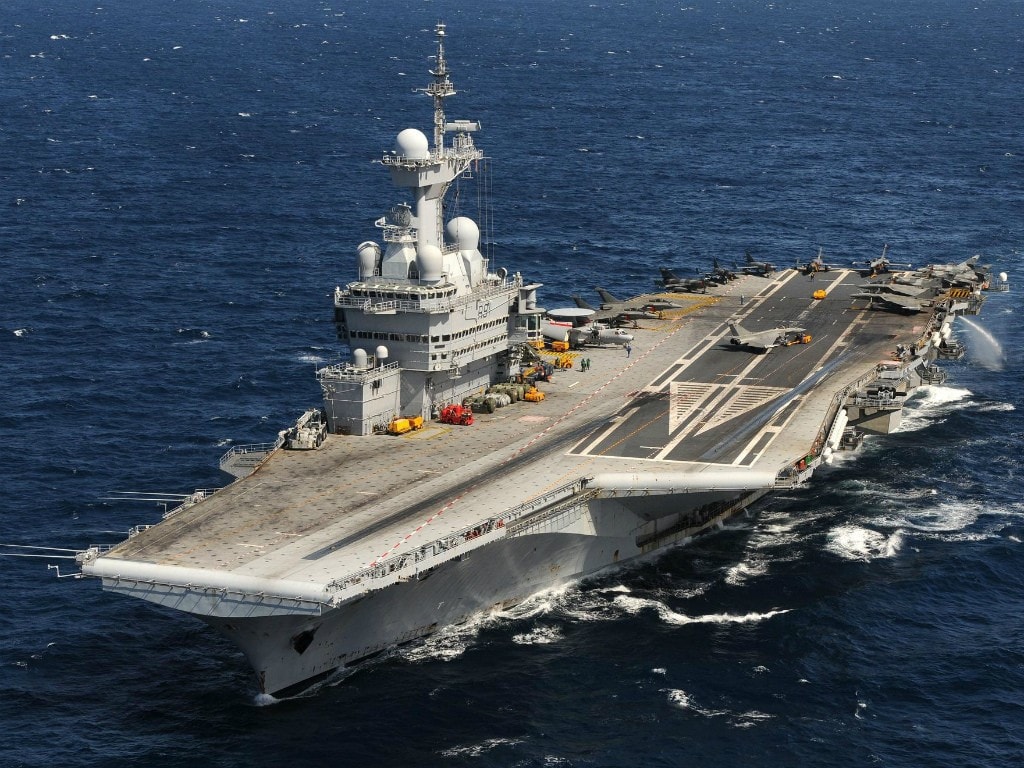
The size and key specifications of the new aircraft carrier.
According to the French Ministry of Defence, the new aircraft carrier will be capable of deploying heavy, long-range weaponry rapidly, continuously, and for extended periods. Key features revealed indicate it is a large naval platform geared towards sustained expeditionary operations.
According to Reuters, the program is called "Porte-Avions Nouvelle Generation" (PANG), with an estimated cost of around 10.25 billion euros (12 billion USD). The French government says the new aircraft carrier will enter service from 2038.
In terms of size and load capacity, PANG is expected to have:
- The payload is approximately 78,000 tons.
- The length is approximately 310 meters.
- Capacity for 30 fighter jets
- The crew consists of approximately 2,000 sailors.
Compared to the current Charles de Gaulle aircraft carrier, the new ship is significantly larger. The Charles de Gaulle has a displacement of approximately 42,000 tons and a length of 261 meters. The nearly double displacement and over 40 meters in length represent a substantial increase in space for equipment, fuel, ammunition, and combat support vehicles.
Comparison table of PANG and Charles de Gaulle
| Criteria | PANG (new ship) | Charles de Gaulle |
|---|---|---|
| Expected load | Approximately 78,000 tons | Approximately 42,000 tons |
| Length | Approximately 310 meters | Approximately 261 meters |
| Motivation | Nuclear energy | Nuclear energy (scenario) |
| Fighter jet capacity | 30 fighter jets | Not mentioned in the source. |
| Sailor staffing | Approximately 2,000 sailors | Not mentioned in the source. |
Nuclear energy technology and its operational significance
Like its predecessor, France's new aircraft carrier will be nuclear-powered. Maintaining the nuclear power option demonstrates France's continued priority on the ability to operate for extended periods at sea without relying frequently on conventional refueling.
Work on manufacturing the nuclear propulsion components for PANG began last year. The final orders are scheduled to be completed within the 2025 budget. This reflects early preparation for the most technically complex component of the spacecraft.
From an operational perspective, the French Ministry of Defence's description of its ability to "rapidly, continuously, and sustainably deploy heavy, long-range armaments" suggests that PANG is designed to ensure a high rate of operation, maintaining a naval and air presence in offshore areas for extended periods.
Air combat capability from the ship's deck.
The new aircraft carrier will be equipped with French Rafale M fighter jets, similar to the Charles de Gaulle. A capacity of 30 fighter jets provides the foundation for an onboard air wing capable of undertaking various roles in modern naval warfare, depending on the French Navy's force structure.
Combined with its larger payload and dimensions, the PANG has the potential to carry a greater amount of fuel, ammunition, and air support equipment for the ship's air wing compared to the current class of ships, thereby better supporting high-intensity and prolonged operations.
The role in nuclear deterrence and European defense autonomy.
According to the description, PANG will be the largest aircraft carrier ever built in Europe and "play a central role in France's nuclear deterrence capabilities." This underscores the aircraft carrier's position within France's overall deterrence force and military presence in strategic seas.
PANG is also associated with "Europe's efforts to enhance defense autonomy." From a geostrategic perspective, a European nation's investment in a large nuclear-powered aircraft carrier, with a projected commissioning date of 2038, demonstrates a commitment to maintaining the capability to project independent military power at sea for decades.
Impact on the French defense industry
President Emmanuel Macron said the new aircraft carrier project would benefit hundreds of French contractors, mostly small and medium-sized enterprises. With an estimated cost of €10.25 billion ($12 billion), the PANG program is a long-term undertaking involving the military shipbuilding industry, nuclear technology, and supporting sectors.
With work on manufacturing nuclear propulsion components having begun last year, and plans to complete orders within the 2025 budget, the program has a clear financial and industrial roadmap, enabling contractors to plan investments and maintain production capacity.
Replacing Charles de Gaulle and reorienting the French carrier force.
The French government has stated that the new aircraft carrier will enter service in 2038, coinciding with the planned decommissioning of the Charles de Gaulle. This demonstrates a commitment to maintaining a continuous fleet of nuclear-powered aircraft carriers in the French navy, preventing a capability gap between generations of carriers.
With its larger size, higher payload, and identified as the largest aircraft carrier ever built in Europe, PANG represents the next step in France's maritime air deployment capabilities and is a crucial component of its long-term deterrence and military presence structure.


