
France and Norway sign nuclear deterrence agreement to enhance European security.
The cooperation agreement between Paris and Oslo marks a new step in building a European nuclear umbrella, amid concerns about regional security.
France and Norway have officially signed an agreement on a "nuclear umbrella," a strategic move aimed at strengthening defense capabilities and deterrence in Europe. This agreement comes as European nations seek to increase their security autonomy in the face of complex geopolitical shifts.
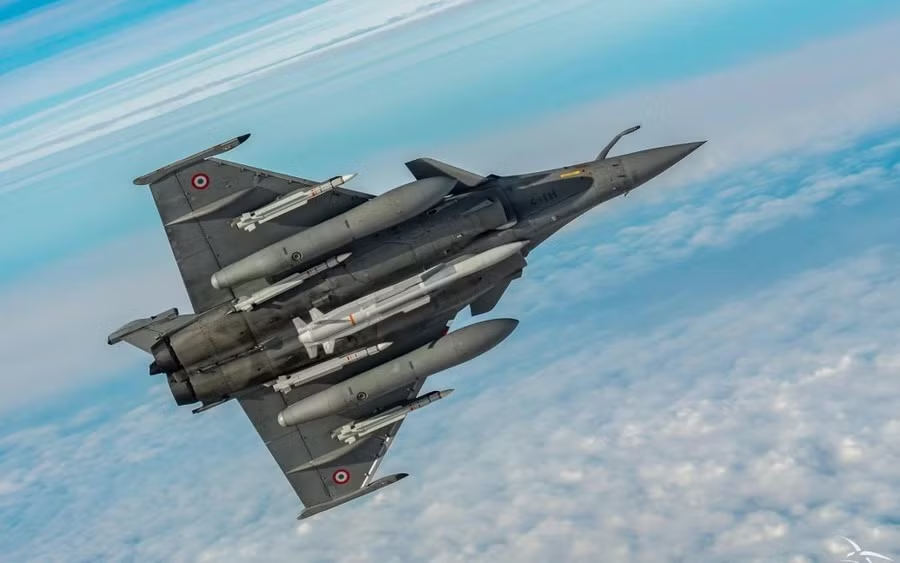
Expanding the nuclear deterrence network in Northern Europe
This important cooperation document was signed by Norwegian Prime Minister Jonas Gahr Støre and French President Emmanuel Macron. Although the detailed terms and specific timeframe of the agreement have not been widely publicized, the core objective is to establish an extended nuclear protection mechanism for this Nordic nation.
According to Prime Minister Jonas Gahr Støre, this decision was made based on an assessment of the current security situation in Europe. He emphasized that Russia's large-scale rearmament programs, including in the nuclear field, were the key reason why Norway had to seek stronger protection commitments from its ally.
Notably, despite participating in this agreement, Norway maintained its position of not deploying nuclear weapons on its territory during peacetime. This demonstrates a cautious approach to balancing deterrence capabilities with efforts to avoid direct escalation of tensions.
The shift in security thinking among Scandinavian countries.
Norway is not alone; other Scandinavian countries are taking similar steps. Denmark has expressed its willingness to co-finance a joint European nuclear deterrence project and has not ruled out the possibility of discussing the deployment of weapons on its territory in the future.
Sweden, a new NATO member, has also been holding preliminary consultations with both France and the United Kingdom since the end of January. This shift reflects growing concerns about the sustainability of security guarantees from the US, forcing European countries to strengthen their internal security pillars.
The crucial role of French nuclear capabilities
Currently, France holds the position of being the only country in the European Union (EU) to possess independent nuclear weapons capabilities. France's deterrence system is based on strategic nuclear submarines and air-to-ground cruise missiles carrying nuclear warheads, ensuring the ability to retaliate in any situation.
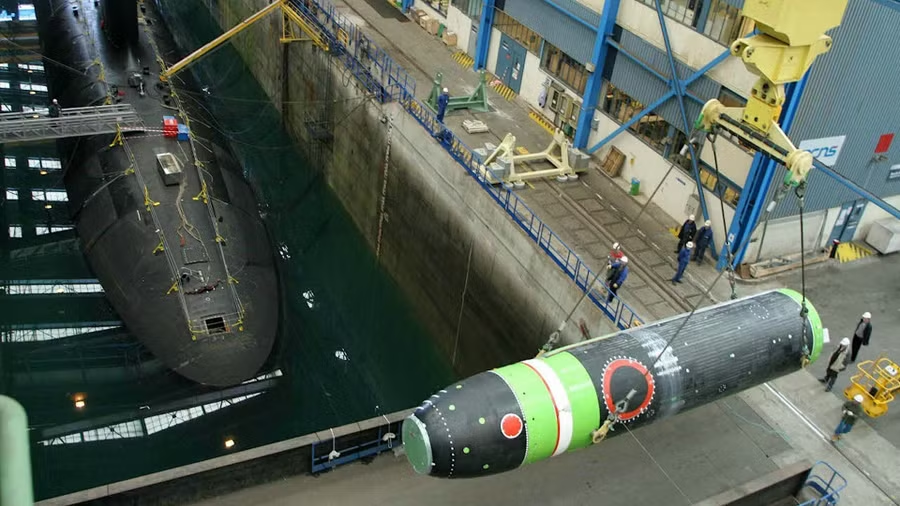
The M51 intercontinental ballistic missile is one of the most powerful symbols of Paris's military might. France's willingness to share this "umbrella" with allies like Norway and Germany indicates a new strategy aimed at building a more autonomous European security structure.
Recent surveys indicate that approximately 59% of French citizens support the use of the nation's nuclear arsenal to defend all of Europe. Simultaneously, Germany is actively negotiating with France on joint nuclear projects, including the possibility of providing financial support for these strategic weapons development programs.
The signing of the agreement between France and Norway is not just a bilateral event, but also signals a new era in European defense policy, where nations proactively cooperate to protect themselves against potential external threats.


