
Remarks by General Secretary To Lam at the closing session of the 12th Central Committee Conference.
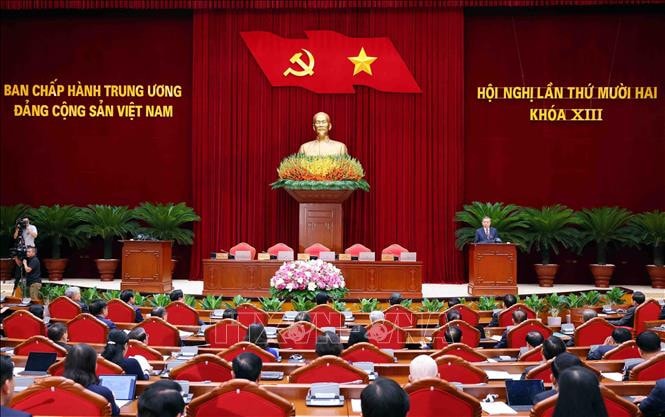
After two days of urgent, serious, democratic, and highly responsible work, the 12th Conference of the Central Committee of the 13th Party Congress completed its entire agenda and adjourned this afternoon (July 19).
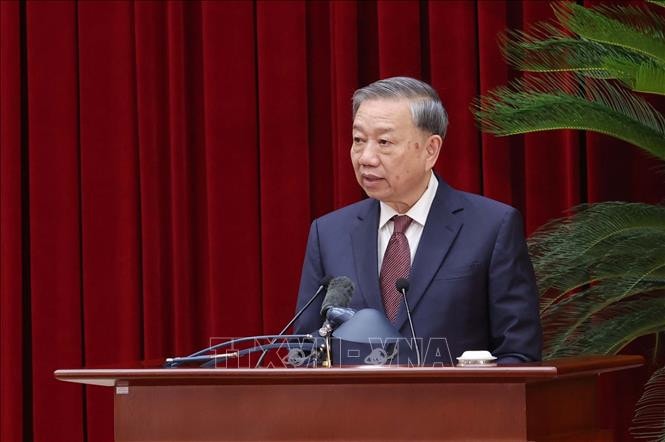
General Secretary To Lam presided over and delivered the closing remarks at the conference. We respectfully present General Secretary To Lam's speech:
"Dear members of the Central Committee of the Party,
Distinguished delegates attending the Conference.
After two days of urgent, serious, democratic, and highly responsible work, the 12th Conference of the 13th Central Committee of the Communist Party of Vietnam completed its entire agenda. The conference discussed, provided in-depth and comprehensive feedback, and reached a high level of consensus on three key strategic areas that provide long-term direction and directly serve the preparation for the 14th Party Congress and promote the continued process of national renewal and sustainable development in the new era.
On behalf of the Politburo and the Secretariat, I would like to express my sincere gratitude to the Central Committee members and delegates attending the conference for their high sense of responsibility and for contributing many heartfelt, frank, and insightful opinions to the conference agenda. I also thank the Central Office and related units for their excellent service in hosting this conference. Following this, I will summarize the important results of the conference and identify the major tasks and solutions that need to be implemented immediately after the conference.
I. Regarding the orientation of the documents to be submitted to the 14th National Congress of the Party
With a revolutionary and proactive spirit, and a spirit of continuous innovation, the Central Committee decided to integrate the content of three documents—the Political Report, the Socio-Economic Report, and the Report on Party Building Summary—into a single Political Report, following a consistent, unified, and synchronized framework, to be presented at the 14th National Congress of the Party. The Central Committee requested that the new Political Report be refined in the following direction:
(1) Ensuring continuity and innovation, reflecting the true development reality of the country, especially the outstanding achievements in politics, economics, culture, society, national defense, security, foreign affairs... with the view that we have the foundation, potential, position and international prestige as we have today because of the culmination of a thousand years of national civilization, especially the achievements of 95 years under the leadership of the Communist Party of Vietnam, 80 years of the Socialist Republic of Vietnam, 40 years of reform and the great contributions and sacrifices of many generations of Party members and the masses of people.
(2) Define the goals of the XIV Congress term and the vision to 2045, 2050 and beyond, linked to two goals: 100 years under the leadership of the Party, 100 years of the establishment of the Socialist Republic of Vietnam.
(3) Emphasize new development drivers, including science and technology, innovation, digital transformation, development of high-quality human resources, and effective exploitation of the advantages of deep international integration.
(4) Affirming the key role of Party building and rectification work, anti-corruption, anti-waste, and anti-negative work; combating individualism, group interests, ideological and moral degradation, and lifestyle degradation; strengthening power control; improving the leadership, governance and fighting capacity of the Party; improving national governance capacity and operational management of the organizational apparatus in the political system.
(5) The Central Executive Committee assigns the Politburo and the Secretariat to continue directing the Subcommittees preparing the XIV Congress to complete the documents, continue to organize widespread consultations within the Party and the entire society, ensuring quality, consensus and strategic significance.
(6) The Reports summarizing the implementation of the Party Charter and the Report summarizing 40 years of reform also need to be further improved with the spirit mentioned above to truly become the foundation for maintaining unity and solidarity within the entire Party and the foundation for planning future national development strategies.
II. Regarding the amendments and additions to some resolutions and conclusions of the Central Committee to create a political basis for the goal of continuing the reform and renewal of the country.
The Central Committee has reviewed and provided guidance on summarizing practical experiences and assessing obstacles and shortcomings in some current laws and institutions, thereby outlining amendments to remove legal bottlenecks and promote development in the new phase.
The research on lawmaking should be oriented towards the following: Legal regulations must be fundamentally stable and have long-term value; laws regulating development should only stipulate framework issues and principles within the authority of the National Assembly, while practical issues that are constantly changing should be left to the Government, ministries, and localities to regulate, ensuring flexibility and suitability to reality. Continue to innovate and improve the structure of the national legal system according to the new development model. The Politburo is tasked with directing the conclusion on amending, supplementing, and perfecting the content of the Resolutions submitted for comments at this Conference, based on the feedback from the Central Committee.
Regarding land management, the focus should be on perfecting the legal framework for land ownership, planning, and use, ensuring transparency, fairness, efficiency, and a harmonious balance of interests between the State, the people, and businesses. It is crucial to emphasize that land is a special national resource, a vital resource for national development, and a key input for socio-economic development investment; land management and use must ensure the common good of all citizens; efforts should be made to complete the construction of a centralized, unified, synchronized, multi-purpose, and interconnected national land database and information system; land use planning should be established at both national and local levels; priority should be given to allocating land for the development of integrated infrastructure, industry, services, and urban development; and the efficiency of land use should be maximized.
Regarding the planning sector: It is necessary to resolve overlaps between sectoral, regional, and local plans; propose appropriate solutions to create a basis for the implementation of harmonious and mutually supportive spatial development planning, creating dynamism between national, regional, and local plans; adjusting the national master plan for the period 2021-2030, with a vision to 2050, is necessary and urgent; the adjustment of the national plan must ensure consistency with the country's socio-economic development strategy, with the major policies and guidelines of the Party and State, and with the orientation of socio-economic spatial organization after administrative unit reorganization.
Regarding education and training, the Central Committee requested strengthening the comprehensive leadership of Party committees at all levels, promoting the role and responsibility of the heads of educational and training institutions; the State playing a leading role in ensuring resources for investment and development of education and training; and at the same time, promoting socialization and maximizing the attraction of social resources for the development of education and training; the level of financial autonomy should not be used as a basis for determining the level of autonomy for public educational and training institutions.
The Central Committee affirmed that institutional reform is a breakthrough and a key driving force for promoting rapid and sustainable development. Therefore, it requires all levels and sectors to: (i) Proactively review and propose amendments and additions to legal documents that are inadequate or contradictory; (ii) Build a synchronous, unified, transparent, and feasible legal system, creating a favorable investment and business environment and ensuring the legitimate rights of the people; (iii) Promote the application of technology in state management, transforming from a management-oriented administrative model to a service-oriented administrative model.
III. Regarding the direction of personnel work for the 14th Party Congress
Recently, despite having to focus intensely on leading and directing the completion of a very large volume of work regarding the restructuring and streamlining of the organizational apparatus and the timely provision of leadership personnel for agencies and units at the central and local levels, the Politburo directed the Personnel Subcommittee to study and fully incorporate the opinions of the Central Committee at the 11th Conference to finalize the Draft Guidelines on Personnel Work of the 14th Central Committee of the Party; at the same time, to develop guidelines for allocating the structure and number of official Central Committee members to localities, agencies, and units, and submit them to the 12th Central Committee Conference for consideration as prescribed. These contents, after discussion, received basic agreement and high consensus from the Central Committee.
The Central Committee unanimously agreed on the following assessment:
(1) The direction of personnel work for the 14th Party Congress is a particularly important document, deciding on all the preparation and election of personnel for the Central Committee, the Politburo, the Secretariat, the General Secretary and key leadership positions of the State, contributing to the success of the 14th Party Congress; continuing to enhance the position and more clearly affirm the comprehensive, absolute, and direct leadership role of the Party over the country, especially when we are directing the strong, synchronous, and comprehensive revolution of reorganizing and streamlining the organizational apparatus from the Central to the grassroots level to enter the era of prosperous development of the nation.
(2) Cadre work is the "key of keys"; therefore, the preparation of personnel for the 14th Party Congress must be carried out in a synchronized, scientific, systematic, rigorous, democratic, objective, and transparent manner; ensuring compliance with Party regulations, the principle of democratic centralism, and legal regulations.
(3) The preparation of personnel for the Party Central Committee, the Politburo, and the Secretariat must adhere to and uphold the Party's basic viewpoints and principles; national interests must be placed above all else; harmoniously and reasonably handle the balance between standards and structure; between inheritance, stability and innovation, development; between universality and specificity; between professional training and practical skills and abilities; between prestige, work experience and development direction; in which, especially the quality, efficiency, work products, and contributions of cadres are emphasized as a measure in evaluating, assigning, and using cadres; ensuring suitability in structure, age, gender, ethnicity, region, and area.
(4) The introduction and selection of personnel must be based on the prescribed standards and conditions, generally based on planning but not too rigid, but based on specific practical considerations, not overlooking factors outside the plan but with outstanding leadership qualities and capabilities, best meeting the requirements of the revolution in the new stage; at the same time, closely linked with the personnel arrangement plan to assume key leadership positions of the committees, ministries, branches, agencies, and units at the central and local levels for the 2026-2031 term and the Vietnam Fatherland Front, political and social organizations for the next term.
(5) Resolutely prevent the inclusion of people who do not meet the standards and conditions and are not worthy of participating in the 14th Party Central Committee; at the same time, effective solutions and measures must be taken to limit and quickly overcome the situation where personnel who have just been elected to the Party Central Committee or have just been planned and appointed have to be reviewed, disciplined or prosecuted for criminal responsibility.
(6) Regarding the orientation for allocating the structure and number of official members of the 14th Party Central Committee to localities, agencies, and units, the Central Committee agrees and highly agrees and believes that the orientation for allocation is prepared relatively thoroughly, strictly, with continuity, close to the practical situation and persuasive; at the same time, it is closely linked to the requirements of leadership in carrying out political tasks and building a team of high-level Party leaders in the present as well as in the new development stage of the country.
Regarding Party Congresses at all levels, the Central Committee has determined that the Party Congresses at all levels for the 2025-2030 term are of đặc biệt importance. This is not only a large-scale and profound political activity throughout the Party and the entire population, but also a prerequisite for the successful organization of the 14th National Congress of the Party. Currently, agencies and organizations within the political system operating under the two-tiered local administrative unit model have begun functioning. Party committees and organizations at all levels need to focus on leading and directing the successful organization of Party Congresses at all levels according to the following schedule: grassroots-level congresses to be completed before July 31st; congresses at the level directly above the grassroots and Party committees at the commune, ward, and special zone levels to be completed before August 31st; and provincial-level Party Congresses and Party committees directly under the Central Committee to be completed before October 31st. At the same time, it is required that Party committees, during the preparation and organization of their congresses, focus on thoroughly discussing tasks and solutions to continue contributing to the completion of the Party's 14th National Congress documents and the documents of their own congresses; demonstrating innovation and revolution in leadership, guidance, and implementation.
The Central Committee requested the Central Organizing Committee, provincial and city Party committees, and subordinate Party committees to urgently implement the plan for organizing congresses at all levels, promptly address any arising difficulties, and avoid being passive, delayed, or causing internal disunity.
Regarding personnel matters, the Central Committee unanimously agreed on the following requirements:
(1) Firmly adhere to the principle of unified Party leadership in personnel work, implement the correct procedures, objectively, transparently, democratically but seriously, and avoid unhealthy lobbying.
(2) Building a team of cadres at all levels, in addition to the policy of paying attention to training strategic-level cadres, we must also pay special attention to building a strong team of grassroots-level cadres, capable of doing the job well, selecting cadres who meet the standards of political qualities, ethics, practical ability, innovative thinking, dare to think, dare to do, dare to take responsibility, are close to the people, have a vision for development to put them in key positions.
The Central Executive Committee decided to discipline comrades Nguyen Xuan Phuc, Vo Van Thuong, Vuong Dinh Hue, and Le Minh Khai by removing them from all their Party positions; expelling comrade Nguyen Thi Kim Tien from the Party; and agreeing to relieve comrade Do Duc Duy from his position as a member of the 13th Central Executive Committee and comrade Vo Chi Cong from his position as an alternate member of the 13th Central Executive Committee.
IV. Regarding the operation of the two-tiered local government model
The conference noted the initial report on the implementation of the two-tiered local government model in 34 provinces and cities, encompassing 3,321 communes, wards, and special zones, with the spatial organization restructured to complement, support, and create endogenous driving forces for each province, region, and nationwide.
Preliminary results after 19 days of implementation show that: (1) The basic system operates well, without major problems, and officials and civil servants have initially adapted; (2) The work process is relatively smooth, and public services are resolved faster; (3) The people express their agreement and hope that the new model will be more effective.
However, the Central Committee also noted: (i) The need to continue improving guiding regulations and building interconnected operational procedures; (ii) Timely adjustment of inadequacies in the assignment and delegation of tasks; (iii) Improving the quality of retraining and professional development of cadres, especially at the commune level; (iv) Strengthening supervision, inspection, and periodic evaluation of the operational effectiveness of the model.
The Central Committee has instructed the Party Committee of the Government, the Party Committee of the Central Party Agencies; the Party Committee of the Fatherland Front and central mass organizations, and the Party Committees of provinces and cities to continue closely monitoring the situation, conducting a comprehensive review after six months to propose adjustments appropriate to the practical situation.
V. Some key tasks following the Conference:
To effectively implement the conclusions of the 12th Central Committee Conference, I propose that Party committees, Party organizations, and the entire political system focus on successfully carrying out the following key tasks:
1. Organize thorough dissemination of the conclusions of the 12th Central Committee Conference, ensuring that every cadre and Party member understands them correctly, implements them correctly, and reaches a high level of consensus.
2. Expedite the completion of draft documents, gather broad feedback, leverage collective intelligence, and refine them to be concise, easy to understand, and strategic in nature.
3. Urgently review and propose amendments to the law in a way that promotes innovation and development, removes barriers, and ensures the interests of citizens and businesses.
4. Implement the preparations for the Party Congress at all levels in a systematic, thorough, democratic, and rigorous manner, following the correct procedures, especially in the areas of documents and personnel.
5. Continue to improve the two-tiered government model, while simultaneously enhancing the quality of the staff, the spirit of service, and the effectiveness of public administration.
6. Organize well the activities commemorating the 80th anniversary of National Day (September 2, 1945 - September 2, 2025) and other major national holidays, creating a vibrant atmosphere of emulation, joy, confidence, and pride among the entire Party, people, and armed forces nationwide. Achieve the goals of national defense, national development, and improving all aspects of people's lives.
Comrades,
The 12th Central Committee Conference marked an important step in the preparation process for the 14th National Congress of the Party. The results of the Conference clearly demonstrated the spirit of innovative thinking, decisive action, unity, democracy, discipline, creativity, and development.
We are facing new opportunities but also many challenges. The global and regional situation continues to be complex and volatile, intertwining opportunities and challenges, requiring the entire Party, the entire people, and the entire army to maintain faith and aspirations for development, and to be determined to continue comprehensive reforms to build a peaceful, developed, strong, prosperous, and happy Vietnam.
With that spirit, I declare the closing of the 12th Central Committee Meeting, 13th term.
Wishing you all good health and success in fulfilling your assigned duties.
Thank you very much.


