
A massive subsurface ocean has been discovered 600km below the ground.
International researchers have discovered a groundwater ocean existing at a depth of 400-600 km below the Earth's surface, which could wipe out life if it dries up.
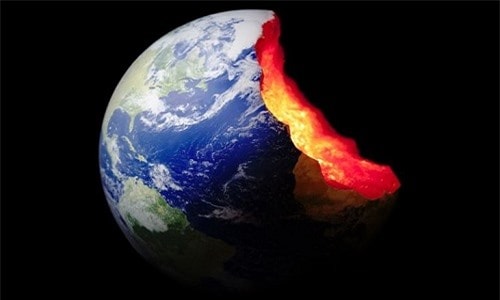 |
| Scientists have discovered a subsurface ocean existing at a depth of 400-600 km below the Earth's surface. (Illustration: iStock) |
A team of researchers at the University of Florida, USA, and the University of Edinburgh, UK, have found evidence of a vast underground ocean hidden beneath the Earth's surface, according to the International Business Times.
In a report recently published in the journal PNAS, researchers examined brucite, a hydrated mineral thought to be unstable for storing water at depths of 400-600 km. Previous experiments have shown that minerals decompose deep within the Earth, releasing all the water they store. This water is then typically transported to the Earth's surface through volcanic activity.
Scientists Mainak Mookherjee and Andreas Hermann performed numerous quantum calculations on thousands of potential structures until they discovered a form of brucite that is stable at high pressure. They found that water could be stored and transported inside the mineral brucite at depths of 400-600 km.
"We didn't think hydrated minerals like brucite could store water under these conditions. But now that we know it's there, we need to calculate how much water is contained within the mineral," Mookherjee said.
The discovery not only shows that water can be stored at much greater depths than previously thought, but also allows scientists to use the information to calculate the amount of water lying beneath the Earth's mantle.
According to Mookherjee, water deep underground is just as important as surface water in terms of its impact on planetary activity. If it dries up from the inside, the planet will die because geodynamic activity within the planet will cease.
"If all the water were removed from the Earth's interior, the planet would become so dry that it would be difficult to sustain itself. Geodynamic activity would be affected and slowed down. This would impact crustal tectonics, and once crustal tectonics stops, there will be no more volcanoes. Volcanoes play a crucial role in shaping the Earth's crust, so everything would cease to function," Mookherjee said.
According to VNE
| RELATED NEWS |
|---|


