
Over 400 artifacts discovered in a royal tomb of the Wei Dynasty.
Archaeological teams in Luoyang, China, are excavating a royal tomb of the Wei dynasty, likely belonging to the empress of Cao Rui, grandson of Cao Cao.
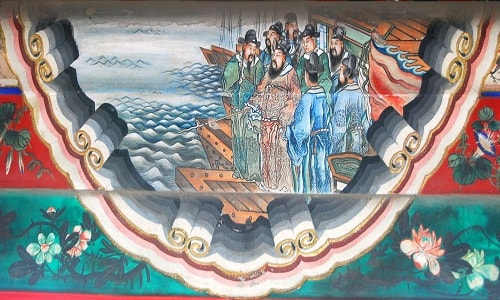 |
A painting depicting Cao Cao reciting poetry before the Battle of Red Cliffs. Image: Wikipedia. |
Archaeologists have discovered a large tomb of a queen from the Three Kingdoms period (220-280 AD) in central Henan province, China, Xinhua reported. Located south of Xizhu village in Luoyang city, the tomb measures 52 meters long, 13.5 meters wide, and 12 meters deep along a sloping bank, according to the Luoyang Institute of Cultural Relics and Archaeology.
"The layout and design of the seven-tiered staircase indicate that the tomb belonged to a high-ranking member of the Cao Wei royal family. Through examining the artifacts and comparing them with historical records, we discovered that this could be the tomb of Cao Rui's empress," said Shi Jiazhen, director of the research institute.
Cao Rui succeeded his father, Cao Pi, as ruler of the Wei Kingdom. Cao Pi was the son of Cao Cao, one of the most famous generals of the Three Kingdoms period.
The tomb was discovered by a local resident in 2015. Due to concerns about looting, the research institute decided to excavate it early. "The tomb suffered significant damage from groups of robbers during the early Song Dynasty (960-1257)," Shi said.
The excavation team unearthed more than 400 samples of pottery, lacquerware, bronze, iron, and jade, along with 100 stone tablets listing the burial objects in the tomb.
According to VNE


