
Authorities discover many beef products are actually pork.
Of the 44 fresh meat samples tested, 35 were beef, 1 was buffalo meat, and 8 were pork.
Recently, through proactive monitoring using samples of raw and cooked meat, the National Institute of Food Safety and Hygiene Inspection discovered many products labeled as beef that were actually pork. Thus, not only are consumers being deceived and paying more because beef is more expensive than pork, but there are also potential dangers as sellers use chemicals to transform beef into pork.
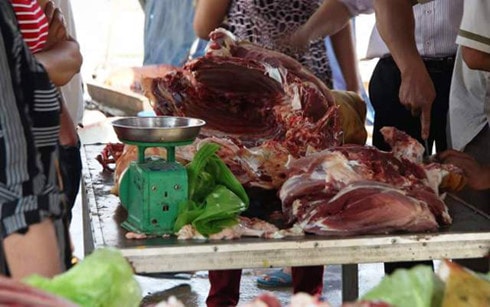 |
| Many beef products on the market are not real beef. |
The samples taken by the National Institute of Food Safety and Hygiene for testing included: fresh beef, beef sausage, beef patties, beef brisket, and beef in pho. The results showed that many samples contained no beef or only negligible amounts of beef. These samples were collected from various districts in Hanoi.
Specifically, out of 44 samples of fresh beef tested, 35 were beef, 1 was buffalo meat, and 8 were pork. Regarding the samples of rare and cooked beef from 10 pho restaurants, 2 restaurants actually served pork pho, while the other 8 served genuine beef pho. Notably, out of 12 samples of beef brisket, 10 were pork, and only two were genuine beef.
Testing was also conducted on 20 samples of beef sausage, revealing that 9 samples were entirely pork, while the remaining 8 samples had very low beef content, with the lowest being 13% and the highest beef content at 60%, with the rest being pork.
Notably, among the 23 samples of beef sausages, 8 samples showed no detectable beef content, and the remaining 15 samples had very low beef content. These sausage samples included products with full labeling, production licenses, and quality declarations.
According to the National Institute for Food Safety and Hygiene Testing, the aforementioned samples of raw and cooked beef, although not containing real beef or containing very little beef, still exhibited the characteristic smell and color of real beef. This necessitates further research by the Food Safety Department (Ministry of Health) to clarify the use of flavorings, additives, and coloring agents to transform pork into beef as described above.
The worrying aspect is that the use of unregulated additives and flavorings, in incorrect dosages, and of unknown origin, can be harmful to consumers.
According to VOV


