
Sustainable development of the fisheries economy
(Baonghean) - With its long coastline, vast fishing grounds, abundant aquatic resources, numerous estuaries, and thousands of hectares of brackish water for aquaculture, Nghe An has great potential for developing a sustainable aquatic economy…
Blessed with an 82 km long coastline, and with 5 coastal districts and towns formed by numerous large river mouths flowing into the sea, along with 6 estuaries, our province has favorable fishing grounds, rich and abundant aquatic resources. The exploitation and harvesting of marine resources always holds an important position in the economic life of the entire province.
Following the development trend and encouraged by the policies and guidelines of the Party and the State, fishermen in the province have boldly invested in large vessels with powerful engines to venture further offshore for longer fishing trips to achieve higher economic efficiency. The capacity of fishing vessels has increased rapidly, with a decrease in inshore fishing vessels and an increase in offshore fishing vessels. To date, the total number of fishing vessels in the province is 3,964, of which 1,380 are offshore fishing vessels.
Many fishing vessels are equipped with modern navigational equipment such as GPS, fish finders, and communication devices; technology and fishing methods are becoming increasingly advanced. To ensure the safe and efficient operation of fishing and service vessels at sea, the provincial fisheries sector has focused on guiding and disseminating information to fishermen about equipping them with relatively modern electronic navigation equipment over the years. Most notably, the fishermen of Nghe An have effectively upheld their tradition of solidarity, cooperation, and mutual support at sea.
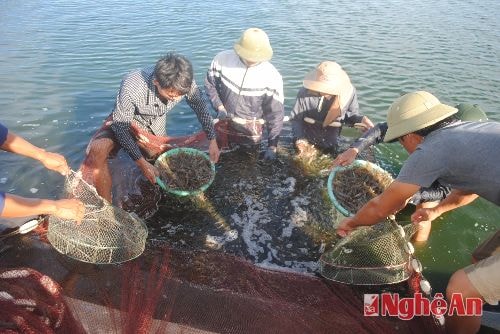 |
| Shrimp harvesting in Quynh Xuan ward, Hoang Mai town. (Photo: Van Hai) |
Simultaneously, emphasis is placed on exploiting the advantages of coastal areas, the sea, and ponds and lakes to expand aquaculture areas and introduce many new species into production. Many aquaculture models following VietGAP standards, intensive whiteleg shrimp farming, tiger shrimp farming, semi-intensive green crab farming, tilapia farming, snakehead fish farming, etc., are being effectively implemented in coastal localities and mountainous and midland regions. In 2015, the province's fisheries sector also produced and raised over a billion aquatic species.
Currently, the province has 22,500 hectares of aquaculture, including 20,000 hectares of freshwater fish farming and 2,500 hectares of brackish water farming (of which 1,750 hectares are intensive and semi-intensive shrimp farming). Total aquatic product output in 2015 reached 145,000 tons, double that of 2006. The growth rate of production value in the aquatic sector during the 2011-2015 period averaged 10-11% per year. |
Another "pull-up" relationship in the fisheries sector is that when production reaches a high level, the processing industry also develops accordingly, bringing significant added value. Like many other coastal regions, seafood processing in Nghe An has received attention and development quite early on, meeting both domestic and export demands. New and upgraded export processing plants with increasingly modern equipment have been invested in, contributing to the shift in the industry's structure towards commodity production and actively serving the export objectives of the region.
Currently, the province has 14 concentrated seafood processing zones, annually supplying the market with nearly 25 million liters of various types of fish sauce, over 15,000 tons of fish meal, and 5,000 tons of various types of fermented fish paste. Export processing facilities have been invested in terms of scale, equipment, and production technology. Accordingly, the export of processed seafood products in 2015 reached 35,000 tons; the value of processed seafood exports in 2015 reached 25 million USD. Along with production development, the fisheries infrastructure has received special attention and investment. To date, the province has upgraded and expanded fishing ports, wharves, and storm shelters such as Lo Lach, Corn Lach, Van Lach, and Cua Hoi, creating favorable conditions for product exchange, increasing product value, and reducing loading and unloading times.
Despite the achievements, the fisheries sector in Nghe An province has also faced many difficulties and limitations in recent years: The value of the fisheries sector in the province's GDP is not high; many fishing vessels are still outdated; productivity, output, and efficiency in aquaculture are still low compared to potential; the capacity for producing aquatic animal seeds is inadequate; there is a shortage of raw materials for processing and export; and concentrated raw material areas have not been developed.
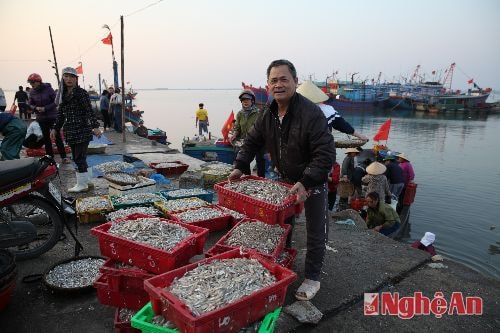 |
| Fishermen in Nghi Hai ward (Cua Hoi), Cua Lo town, are enjoying the anchovy fishing season. (Photo by Xuan Nhuong) |
To exploit and develop the fishing and aquaculture industry in an efficient, safe, and sustainable manner, it is necessary to strengthen the management and rational use of natural resources and protect the ecological environment; focus on mobilizing, managing, and rationally using resources for investment in infrastructure construction; encourage organizations and individuals to invest in production and breeding of aquatic species in Nghe An to proactively secure breeding stock for key species according to the agricultural restructuring plan; encourage aquaculture according to VietGAP standards; build offshore fishing vessels according to Government Decree 67; and gradually modernize the fishing industry.
Simultaneously, it is necessary to strengthen training to improve the quality of human resources and promote the application of scientific and technological advancements, especially biotechnology, to enhance the productivity and quality of aquaculture, fishing, and seafood processing; linking fisheries development with consolidating production relations, improving people's lives, addressing social issues, maintaining political security, and firmly ensuring national sovereignty over the sea and islands.
The province's goal by 2020 is to develop the fisheries sector into a large-scale, stable commodity production industry to ensure the province's agricultural, forestry, and fisheries growth targets, contributing to job creation and increased people's income. The target is to achieve a total fisheries production of 150,000 tons by 2020; including 100,000 tons from fishing and 50,000 tons from aquaculture. The goal is also to produce 100% high-quality aquatic species and 100% disease-free tiger shrimp and whiteleg shrimp by 2020. |
Tran Huu Tien
(Deputy Director of the Department of Agriculture and Rural Development)


