
Philippines - China before the ruling
(Baonghean) - Tomorrow (July 12th) will be the day the Permanent Court of Arbitration in The Hague issues its ruling on the Philippines' lawsuit challenging China's "nine-dash line" claim in the South China Sea. Ahead of this important political event, Bao Nghe An newspaper interviewed Associate Professor, Doctor, Major General Le Van Cuong - former Director of the Institute of Strategy and Science of the Ministry of Public Security - about this issue.
PV:General, could you explain why the Philippines filed a lawsuit against China and what the lawsuit entails?
Major General Le Van Cuong:The Philippines' lawsuit against China has become a focal point of international attention. Currently, there are more than 50 disputed maritime and territorial issues around the world, and the parties involved must resolve these disputes through various means.
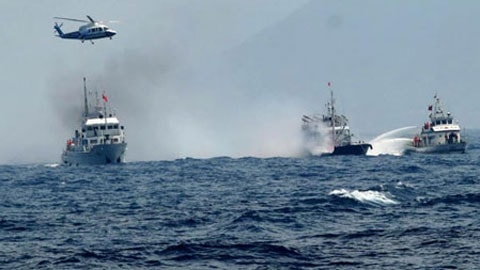 |
| The South China Sea dispute is creating security risks in the region. Photo: Internet |
In the event of a dispute with China, the Philippines chose to bring the case before the Permanent Court of Arbitration (PCA) in The Hague (Netherlands) because the country had also engaged in peaceful dialogue with China based on international law.
However, after years of unsuccessful attempts, former Philippine President Aquino was forced to choose the method of suing China at the PCA – a court established under Annex 7 of the 1982 United Nations Convention on the Law of the Sea. In terms of legal status, the PCA is an international judicial body of the United Nations, but it does not have the authority to rule on issues of sovereignty. Therefore, in its 4,000-page lawsuit, the Philippines focused on 15 points, but the most crucial was the request for the PCA to rule that China's "nine-dash line" claim is contrary to the 1982 United Nations Convention on the Law of the Sea (UNCLOS).
PV:Why did China react negatively to the Philippines' lawsuit and insist on not joining the case?
Major General Le Van Cuong:In 2013, as soon as the Philippines submitted its case to the PCA, China publicly declared to the world that the PCA had no legal standing, no function, and no authority to hear and resolve the case, and therefore would not participate in the proceedings.
China also claims that it and the 10 ASEAN countries already have a Declaration on the Conduct of Parties in the South China Sea (DOC) from 2002. Beijing's view is that this is already a solution to the dispute and therefore does not require an international judicial body. However, what China doesn't say is that it has absolutely no legal basis for asserting sovereignty over the Paracel and Spratly Islands, especially regarding its "nine-dash line" or "cow tongue line" claim.
In 2009, in a diplomatic note to the United Nations, China for the first time publicly stated its position that it has sovereignty over the area encompassed by the "nine-dash line." However, this claim is entirely vague because China has not been able to determine the coordinates and has no basis for making its sovereignty claim. Because it lacks a legal basis, it greatly fears being sued by other countries at the Permanent Court of Arbitration (PCA).
PV:So, what are your predictions regarding the PCA ruling, Major General?
Major General Le Van Cuong:Tomorrow (July 12th), the PCA will issue its final ruling. The whole world is studying, watching, and making various judgments.
The PCA's initial ruling on October 29, 2015, a 151-page document, shows that, firstly, based on Annex VII of the 1982 UN Convention on the Law of the Sea, the PCA has full jurisdiction to hear and handle the Philippines' case against China. Secondly, China's non-participation in the case does not affect the PCA's conclusion because both China and the Philippines are signatories to the Convention on the Law of the Sea and are obligated to comply with the provisions regarding dispute resolution. In this ruling, the PCA addressed 7 out of the 15 points raised by the Philippines and will issue a further ruling on July 12th.
I think, based on the above ruling, the PCA will have several options: Firstly, the PCA will rule in accordance with the Philippines' request that the 100 features in the Spratly Islands fall into only two categories. The first category consists of partially submerged rocks, which, according to the 1982 UN Convention on the Law of the Sea, have no 12-nautical-mile territorial sea and no exclusive economic zone. The second category consists of rocks and islands or inhabited islands, which have a 12-nautical-mile territorial sea. Islands also have a 200-nautical-mile exclusive economic zone. If the PCA rules that all features in the Spratly Islands are merely partially submerged or rocks, this would be very beneficial for the Philippines in particular, and for countries with or without disputes in the Spratly Islands in general, because fishing vessels, commercial ships, and warships would be free to navigate through the Spratly Islands waters without anyone having the right to obstruct them.
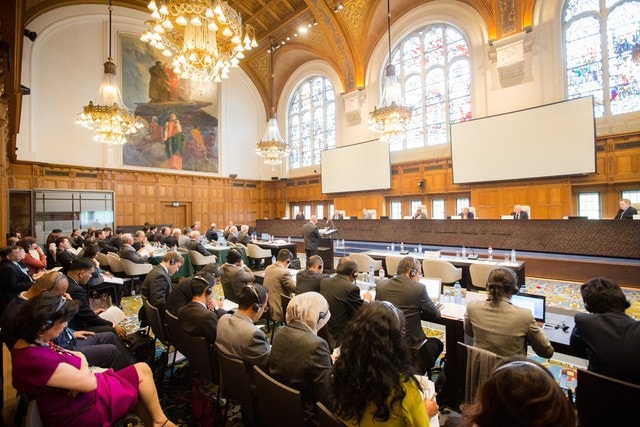 |
| From July 7-13, the Permanent Court of Arbitration held closed-door hearings in the Netherlands to hear the Philippines present its arguments regarding the case. Images from inside the courtroom were only released by the Philippines after it received an email from the PCA. |
But I think the PCA must choose a ruling that is both favorable to the Philippines and doesn't push China into a corner. For example, the ruling that all submerged rocks in the Spratly Islands have no legal standing to determine a 12-nautical-mile territorial sea, and are completely incapable of determining a 200-nautical-mile exclusive economic zone, except for some special cases called rocks which have a 12-nautical-mile zone.
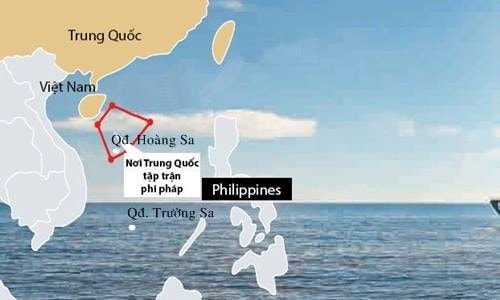 |
| Area where China conducts illegal military exercises. Graphic: Takungpao |
It is possible that, if the outcome is positive, the PCA will rule that the "nine-dash line" claims have no basis in international law. It is also possible that the PCA will affirm that China's reclamation activities on submerged reefs in the Spratly Islands violate the Law on Marine Ecological Protection. We also cannot rule out the scenario where the PCA might not address these issues but only address general matters, without favoring either side. One possibility to consider is that the PCA will rule that out of over 100 features in the Spratly Islands, only Ba Bình is an island, while all other features are rocks or semi-submerged. If so, Ba Bình Island would have the right to establish a 200-nautical-mile exclusive economic zone, thus overlapping with all other rocky areas belonging to Vietnam, the Philippines, Malaysia, and Brunei.
Accordingly, even though Ba Bình Island is occupied by Taiwan, China still has the ability to驱赶 (drive away) Vietnamese and Philippine fishing vessels operating in the area. Overall, international opinion predicts that the PCA ruling on July 12th will likely favor the Philippines and disadvantage China, both legally and politically.
PV:According to the Major General, how will China react?
Major General Le Van Cuong:If the PCA rules against China, in my opinion, China will continue to militarize the South China Sea, be prepared to reclaim Scarborough Shoal – a disputed area between China and the Philippines in the South China Sea – and potentially declare an air defense identification zone (ADIZ) in the South China Sea. In addition, China may continue to encircle Second Thomas Shoal, increase its coast guard vessels to驱赶 foreign fishing boats operating within the "nine-dash line." Of these actions, establishing an ADIZ in the South China Sea would be the most dangerous because it would infringe upon the significant interests of the international community. If China proceeds with this in the Spratly Islands, it would overlap with the entire airspace of 10 major cities in Vietnam, Singapore, the Philippines, and Malaysia.
PV:World opinion suggests that the new Philippine President Duterte has made significant changes to foreign policy towards the US and China. According to the Major General, will these adjustments affect the ruling in this case?
Major General Le Van Cuong:Throughout his election campaign, in his foreign policy platform, President Duterte clearly stated that he would hold dialogue with China. And immediately after taking office, he adjusted his foreign policy. His stance was to continue cooperating with the US on military and security matters, but not to rely entirely on the US, while Manila opened the door to dialogue with Beijing. China clearly saw that the Philippines needed significant capital to invest in infrastructure such as railways and highways.
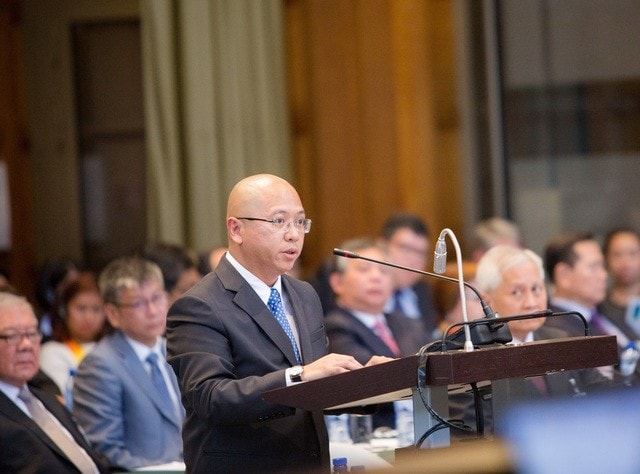 |
| Attorney Florin Hilbay, head of the Philippine legal team, participated in the proceedings. China rejected the jurisdiction of the Arbitration Tribunal and refused to attend. |
And China has stated its readiness to support the Philippines in building infrastructure, restoring the economy, and even helping the Philippines develop new rice varieties so that the country can achieve food self-sufficiency in the shortest possible time. Thus, it seems that from June 30th onwards, relations between the Philippines and China are evolving in a different direction. And this directly impacts the disputes and lawsuits in the South China Sea.
But I think President Duterte is only adjusting relations within a certain range because he cannot abandon his commitment to the US in the military and security fields; he is following in the footsteps of Arroyo before him. Whether we like it or not, the Philippines' own South China Sea dispute and the cohesion within ASEAN countries in resolving these disputes will be affected.
An Nhan
(Perform)
| RELATED NEWS |
|---|


