
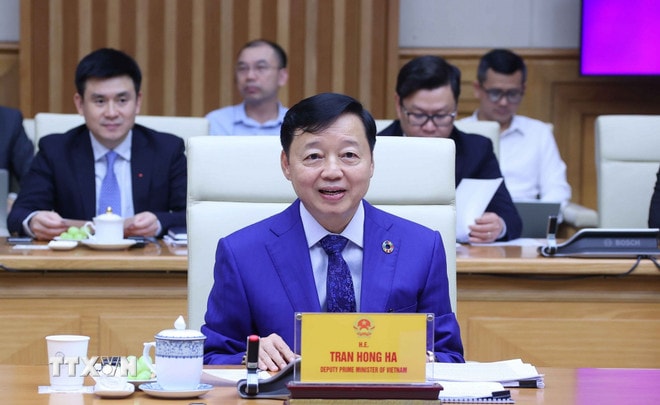
Deputy Prime Minister Tran Hong Ha works with the EC's IUU inspection team.
The Deputy Prime Minister affirmed that Vietnam does not consider the implementation of IUU prevention and control recommendations solely as a goal to lift the "yellow card," but rather views it as a matter of sustainable development and protection of aquatic resources.
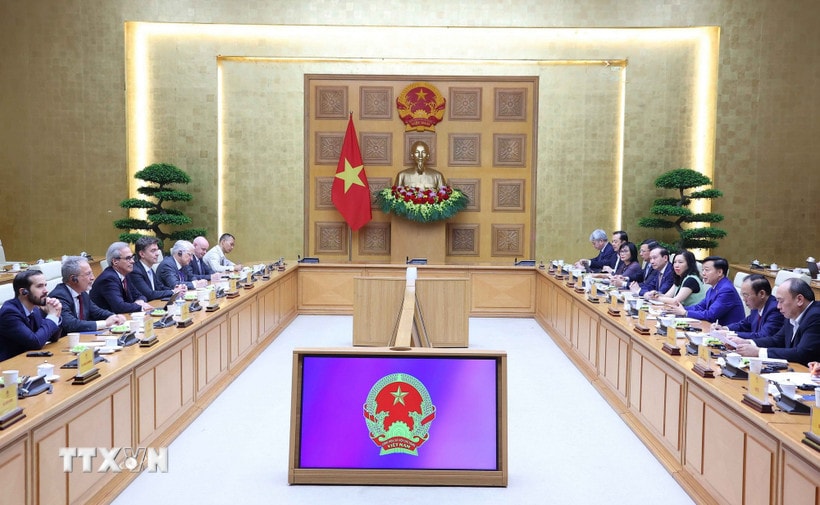
On the afternoon of March 19, at the Government Headquarters, Deputy Prime Minister Tran Hong Ha held a working session with the European Commission (EC) inspection team assessing and reviewing the implementation of measures to combat illegal, unreported, and unregulated (IUU) fishing in Vietnam.
Speaking at the meeting, Deputy Prime Minister Tran Hong Ha emphasized that the period from 2017 (when the EU and Vietnam identified existing issues related to IUU fishing) to the present has been a remarkable milestone. The recommendations and activities of the IUU inspection team during these meetings have had a significant impact, contributing to Vietnam's efforts to improve policies and enhance management capacity, develop sustainable fisheries, protect the environment and aquatic resources, and address strategic issues related to the sea and oceans.
Vietnam has gradually integrated, ratified, and implemented international treaties, built a sustainable marine economic development strategy, and simultaneously perfected its legal system, including the Fisheries Law and related decrees, circulars, and regulations.
In particular, the Deputy Prime Minister affirmed that Vietnam does not consider the implementation of IUU prevention and control recommendations solely as a goal to lift the "yellow card," but rather views it as a matter of sustainable development, protecting aquatic resources and long-term livelihoods for the people, and as a responsibility of Vietnam towards regional and global issues.
Emphasizing the cooperative relationship between Vietnam and the European Union (EU), the Deputy Prime Minister stated that the two sides have experienced 35 years of sustainable development, with high trade volumes, stable growth, and the active participation of the European business community in Vietnam. The EU continues to be an important partner of Vietnam in the political, economic, and diplomatic fields, especially since the two sides have upgraded their relationship to a Comprehensive Strategic Partnership.
The Deputy Prime Minister expressed his desire to continue listening to frank, in-depth, and constructive opinions from the IUU inspection team, thereby helping Vietnam improve policies, enhance the effectiveness of fisheries management, sustainably utilize marine resources, and fulfill its national responsibilities regarding ocean issues.
During the meeting, Mr. Fernando Andresen Guimaraes, Director of the Department of International Ocean Governance and Sustainable Fisheries, Directorate General for Maritime Affairs and Fisheries (DG MARE), and Head of the IUU Inspection Team, stated that Vietnam has made outstanding efforts and achieved significant progress in eliminating IUU for the national interest, for the goal of sustainable development and a green economy.
For example, the construction and operation of the National Fisheries Database (VNFishbase), the electronic traceability system (eCDT), and the installation rate of vessel monitoring systems (VMS) have reached nearly 100%..., especially the comprehensive approach and close guidance of the Government, the Prime Minister, and the regular meetings of the National Steering Committee on IUU.
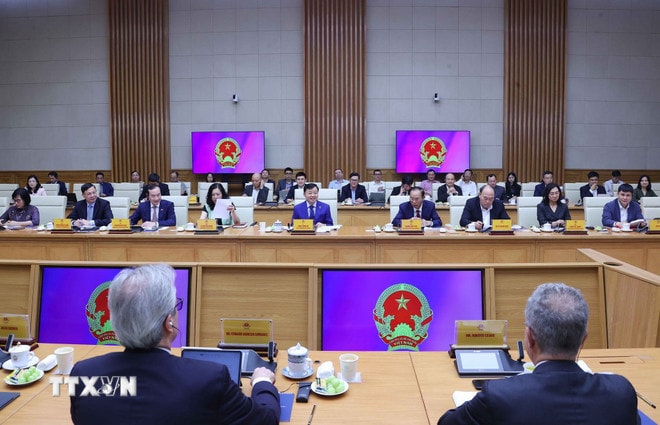
In addition, the EC inspection team also raised several issues that Vietnamese ministries, departments, and localities need to focus on clarifying and addressing, such as the transparency of seafood raw materials used in export processing plants; and stricter handling of fishing vessels that lose VMS connectivity or intentionally transfer equipment to other vessels to avoid detection.
In addition to criminal penalties, the IUU inspection team also recommended measures to enhance deterrence, such as high administrative fines, along with supplementary measures like license suspension or vessel confiscation for fishing vessels violating foreign waters.
“Vietnam’s efforts over the past eight years have been extraordinary. Completing the remaining work now rests in your hands. This is an opportunity for Vietnam to build a sustainable fisheries management system that will bring long-term benefits to fishermen and coastal communities. We are always ready to support Vietnam in bringing this process to a close and having the yellow card lifted,” said Fernando Andresen Guimaraes.
In further discussions with the IUU inspection team, Deputy Prime Minister Tran Hong Ha stated that Vietnam is at a crucial juncture, entering a new phase of development with higher goals, aiming for standards achieved by Europe, especially in economic growth, digital transformation, green transformation, and marine economic development. Vietnam's development process is closely linked to global and regional responsibilities, particularly in issues of climate change, oceans, plastic waste, biodiversity, and fisheries resources.
Vietnam has cooperated closely with the EU and participated in many international commitments such as agreements on biodiversity, climate change, as well as initiatives on the Joint Fair Energy Transition Partnership (JETP), and emission reduction in agriculture and forestry. Vietnam has been both a partner, a learner, and an active participant with the EU.
Regarding the prevention and control of IUU (Illegal, Unreported, and Unregulated) fishing, the Deputy Prime Minister emphasized that Vietnam has drawn on many experiences from the EU in improving its institutions, especially innovations in laws related to the sea, oceans, and fisheries management.
Vietnam has drastically reformed its laws while emphasizing a strong political commitment to combating IUU (Illegal, Unreported, and Unregulated) fishing, considering it a crucial and vital task. Based on an assessment of fishery resources, Vietnam has determined the need for strict management to prevent exceeding natural fishing quotas.
Regarding existing issues related to law, technology, and organizational capacity for implementation, the Deputy Prime Minister requested the EC to continue providing specific feedback on solutions, including both policy and enforcement, especially in addressing the relationship between administrative and criminal sanctions to ensure deterrence and effectiveness in preventing and combating IUU (Illegal, Unreported, and Unregulated) fishing.
The Deputy Prime Minister added that the administrative penalties for fishing vessels violating IUU regulations in Vietnam have now been raised to a high level, and additional measures such as confiscation of vessels for non-compliance are being applied. New violations such as fraudulent traceability, false declarations, or disruption of monitoring equipment will continue to be reviewed and regulations for handling them will be supplemented.
In terms of technology, Vietnam has deployed a VMS system and related databases, while also adding technical solutions to ensure continuous monitoring of fishing vessel movements, even in the event of satellite signal loss. Vietnam's current management system allows for the control of almost all eligible fishing vessels; those that do not meet the requirements are not permitted to operate.
In its enforcement efforts, Vietnam mobilizes all maritime forces, combining technological surveillance with raising awareness and improving the actions of fishermen. Cases with a risk of violating foreign waters are promptly warned and prevented.
Furthermore, Vietnam is reforming its governance and management model for the fisheries and seafood processing industry, moving towards strong decentralization to local authorities, especially at the grassroots level, based on interconnected digital data. The central government plays a role in policy development and data systems, while local authorities directly manage and implement policies.
For the electronic seafood traceability system, Vietnam has identified the requirement that data must be "accurate, complete, clean, and live," regularly updated, and interconnected with VMS and VNFishbase databases; while also expanding access for management agencies, businesses, and stakeholders, aiming for comprehensive control.
Regarding the management of imported seafood raw materials, the Deputy Prime Minister stated that the responsibilities of businesses and parties in the international supply chain need to be clarified, especially in cases where product information is inaccurate. This is a point on which Vietnam hopes to continue receiving feedback from the EC.
The Deputy Prime Minister emphasized that the current shortcomings are mainly loopholes that are being discovered and will be addressed in two ways: determining responsibility if legal violations occur, and simultaneously improving policy mechanisms if inadequacies exist.
"Vietnam is committed to reviewing and amending relevant regulations in a short period of time, possibly applying a mechanism of amending multiple regulations with a single document to promptly address shortcomings. At the same time, we will strictly handle violations and publicly disclose the results," the Deputy Prime Minister said.
Besides the work of preventing and combating IUU (Illegal, Unreported, and Unregulated) fishing, the Deputy Prime Minister also informed the IUU inspection team about the amendment of laws related to the sea and fisheries towards sustainable development, linked to environmental protection, biodiversity, and reduction of ocean pollution. Vietnam aims to increase the proportion of marine protected areas to 6% of the natural sea area by 2030, while promoting the transformation of fishing towards high-tech aquaculture and other livelihood sectors.
The Deputy Prime Minister also proposed that Vietnam and the EU strengthen cooperation and regular exchanges in agriculture, forestry, and other sectors... to support each other in harmonizing high-level technical standards and regulations on environmental protection and climate change; promote technical cooperation, especially in digital transformation, data management, and sustainable marine economic development; and expand cooperation in the field of energy transition, especially the development of renewable energy such as offshore wind power, within the framework of JETP, in order to improve mechanisms to attract international investment and resources.
The Deputy Prime Minister stated that establishing a mechanism for regular exchanges would contribute to improving the effectiveness of cooperation and strengthening coordination between the two sides in the future.


