
2024 Porsche Panamera 2.9T: Price drops amid domestic competition.
Demand for imported luxury cars in China is weakening as buyers shift to domestically produced vehicles that are more affordable, offer more incentives, and boast advanced technology. A 2024 Porsche Panamera 2.9T with approximately 20,000 km on the odometer is being offered for 950,000 yuan, significantly lower than its original purchase price of 1,400,000 yuan.
Demand for luxury cars from overseas in China is declining significantly, as consumers prioritize more accessible domestic models, often with substantial discounts and a focus on electric and hybrid technology. This development not only impacts sales for international automakers but also reflects a shift in consumer preferences and macroeconomic pressures, according to an AP report.
An example recorded at a retail system: a salesperson at a Porsche center in Beijing said a 2024 Porsche Panamera 2.9T with approximately 20,000 km on the odometer was being offered for 950,000 yuan (approximately $133,000 USD or 3.1 billion VND), while the original purchase price from the previous owner was around 1,400,000 yuan (approximately $196,000 USD or 4.5 billion VND). According to this salesperson, a similar situation is also occurring with Mercedes, BMW, Bentley, and Rolls-Royce.
Why are luxury cars losing ground? High prices, cautious consumer attitudes, and incentives skewed towards lower-priced vehicles.
Paul Gong, head of automotive research at UBS, noted that the downturn in the real estate market has made consumers more cautious about large expenditures. He also suggested that the wealthy are increasingly less inclined to flaunt their wealth.
At the same time, the 20,000 yuan (approximately $2,800 or VND 65 million) subsidy for electric and hybrid vehicles significantly impacted purchasing decisions. Gong emphasized that buyers tended to choose cheaper vehicles because the subsidy rate for this group was higher and largely came from domestic brands.
Domestic car manufacturers are accelerating: technology, frequent launches, and competitive pricing.
Claire Yuan, director of automotive industry assessments at S&P Global Ratings, said slowing economic growth is a major factor driving weaker demand for luxury cars. Meanwhile, Chinese automakers like BYD are described as aggressively innovating technologically, consistently launching new electric and hybrid vehicles at competitive prices, even in the premium segment.
According to Yuan, even in the high-end segment, Chinese brands' products are becoming increasingly competitive and "more reasonably priced," which explains why foreign brands are gradually losing their appeal in the market.
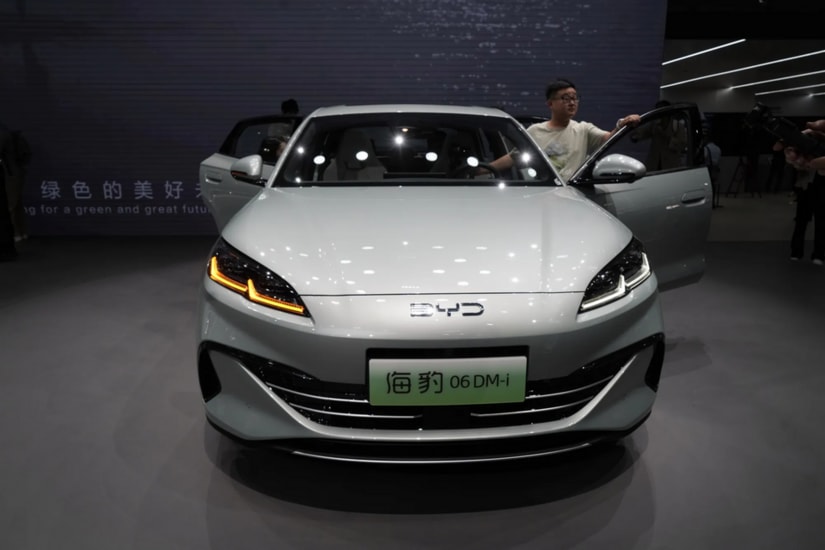
Market share shifts: Chinese brands dominate, BYD surpasses Volkswagen.
Data from the China Association of Automobile Manufacturers shows that in the first 11 months of this year, the market share of Chinese-branded passenger cars increased to nearly 70%. Meanwhile, the market share of German brands was 12%, Japanese brands around 10%, and American brands nearly 6%.
According to the report, BYD has surpassed Volkswagen to become the best-selling car brand in China. Data from the China Association of Automotive Market Information shows that BYD continues to be the top-selling brand in the "electric vehicle" segment (including pure electric and hybrid vehicles) this year.
The level of competition is evident in pricing strategies: BYD has reportedly offered discounts of up to 34% on its electric and hybrid models, putting pressure on rivals like Geely and Leap Motor.
Luxury cars priced over 300,000 yuan: from strong growth to a correction phase.
According to S&P data, the market share of luxury car models priced above 300,000 yuan (approximately $42,000 or VND 980 million) doubled from 2017 to 2023, reaching about 15% of total sales. However, this trend is projected to reverse: market share is expected to fall to 14% in 2024 and further decline to 13% in the first nine months of 2025.
Placed in the broader context, this signals that the market is becoming more sensitive to pricing and incentives, while the "brand icon" advantage of imported luxury cars is no longer as absolute as it was in the past.
International airline sales figures: numbers reflecting the pressure.
According to the latest financial reports cited, Mercedes-Benz's sales in China in the third quarter of 2025 (July to September) decreased by 27% compared to the same period last year. BMW and its subsidiary MINI also recorded a decrease of 11.2% in the first nine months of 2025.
Porsche and Aston Martin have indicated that demand in China is struggling. Ferrari is no exception, with deliveries in China in the first three quarters of 2025 down 13%, making it the only region globally to record a sales decline.
Mercedes-Benz CEO Ola Källenius told investors that the “fierce competition” in the Chinese market will not end anytime soon, while emphasizing that the luxury car segment still faces many challenges.
Key data points: subsidies, market share, discounts, and sales.
| Category | Data | Note |
|---|---|---|
| Subsidies for electric and hybrid vehicles. | 20,000 yuan | This is equivalent to approximately $2,800 USD or 65 million VND. |
| Market share of Chinese-branded passenger cars. | Nearly 70% | In the first 11 months of this year |
| German brand market share | 12% | In the first 11 months of this year |
| Japanese brand market share | Approximately 10% | In the first 11 months of this year |
| US brand market share | Nearly 6% | In the first 11 months of this year |
| BYD's price reductions (electric and hybrid vehicles) | Up to 34% | According to the China Association of Automotive Market Information |
| Mercedes-Benz in China | 27% off | Third quarter of 2025 compared to the same period |
| BMW and MINI in China | A decrease of 11.2% | The first nine months of 2025 |
| Ferrari in China | 13% off | First three quarters of 2025 |
| Porsche Panamera 2.9T 2024 (used car) | 950,000 yuan | Approximately 20,000 km; original purchase price around 1,400,000 yuan. |
| November car production | Sales exceeded 3.5 million units in a single month for the first time. | According to the China Association of Automobile Manufacturers |
| Domestic car sales | 4% discount | Compared to the same period last year, due to the suspension of subsidies in some areas. |
Looking at the Panamera: brand value remains strong, but the margin of safety is shrinking.
The case of the 2024 Porsche Panamera 2.9T being offered for sale at significantly lower than its original purchase price illustrates the pricing risks during a period of market pressure. As domestic brands accelerate their electric and hybrid vehicle product cycles and use deep discounts as a competitive tool, imported luxury cars may face two challenges simultaneously: weakening demand and a downward pressure on expected price levels.
Conversely, buyers interested in used luxury cars may see opportunities to access high-end models at more affordable prices than before. However, the report also reveals a mixed picture: overall market output continues to increase, but sales may decline as incentives vary by region.
Conclude
The market share and sales data presented in the report show that the balance in China is rapidly shifting towards domestic brands, especially in the electric and hybrid vehicle segments. For imported luxury cars, pressure comes not only from macroeconomic factors and consumer sentiment, but also from the product competitiveness and pricing strategies of domestic rivals. In this context, a 2024 Porsche Panamera 2.9T experiencing price depreciation at a dealership becomes a typical example of this market adjustment phase.


