
The US military has begun joint exercises near Russian territory.
On May 4th, US military forces in Europe began joint exercises with 28,000 troops from 26 countries near Russian territory for more than six weeks, with a focus on the Balkan and Black Sea regions.
According to the Washington Examminer, this is the largest multinational exercise ever organized by the U.S. European Command (EUCOM). This move comes shortly after an exercise reportedly involving around 100,000 Russian troops on the eastern border of Ukraine and Crimea.
Themilitary exercisesThe long-planned exercise aims to test the military infrastructure and response capabilities of the country.NATOIn Southeast Europe, General Tod Wolters, commander of EUCOM, stated that the exercise also aimed to improve logistics.
"What we're trying to do is improve our transparency and strategic alignment, something that hasn't been done on this scale and scope since the 1940s," Wolters said.
|
| A contingent of US military equipment landed at Durres Port, Albania on May 1st. Photo: AP |
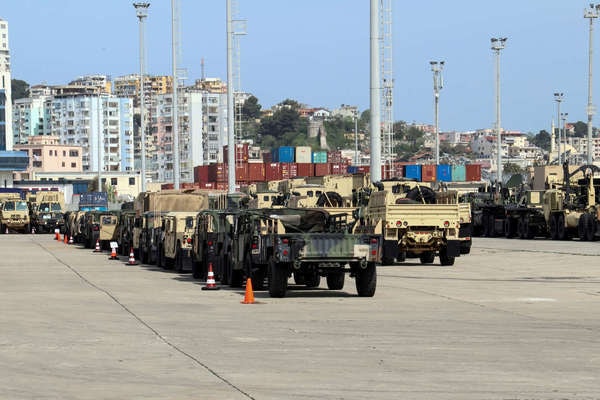
The exercises included armed incursions, air and missile defense, live firing, and a command-line drill. All were aimed at improving the readiness of U.S. troops to easily integrate with NATO partners in the event of a regional crisis.
“We are trying to follow the direction of the EUCOM commander and the U.S. Department of Defense in immediately shifting our focus to the Balkans and the Black Sea. This is a strategically important region where we have always had a presence, but we still want to increase our presence,” an EUCOM official told the Washington Examiner in March.
Following tensions in Russia-Ukraine relations in 2014, the US began a rotational military presence across NATO's sphere of influence in Eastern Europe. NATO partner countries in the Black Sea region, such as Romania and Bulgaria, are also among the US's largest military partners.
According to Washington Examinter, activities within the framework of next week's exercise will also include inspections of roads, ports, and military infrastructure. Some of these items have benefited from the $20 billion funding package for the U.S. European Deterrence Initiative (EDI) over six years.


