
Vietnam-US relations under President Trump: Challenges and opportunities
According to Ambassador Pham Quang Vinh, Vietnam-US relations under President Donald Trump face many challenges but also present numerous opportunities.
In January 2017, the United States entered a new chapter in its history when billionaire Donald Trump officially took office as the 45th President. With the new administration of a Republican president, the US was predicted to see many changes in its foreign policy, especially towards the Asia-Pacific region.
Vietnamese Ambassador to the US Pham Quang Vinh spoke with a VOV reporter about policy changes in general, and policies towards the region and Vietnam in particular, as well as his feelings during the US transition of power.
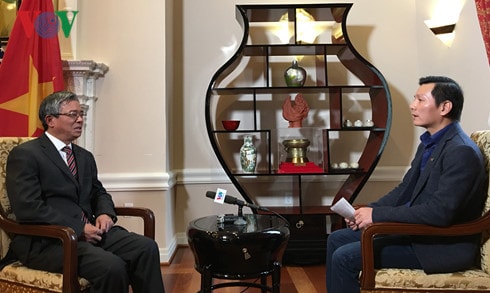 |
| Vietnamese Ambassador to the US Pham Quang Vinh answers questions from VOV reporters. |
PV:On January 20th, the Ambassador personally attended the inauguration ceremony of President Donald Trump. Could the Ambassador share his feelings about witnessing this moment of power transition?
Ambassador Pham Quang Vinh:The ceremony is a major event that happens every four years. Personally, this was my first time attending a handover ceremony between two US administrations. Anyone who attended or followed the ceremony would have noticed how well-organized, meticulous, and solemn it was.
The past two years working with the Obama administration have seen many activities promoting relations between the two countries. Looking ahead to working with the new administration, we are all very much looking forward to and closely monitoring how we can build a relationship and promote our policies in a way that aligns with your interests and priorities, thereby advancing those priorities with the new administration.
But there are also feelings of nostalgia. I have friends who worked during the Obama administration and are now out of office. Perhaps those who served as representatives in America have different feelings than those observing from a television perspective or from a different location.
PV:In his inaugural address and subsequent statements, the new US President indicated that the country would review many policies, including its Asia-Pacific policy. Ambassador, how might this impact Vietnam-US relations in the coming period?
Ambassador Pham Quang Vinh:Before discussing the new administration's policies toward the region in general, looking at Vietnam-US relations over the past 20 years, we can see that diplomatic relations have developed significantly, becoming a comprehensive partnership in all aspects.
Over the past 20 years, there have been several changes in US administrations under various presidents. We are confident that this comprehensive partnership, in the best interests of both countries, will continue to grow.
We can see that economic and trade relations have served the interests of both Vietnam and the United States, as well as creating momentum for development in the region. The increase in trade turnover from $0.5 billion to $50 billion demonstrates the depth of Vietnam-US trade relations.
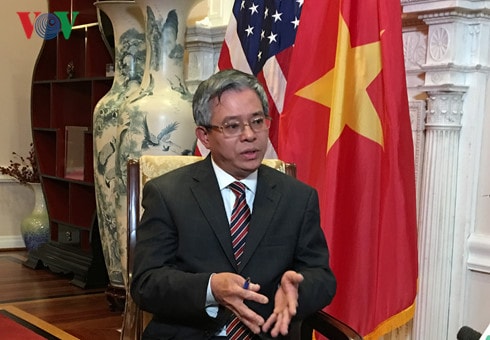 |
| Ambassador Pham Quang Vinh shared interesting insights about President Trump's policy changes towards the world, the region, and Vietnam. |
Secondly, bilateral relations have expanded across all areas as outlined in the comprehensive partnership. This includes science and technology, investment, education, and defense and security. Most importantly, both sides benefit and inherit advantages from this relationship. The US needs to develop relations with Vietnam, and Vietnam also needs to develop relations with the US for the benefit of each country and for the benefit of the region, for peace and stability.
Here we want to emphasize that, across different presidential administrations, and across both Republican and Democratic parties, the shared interests of the two countries have formed the foundation for the bilateral relationship. And in particular, many frameworks for cooperation, such as the Comprehensive Partnership framework and dialogue frameworks, have been maintained.
Looking back, we can see that all three previous presidents, from President Clinton, President Bush, and President Obama, have visited Vietnam. We hope that with these shared interests and a mutually beneficial relationship, the relationship will continue to develop.
Furthermore, in addition to bilateral cooperation, the two countries have many cooperation frameworks serving their own interests and the interests of the region in other bilateral and multilateral forums. Recently, we have coordinated in ensuring peace and development in the Asia-Pacific region, such as within the framework of ASEAN.
National interests are long-term, but at different times and under different administrations—not just the US—countries will be defined differently, and different approaches will be taken.
This is precisely what we will continue to discuss and share with the new administration, so that the mutually beneficial aspects between our two countries can be further promoted. We must identify new opportunities for development. I believe that similarities will outweigh differences. New areas will require better forms of cooperation.
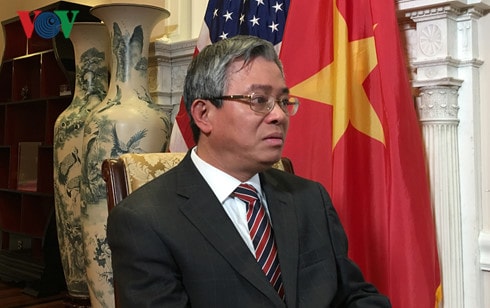 |
| According to Ambassador Pham Quang Vinh, Vietnam-US relations under President Trump face many challenges but also present numerous opportunities. |
We cannot yet clearly define the overall US policy toward Vietnam or toward the region, not only the Asia-Pacific but also other regions. However, there is a very clear message in President Trump's inaugural address: he will view America's interests in a more practical and concrete way.
In this relationship, neither the US nor Vietnam prioritizes national interests. However, national interests here don't necessarily mean conflict; the most important thing is that there are many points of convergence.
In terms of trade, the US wants to gain trade benefits in its relations with other countries. We also want to gain trade benefits from other countries. Both sides support each other, and this is a point we should pay more attention to. Besides our own interests, we can also promote and bring benefits to our partners, and vice versa.
If we talk about last year's contract to buy 100 Boeing aircraft from the US, that's definitely beneficial for the US. In terms of science and technology, the US can transfer a lot to Vietnam. Competitively priced Vietnamese products will give American consumers access to cheaper goods. Meanwhile, the US can invest in areas where it has an advantage in Vietnam. That's a mutually beneficial arrangement.
The US cannot be without interests in the South China Sea.
PV:In general, President-elect Donald Trump has declared that he puts America's interests first. Regarding the South China Sea issue, both the new President and the US Secretary of State nominee have shown a tough stance. Could the Ambassador elaborate on this issue?
Ambassador Pham Quang Vinh:The United States cannot leave the Asia-Pacific region; it cannot be without interests in the South China Sea, a South China Sea that is peaceful, stable, and free.
The US will win over other countries, other major powers will also win over others, and the countries in the region will also win over each other. That's about cooperating with each other.
There is already an existing and effective cooperation framework in the region, namely the ASEAN framework and the expanded ASEAN forums. This is something I believe countries will be interested in, including the new US administration.
We believe that regardless of the statements, the consistent policy not only of the US but also of the countries in the region has several key points: Firstly, peace, stability, security, safety, and especially freedom of navigation are in the interest of all countries. The South China Sea is a geostrategic area with enormous maritime trade and commerce, so maritime security and freedom of navigation are in the interest of all countries, and all countries must work together to preserve them.
Secondly, to ensure that, all countries must prioritize maritime law and conventions. I firmly believe that everyone must rely on that framework.
Third, to create a joint effort to achieve this goal, it is necessary to promote enhanced cooperation and coordination among countries in the region.
We will wait a little longer. But the three key points remain: peace and stability, maritime security and safety, international law and the Convention on the Law of the Sea, and finally, working together to contribute to building it. I believe that is a policy adjustment for any country.
PV:During the recent APEC Vietnam 2017 promotional event in the US, American businesses showed great interest. However, the new US President has repeatedly stated that he will reconsider the multilateral forums that the US participates in, including APEC. Ambassador, will this stance have any impact on APEC Vietnam?
Ambassador Pham Quang Vinh:First, the APEC forum represents the Asia-Pacific region. Second, it is the only forum for economic coordination and cooperation in the leading and most dynamic region of the world economy.
America's interests lie here, and successive US presidents have attended APEC. The American businesses I've spoken with over the years have all shown great interest in APEC.
Thirdly, through APEC, it is possible to shape regional priorities that benefit member economies. This forum can create regulations and standards on trade to best support the economy of each member country within the APEC framework.
We believe that while the new administration hasn't said much about multilateral forums, our assessment is that, given the economic and trade interests, the American business community is very much looking forward to US participation to make this region more dynamic and to establish standards that are acceptable to both the US and other countries.
We have worked with the US administration recently, and in the congratulatory letter from our senior leaders and the telephone conversation between our Prime Minister and the then-President-elect, we have all highlighted the position of the Asia-Pacific region and the importance of APEC in this region for each member partner. Our leaders have extended an official invitation to the then-President-elect, Donald Trump, to attend APEC in Vietnam.
We will continue our discussions with the US side. We firmly believe that, at this stage when the global economy and trade are recovering, while also facing many challenges and obstacles, countries need to sit down together, consider their own interests, and participate more actively.
PV:President Donald Trump has announced his withdrawal from the Trans-Pacific Partnership (TPP). In this agreement, the US was considered the leading force, so how will this impact the region, and how should Vietnam handle the situation?
Ambassador Pham Quang Vinh:First of all, countries have the right to choose which agreement to join. We will continue to monitor how the new administration handles the TPP, but there are two main points to consider here.
First, the Asia-Pacific region is a dynamic economic area, accounting for half of the world's trade, economic benefits, and growth. I believe that the United States, in one form or another, will have to engage with this region for the sake of American development and for American interests. This will have to be considered by the new administration.
Secondly, if the approach to the TPP is adjusted or changed, sooner or later the United States will still have to send a message about economic and trade integration with the region. That is in the interest of the United States and it is also what the region expects.
Thirdly, for Vietnam, we have actively participated in the TPP negotiations and made many efforts to finalize this agreement. We, along with the other 11 countries, hoped that if the TPP were ratified by all countries, it would create a significant impetus for economic development. But even if it is not, the region is still undergoing many changes to further promote integration, cohesion, and strengthen trade within the region itself.
For Vietnam, in addition to the TPP, we have recently promoted negotiations and signed many trade agreements, including new-generation trade agreements such as those with the EU and South Korea. As a result, our trade space continues to expand.
Without the TPP and the US market, we have to figure out how to continue our larger economic and trade relationship.
Internally, our major policies on economic reform and promoting the investment environment in Vietnam will certainly continue. This is an inherent requirement for our national development, and also a requirement stemming from the FTA agreements we have joined.
PV:Thank you, Ambassador.
According to VOV


