
PhantomStrike radar enhances the capabilities of the X-62A fighter jet.
The lightweight, air-cooled, and low-cost PhantomStrike radar has been integrated into the X-62A VISTA autonomous fighter jet, expanding the capabilities for AI-controlled air combat testing.
A company in Massachusetts, USA, has just been awarded a contract to supply PhantomStrike radar for the US Air Force's X-62A VISTA autonomous fighter jet. This is a new generation fire control radar, introduced by Raytheon, boasting advantages such as compactness, lightness, and energy efficiency while maintaining high performance, targeting autonomous and unmanned combat platforms.
Overview of PhantomStrike and X-62A VISTA
According to Raytheon, PhantomStrike is designed to be integrated onto a wide variety of platforms, from light attack aircraft, helicopters, and unmanned aerial vehicles (UAVs) to fixed stations. The selection of a test platform like the X-62A VISTA to equip PhantomStrike demonstrates the role of this radar in the development of automated air combat programs.
The X-62A VISTA is a variant of the F-16D Block 30, upgraded with Block 40 electronics and integrated with specialized software packages. This aircraft serves as a test platform for AI algorithms and autonomous flight modes, allowing the U.S. Air Force to evaluate how autonomous aircraft make decisions in complex combat environments.
The compact, energy-efficient PhantomStrike radar will be equipped on the X-62A VISTA autonomous fighter jet to enhance situational awareness and combat capabilities in AI-controlled flight scenarios.
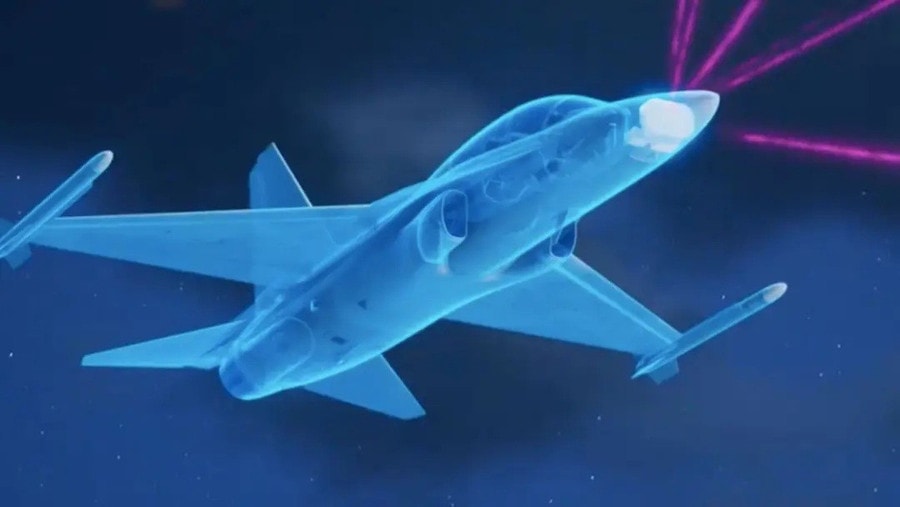
Key technical specifications of the PhantomStrike radar
Information released by Raytheon indicates that the PhantomStrike focuses on balancing size, performance, and operating costs, with several notable features:
- Weight under 68 kg, which is only about half the capability of modern active electronically scanned array (AESA) radars.
- Low energy consumptionThis is superior to conventional AESA radar systems, resulting in reduced power requirements on the carrier platform.
- Uses fully air-cooled technology., no complex liquid cooling system is needed.
- Integration of GaN (Gallium Nitride) materialsalong with advanced packaging design in radar architecture.
- Open architectureThis allows for flexible software and hardware upgrades without complex maintenance procedures.
- The ability to generate digital beamforms and control beamforms flexibly.It operates in multiple modes.
- It is possible to track both airborne and ground targets simultaneously., supporting enhanced situational awareness for the carrier group.
Raytheon claims that PhantomStrike delivers superior combat effectiveness at approximately half the cost of conventional fire control radars. This places the radar in a suitable segment for combat platforms requiring good performance but with budget or payload constraints.
Compact and energy-efficient design
Weighing under 68 kg, the PhantomStrike significantly reduces the payload weight mounted on the nose or pylons of light attack aircraft, helicopters, and UAVs. For small platforms, every kilogram of payload directly impacts range, weapon load, and operational time, so reducing radar weight is a crucial factor.
Low energy consumption and a fully air-cooled system also simplify the aircraft's electrical and electronic system architecture. Instead of having to reserve large amounts of power for radar and maintain pipes, pumps, and coolant, the platform only needs to ensure adequate airflow. This approach aligns with the trend towards lightweight design in autonomous fighter aircraft and UAVs.
Open architecture and upgradeability
PhantomStrike is built on an open architecture, allowing for software updates, the addition of new operating modes, or integration with other avionics systems without requiring deep, complex hardware modifications. In a rapidly changing battlefield environment, such upgrade capabilities help the radar maintain its relevance for many years without needing a complete system replacement.
For a test platform like the X-62A VISTA, an open architecture is particularly important. It allows development teams to easily test new signal processing algorithms, radar usage tactics, and how AI prioritizes and exploits sensor information in simulated combat scenarios.
Role in automated warfare and UAVs
Raytheon stated that PhantomStrike can be installed on a variety of light attack aircraft, helicopters, UAVs, and even fixed stations. When combined with automated flight control systems and AI, this radar becomes a key sensor that helps autonomous combat platforms build a picture of the air and ground combat situation.
On the X-62A VISTA, PhantomStrike supports the following tests:
- How AI algorithms prioritize, classify, and track different targets.
- The system automatically coordinates radar with other sensors to make decisions about flight control and weapon deployment.
- The ability to maintain situational awareness in complex environments, with multiple targets both in the air and on the ground.
By using a multi-mode fire control radar like the PhantomStrike on the test aircraft, the U.S. Air Force has an additional tool to assess the potential of future integrated combat concepts involving pilots, autonomous aircraft, and UAVs.
Export potential and market impact
PhantomStrike has been approved by the US government for direct commercial sale, opening up export possibilities to many countries. Its compact design, Raytheon's claim that its cost is only about half that of conventional fire control radars, and its ability to integrate across multiple platforms, make this system a popular choice in autonomous and unmanned combat aircraft programs.
Dan Theisen, President of Raytheon's Advanced Products and Solutions division, emphasized that autonomous aircraft will play a crucial role in helping the U.S. maintain air superiority, and the PhantomStrike is specifically designed to serve this goal. Thus, radar is not just a new sensor product, but a piece of a broader strategy for autonomous warfare.
Overall assessment
The emergence of PhantomStrike represents a technological leap in the field of military radar, focusing on criteria such as compactness, energy efficiency, open architecture, and low operating costs. When integrated into the X-62A VISTA, this system helps shape how the US Air Force tests and develops future autonomous combat concepts.
According to IE, with the characteristics mentioned above, PhantomStrike is likely to continue appearing in autonomous fighter aircraft and UAV development programs of both the US and foreign customers, as the demand for intelligent, cost-effective combat platforms increases.


